

AMC 8/10/12Exam information
What it is, what's tested, and how it's scored.
AMC exam details
Achievable's AMC course is designed for students preparing for all levels of the American Mathematics Competition (AMC), an academic contest for middle and high schoolers. Each section of the course covers a different mathematical topic found on the AMC 8, 10, and/or 12. We've helpfully identified which chapters are best suited for each exam, allowing students to focus on preparing for a specific level or challenge themselves with more advanced content.
Through Achievable's course, students benefit from skill-building drills and expert testing advice, providing them with an accessible pathway to high-level mathematical proficiency. The best way to prepare for the AMC is to take numerous practice questions and develop your test-taking and time management strategies. Achievable offers numerous mock exercises and key tips and tricks to help you maximize your performance. Participation and high performance in the AMC can lead to qualifying for selective competitions and also enhance your academic profile when applying to elite high schools or colleges.
AMC 8
The AMC 8 is a multiple choice examination in middle school mathematics designed to promote the development of problem-solving skills.
The material covered on the AMC 8 includes topics from a typical middle school mathematics curriculum. Possible topics include but are not limited to: counting and probability, estimation, proportional reasoning, elementary geometry including the Pythagorean Theorem, spatial visualization, everyday applications, and reading and interpreting graphs and tables. In addition some of the later questions may involve linear or quadratic functions and equations, coordinate geometry, and other topics traditionally covered in a beginning algebra course.
AMC 10
The AMC 10 is open to students in grade 10 or below who are under 17.5 years of age on the day of the contest. The content covers elementary algebra, basic geometry, area and volume formulas, elementary number theory, and elementary probability. Unlike the AMC 12, advanced topics like trigonometry, advanced algebra, and advanced geometry are excluded. Generally, the material is aligned with the mathematical topics taught in middle school and early high school classes.
AMC 12
The AMC 12 covers the entire high school curriculum including trigonometry, advanced algebra, and advanced geometry, but excluding calculus. Students in grade 12 or below and under 19.5 years of age on the day of the contest can take the AMC 12.
The AMC 12 assumes knowledge of elementary algebra; basic geometry knowledge including the Pythagorean Theorem, area and volume formulas; elementary number theory; and elementary probability.
The AMC exam is hosted by MAA. Participants have 40 minutes (AMC 8) and 75 minutes (AMC 10/12) to answer 25 multiple-choice questions (AMC 8 and AMC 10/12).
Time
40 minutes (AMC 8)
75 minutes (AMC 10/12)
Format
25 questions (AMC 8)
25 questions (AMC 10/12)
Details
Students in the U.S. and Canada take the AMC through a school or other competition site registered with the MAA, including homeschools. Students elsewhere sit the same competitions through the MAA's AMC International program, so check whether your country participates.
An invitation to the American Invitational Mathematics Examination (AIME) goes to at least the top 2.5% of AMC 10 scorers and the top 5% of AMC 12 scorers. Achieving a high score in the AIME paves the way for a place in the U.S. Mathematical Olympiad and eventually the International competition. The MAA sets the qualifying cut-off scores after each competition, so they vary by year.
Achievable AMC content outline
1
Algebra
Covers foundational algebra topics, including linear equations and inequalities, quadratics, exponents and radicals, and functions. Builds the core skills for problem-solving and equation manipulation.
2
Geometry
Explores essential geometric concepts such as triangles, circles, lines and angles, quadrilaterals, and polygons, and coordinate geometry. Includes area, perimeter, volume, and surface area applications.
3
Number theory
Introduces fundamental number properties and relationships. Topics include factors and multiples, prime numbers, and modular arithmetic.
4
Counting and probability
Focuses on combinatorial reasoning and probability principles. Covers permutations and combinations, the stars and bars method, and the basics of calculating and interpreting probability.
5
Intermediate topics (AMC 10/12)
Steps up to the material that separates the AMC 10 and 12 from the AMC 8: sequences and series, polynomials, and geometric transformations and symmetry.
6
Advanced topics (AMC 12)
Examines the higher-level concepts tested on the AMC 12. Includes logarithmic and trigonometric functions, complex numbers, and combinatorial identities.
7
General approaches
Develops strategic thinking and problem-solving creativity. Emphasizes simplifying problems, finding direct solutions, and thinking flexibly in mathematical contexts.
8
Practical strategies
Provides effective test-taking and reasoning techniques. Focuses on backsolving, estimation, and elimination to improve accuracy and efficiency under timed conditions.
AMC 8/10/12 exam: quick answers
- What is on the AMC 8/10/12 exam?
- The AMC 8/10/12 exam has 25 multiple-choice questions (AMC 8 and AMC 10/12). The content outline on this page lists every tested topic with the number of questions and the percentage of the exam it accounts for.
- Who administers the AMC 8/10/12 exam?
- The AMC 8/10/12 exam is administered by MAA, which sets the official content outline and scoring.
More questions about the exam and how to prepare for it? AMC 8/10/12 FAQ
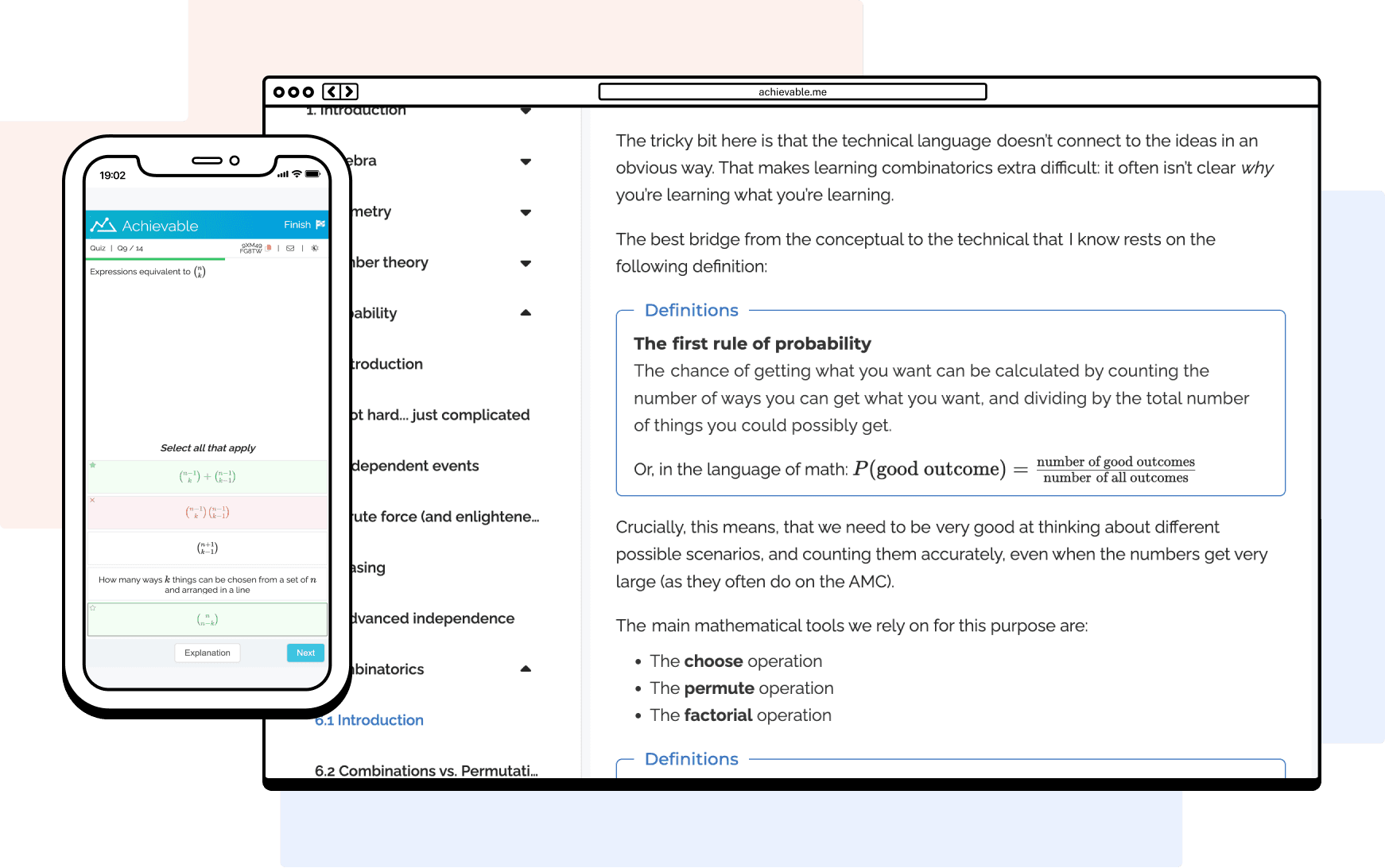
Reach your target score
Achievable is the best online AMC exam prep course: effective, personalized, and convenient. With Achievable, you'll spend less time studying and hit your target score with confidence.