

FE Civil
review & study guide
Every chapter of the course summarized, with each section linked to its lesson.
Pass the first time
Try Achievable FE Civil
No credit card required
This free FE Civil review summarizes all 17 chapters of Achievable's FE Civil course: what each covers, the points to remember, and its 32 sections in order. Read each chapter after you study it, or work through the whole guide before exam day.
Each section links to its full lesson in Achievable, with the review quizzes and full-length practice exams.
Chapter 1: Mathematics
5 sections
Free chapter
- Coordinate geometry: Straight line, circle, sphere, parabola, ellipse, hyperbola, and conic section equation all use standard forms and type depends on .
- Geometric formulas: Parabola, ellipse, circular segment, circular sector, sphere, parallelogram, regular polygon, prismoid, cone, cylinder, and paraboloid each have specific area, perimeter, or volume formulas.
- Algebra essentials: Quadratic equation roots, logarithms, complex numbers, and arithmetic and geometric progression formulas rely on discriminant, change-of-base, polar form, and convergence rules.
- Calculus and vectors: Derivatives, integrals, differential equations, transforms, matrices, vectors, gradient, divergence, curl, Newton's method, and numerical integration use the stated formulas and identities.
In this chapter
Start this chapter free
Chapter 2: Combinatorics, probability and statistics
2 sections
- Counting rules: Permutations are arrangements where order matters, combinations are selections where order does not matter, and each uses a different formula.
- Probability and distributions: Probability equals favorable outcomes / total outcomes, and PDF, CDF, binomial, normal, t-distribution, , and Gamma describe continuous or discrete behavior.
- Inference and fit: Hypothesis testing uses sample data to infer population parameters, and linear regression uses least squares; use FE Handbook for detailed tables and distribution functions.
In this chapter
Study this chapter in Achievable
Chapter 3: Ethics and professional practice
- Ethics authority: State board rules of professional conduct are legally binding and can revoke license, while society codes of ethics bind members but have no license power.
- Professional duties: NCEES, NSPE, and ASCE require public safety first, honesty, competence, confidentiality, and conflict disclosure, and ASCE ranks society above peers while not setting legal standard of care.
- Practice and contracts: Licensure is by jurisdiction, negligence needs duty, breach, causation, and damages, and contracts need offer, acceptance, consideration, competent parties, lawful purpose, and written change orders.
Study this chapter in Achievable
Chapter 4: Engineering economics
- Cash flow types: Present value, Future value, Annuity, and Gradient series each model a different cash flow pattern over time, with all cash flows assumed to occur at year-end.
- Money conversion formulas: Time value of money grows via compounding at rate ; single-payment, uniform series, gradient series, and nonannual compounding formulas convert between , , , and .
- Cost and tax analysis: Present worth discounts future cash flows, sinking funds accumulate future sums, and capitalized cost, EUAC, depreciation, taxes, bonds, break-even analysis, and B/C analysis apply these relationships.
Study this chapter in Achievable
Chapter 5: Statics
- Force and resultant: Force is a vector with magnitude and direction, and resolution uses , , while and for a resultant.
- Moments and equilibrium: Moment is , a couple has two equal, opposite forces with and no net force, and equilibrium requires , , .
- Centroids and trusses: Composite centroid is a weighted average of component locations, , , , and a statically determinate truss satisfies with plane truss joints or sections equations.
Study this chapter in Achievable
Chapter 6: Materials
2 sections
- Steel and concrete curves: Steel reinforcement passes elastic, yield plateau, strain hardening, and necking/rupture, while plain concrete rises nonlinearly to and then softens and crushes.
- Strength and mix rules: Concrete strength tests use 2 (6"x12") or 3 (4"x8") cylinders at 28 days, and mix design uses yield, absolute volume, and .
- Exposure categories: F0–F3, S0–S3, W0–W2, and C0–C2 classify freezing/thawing, sulfate, water contact, and corrosion exposure by increasing severity.
In this chapter
Study this chapter in Achievable
Chapter 7: Dynamics
- Particle motion: Particle kinematics describes motion without considering forces, and constant acceleration uses , , and .
- Forces and energy: relates net force to mass and acceleration, while work, energy, momentum, impact, and friction use , , and .
- Rigid body motion: Plane motion of a rigid body combines translation and rotation with and , and free and torsional vibration use and .
Study this chapter in Achievable
Chapter 8: Mechanics of materials
- Stress and strain: Stress is internal force per unit area, , and strain is deformation per unit original length, .
- Elastic relations: Axial elongation, Hooke's law, shear stress and strain, bulk modulus, thermal deformations, and thin-walled cylindrical pressure vessels use the listed formulas for force, pressure, temperature change, and material stiffness.
- Beam and instability: Mohr's circle, torsion, shear force and bending moment conventions, beam differential equations, bending and shear stress in beams, beam deflection, buckling, and elastic strain energy use the corresponding equations.
Study this chapter in Achievable
Chapter 9: Fluid mechanics
4 sections
- Fluid statics: Density, specific weight, pressure, viscosity, surface tension, and capillarity define static-fluid behavior, and pressure increases with depth, with absolute pressure equal to atmospheric plus gauge pressure.
- Forces and buoyancy: Manometers and barometers use fluid-column heights, submerged-surface force depends on depth, and buoyant force equals the weight of displaced fluid.
- Conservation relations: Continuity gives , the energy equation accounts for pumps, turbines, and head loss, and major and minor losses add to total head loss.
- Pipe flow and measurement: Reynolds number classifies flow, pumps follow head, power, and affinity laws, and orifice meters, Pitot tubes, and Venturi meters measure flow or velocity from pressure differences.
Study this chapter in Achievable
Achievable FE Civil
The Fundamentals of Engineering (FE) Civil exam is the first step for early-career civil engineers seeking a Professional Engineer (PE) designation. Achievable's interactive online FE Civil prep course simplifies complex topics with guided lessons and adaptive practice.
570+ practice problems with explained solutions
3 full-length practice exams, timed like the real one
Textbook keyed to the FE Reference Handbook
Pass guaranteed, or your money back

Chapter 10: Soil mechanics
4 sections
- Phase relationships: Soil is a three-phase system of solids, water, and air, with and .
- Index parameters: Water content, unit weights, void ratio, porosity, degree of saturation, specific gravity, relative density, relative compaction, plasticity index, and gradation coefficients use the given formulas and definitions.
- Flow and consolidation: Hydraulic conductivity, discharge velocity, seepage velocity, flow nets, seepage liquefaction safety, consolidation stages, stress history, settlement, degree of consolidation, and time factor use the stated relationships.
- Stress and classification: Effective stress governs strength and deformation, bearing capacity and earth pressure use the listed coefficients, slope stability uses , and AASHTO and USCS classification use grain size, LL, and PI.
Study this chapter in Achievable
Chapter 11: Structural engineering
- Stability and determinacy: Stability resists rigid body motion and internal collapse, and determinacy means all reactions/internal forces come from static equilibrium equations.
- Loads and combinations: Flat roof snow load is , wind load velocity pressure is , and ASD uses service loads while LRFD uses factored loads.
- Member design checks: Tension, compression, flexural, and shear design compare required force or moment to available strength, using yielding, fracture, buckling, plastic, and shear nominal strengths with ASD or LRFD limits.
Study this chapter in Achievable
Chapter 12: Concrete structure design
- Beam design: Analyze for bending and shear using strain compatibility, force equilibrium, and strength reduction; is singly reinforced, and is doubly reinforced.
- Shear and slab design: with , and slab design uses minimum thickness , self-weight , and temperature and shrinkage reinforcement.
- Column and footing design: Column design requires , and footing design uses and shear checks.
Study this chapter in Achievable
Chapter 13: Water resources engineering
3 sections
- Open channel flow: Channel geometry controls area, wetted perimeter, hydraulic radius, top width, and hydraulic depth, and section factors such as simplify discharge and force calculations.
- Surface water hydrology: The hydrologic cycle satisfies , runoff and rainfall are estimated with methods such as Rational, SCS Curve Number, Thiessen polygon, and IDF relationships, and hydrographs and unit hydrographs describe streamflow response.
- Groundwater hydrology: Darcy's law governs saturated flow, Dupuit's formula and the Thiem equation describe steady aquifer flow, and transmissivity and storativity describe aquifer response to pumping.
Study this chapter in Achievable
Chapter 14: Environmental engineering
2 sections
- BOD basics: BOD measures oxygen needed by microbes to oxidize organic matter and is key for wastewater treatment design, compliance, and impact assessment.
- Oxygen demand: BOD exertion follows , and Streeter Phelps predicts DO changes with .
- Treatment calculations: Population modeling, mass balance, reactor parameters, specific gravity, trickling filter performance, and activated sludge use the listed equations for system design and checks.
In this chapter
Study this chapter in Achievable
Chapter 15: Transportation engineering
- Vertical curves: Vertical curves use parabolic equations , with , , and crest or sag sight-distance equations depend on whether .
- Horizontal operations: Horizontal curves use , , and ; traffic timing and use their given formulas.
- Safety and pavement: Crash rates use and , and structural number is .
Study this chapter in Achievable
Chapter 16: Surveying
- Lock constants: Always lock constants using 1.
- Reference tables: Use relative references for data tables and use mixed references for 2D lookup tables.
- Check units: Check units before applying formulas.
Study this chapter in Achievable
Chapter 17: Construction engineering
- Contract and delivery: Six core contract documents are agreement, general conditions, supplementary conditions, drawings, specifications, and addenda; public construction uses competitive sealed bidding, and Brooks Act services use qualifications-based selection.
- Bonds and safety: A surety bond is a three-party guarantee, with bid, performance, and payment bonds covering signing, completion, and paying subs/suppliers, while OSHA 1926 sets the hierarchy of controls and excavation and fall-protection rules.
- Scheduling and control: Production uses , CPM and PERT estimate time and float, earned value compares BCWS, BCWP, and ACWP, and estimates and drawings depend on takeoff, scale, contours, and pipe slope.
Study this chapter in Achievable
FE Civil exam at a glance
- Questions
- 110 multiple-choice questions
- Time
- 5 hours 20 minutes
- Exam fee
- $225
More on the FE Civil exam
- FE Civil exam prep courseAchievable's course: online textbook, review quizzes and full-length practice exams.
- FE Civil exam format, content and scoringWhat's tested, how long it takes, what it costs, and the score you need to pass.
- FE Civil FAQThe questions asked most about the exam and preparing for it, answered.
- Best FE Civil exam prep coursesHow the leading providers compare on content, format and price.
- FE Civil study resourcesGuides and study advice from Achievable's instructors.
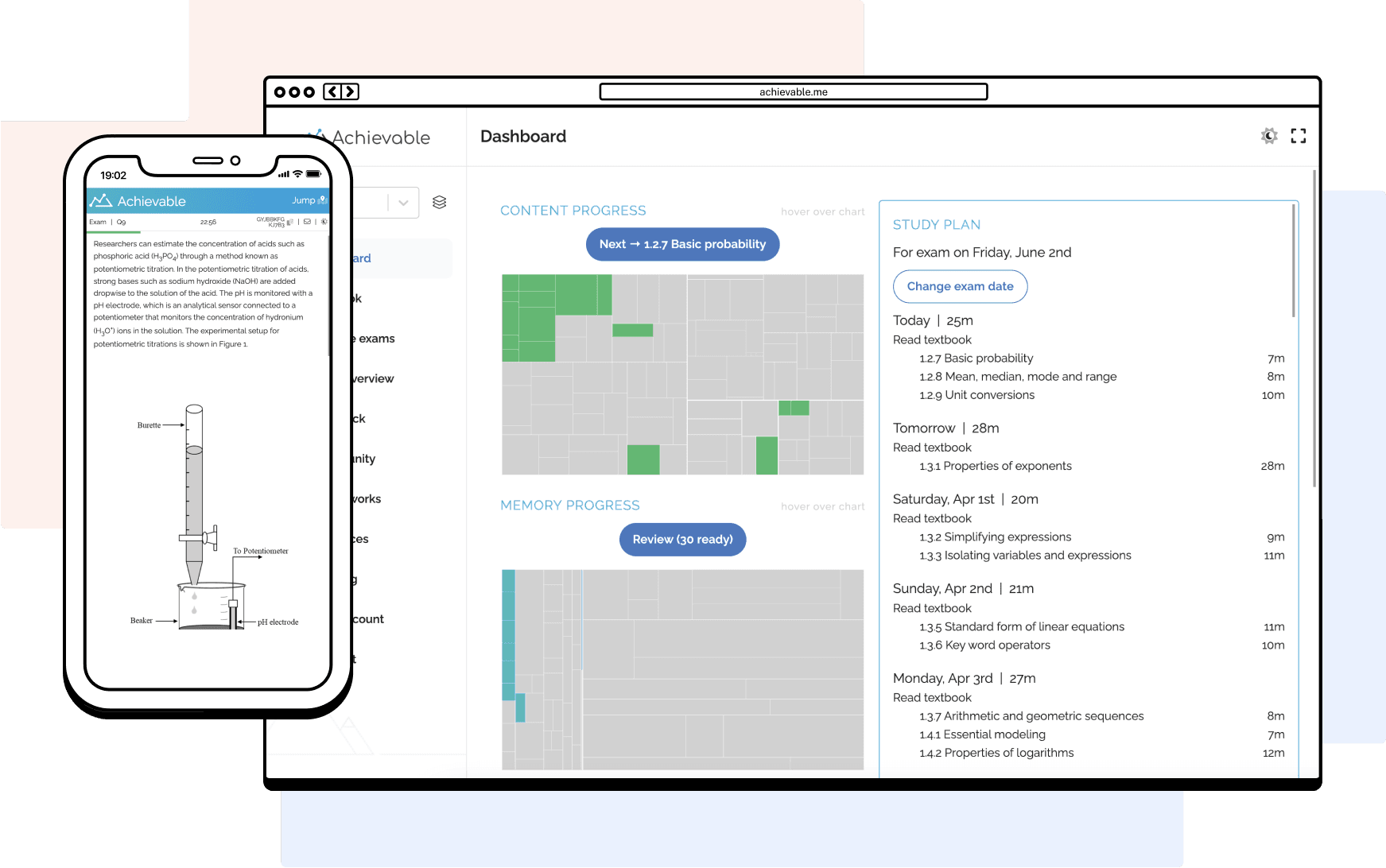
Pass the FE Civil. Guaranteed.
Achievable is the best FE Civil exam prep course: effective, personalized, and convenient. With Achievable, you'll spend less time studying and pass your exam the first time, or your money back.