CLT practice test


Free CLT practice test
This passage is adapted from Edgar Allan Poe, “The Fall of the House of Usher,” first published in 1839.
DURING the whole of a dull, dark, and soundless day in the autumn of the year, when the clouds hung oppressively low in the heavens, I had been passing alone, on horseback, through a singularly dreary tract of country, and at length found myself, as the shades of the evening drew on, within view of the melancholy House of Usher. I know not how it was—but, with the first glimpse of the building, a sense of insufferable gloom pervaded my spirit. I say insufferable; for the feeling was unrelieved by any of that half-pleasurable, because poetic, sentiment, with which the mind usually receives even the sternest natural images of the desolate or terrible. I looked upon the scene before me—upon the mere house, and the simple landscape features of the domain—upon the bleak walls—upon the vacant eye-like windows—upon a few rank sedges—and upon a few white trunks of decayed trees—with an utter depression of soul which I can compare to no earthly sensation more properly than to the after-dream of the reveler upon opium—the bitter lapse into every-day life—the hideous dropping off of the veil. There was an iciness, a sinking, a sickening of the heart—an unredeemed dreariness of thought which no goading of the imagination could torture into aught of the sublime. What was it—I paused to think—what was it that so unnerved me in the contemplation of the House of Usher? It was a mystery all insoluble; nor could I grapple with the shadowy fancies that crowded upon me as I pondered …
Nevertheless, in this mansion of gloom I now proposed to myself a sojourn of some weeks. Its proprietor, Roderick Usher, had been one of my boon companions in boyhood; but many years had elapsed since our last meeting. A letter, however, had lately reached me in a distant part of the country—a letter from him—which, in its wildly importunate nature, had admitted of no other than a personal reply. The MS. gave evidence of nervous agitation. The writer spoke of acute bodily illness—of a mental disorder which oppressed him—and of an earnest desire to see me, as his best and indeed his only personal friend, with a view of attempting, by the cheerfulness of my society, some alleviation of his malady. It was the manner in which all this, and much more, was said—it was the apparent heart that went with his request—which allowed me no room for hesitation; and I accordingly obeyed forthwith what I still considered a very singular summons.
Although, as boys, we had been even intimate associates, yet I really knew little of my friend. His reserve had been always excessive and habitual. I was aware, however, that his very ancient family had been noted, time out of mind, for a peculiar sensibility of temperament, displaying itself, through long ages, in many works of exalted art, and manifested, of late, in repeated deeds of munificent yet unobtrusive charity, as well as in a passionate devotion to the intricacies, perhaps even more than to the orthodox and easily recognizable beauties, of musical science. I had learned, too, the very remarkable fact, that the stem of the Usher race, all time-honored as it was, had put forth, at no period, any enduring branch ...
At the beginning of the passage, the narrator
This passage is adapted from Edgar Allan Poe, “The Fall of the House of Usher”, first published in 1839.
DURING the whole of a dull, dark, and soundless day in the autumn of the year, when the clouds hung oppressively low in the heavens, I had been passing alone, on horseback, through a singularly dreary tract of country, and at length found myself, as the shades of the evening drew on, within view of the melancholy House of Usher. I know not how it was—but, with the first glimpse of the building, a sense of insufferable gloom pervaded my spirit. I say insufferable; for the feeling was unrelieved by any of that half-pleasurable, because poetic, sentiment, with which the mind usually receives even the sternest natural images of the desolate or terrible. I looked upon the scene before me—upon the mere house, and the simple landscape features of the domain—upon the bleak walls—upon the vacant eye-like windows—upon a few rank sedges—and upon a few white trunks of decayed trees—with an utter depression of soul which I can compare to no earthly sensation more properly than to the after-dream of the reveler upon opium—the bitter lapse into every-day life—the hideous dropping off of the veil. There was an iciness, a sinking, a sickening of the heart—an unredeemed dreariness of thought which no goading of the imagination could torture into aught of the sublime. What was it—I paused to think—what was it that so unnerved me in the contemplation of the House of Usher? It was a mystery all insoluble; nor could I grapple with the shadowy fancies that crowded upon me as I pondered …
Nevertheless, in this mansion of gloom I now proposed to myself a sojourn of some weeks. Its proprietor, Roderick Usher, had been one of my boon companions in boyhood; but many years had elapsed since our last meeting. A letter, however, had lately reached me in a distant part of the country—a letter from him—which, in its wildly importunate nature, had admitted of no other than a personal reply. The MS. gave evidence of nervous agitation. The writer spoke of acute bodily illness—of a mental disorder which oppressed him—and of an earnest desire to see me, as his best and indeed his only personal friend, with a view of attempting, by the cheerfulness of my society, some alleviation of his malady. It was the manner in which all this, and much more, was said—it was the apparent heart that went with his request—which allowed me no room for hesitation; and I accordingly obeyed forthwith what I still considered a very singular summons.
Although, as boys, we had been even intimate associates, yet I really knew little of my friend. His reserve had been always excessive and habitual. I was aware, however, that his very ancient family had been noted, time out of mind, for a peculiar sensibility of temperament, displaying itself, through long ages, in many works of exalted art, and manifested, of late, in repeated deeds of munificent yet unobtrusive charity, as well as in a passionate devotion to the intricacies, perhaps even more than to the orthodox and easily recognizable beauties, of musical science. I had learned, too, the very remarkable fact, that the stem of the Usher race, all time-honored as it was, had put forth, at no period, any enduring branch ...
It can be inferred from the passage that the narrator responded to his friend’s letter
This passage is adapted from Edgar Allan Poe, “The Fall of the House of Usher”, first published in 1839.
DURING the whole of a dull, dark, and soundless day in the autumn of the year, when the clouds hung oppressively low in the heavens, I had been passing alone, on horseback, through a singularly dreary tract of country, and at length found myself, as the shades of the evening drew on, within view of the melancholy House of Usher. I know not how it was—but, with the first glimpse of the building, a sense of insufferable gloom pervaded my spirit. I say insufferable; for the feeling was unrelieved by any of that half-pleasurable, because poetic, sentiment, with which the mind usually receives even the sternest natural images of the desolate or terrible. I looked upon the scene before me—upon the mere house, and the simple landscape features of the domain—upon the bleak walls—upon the vacant eye-like windows—upon a few rank sedges—and upon a few white trunks of decayed trees—with an utter depression of soul which I can compare to no earthly sensation more properly than to the after-dream of the reveler upon opium—the bitter lapse into every-day life—the hideous dropping off of the veil. There was an iciness, a sinking, a sickening of the heart—an unredeemed dreariness of thought which no goading of the imagination could torture into aught of the sublime. What was it—I paused to think—what was it that so unnerved me in the contemplation of the House of Usher? It was a mystery all insoluble; nor could I grapple with the shadowy fancies that crowded upon me as I pondered …
Nevertheless, in this mansion of gloom I now proposed to myself a sojourn of some weeks. Its proprietor, Roderick Usher, had been one of my boon companions in boyhood; but many years had elapsed since our last meeting. A letter, however, had lately reached me in a distant part of the country—a letter from him—which, in its wildly importunate nature, had admitted of no other than a personal reply. The MS. gave evidence of nervous agitation. The writer spoke of acute bodily illness—of a mental disorder which oppressed him—and of an earnest desire to see me, as his best and indeed his only personal friend, with a view of attempting, by the cheerfulness of my society, some alleviation of his malady. It was the manner in which all this, and much more, was said—it was the apparent heart that went with his request—which allowed me no room for hesitation; and I accordingly obeyed forthwith what I still considered a very singular summons.
Although, as boys, we had been even intimate associates, yet I really knew little of my friend. His reserve had been always excessive and habitual. I was aware, however, that his very ancient family had been noted, time out of mind, for a peculiar sensibility of temperament, displaying itself, through long ages, in many works of exalted art, and manifested, of late, in repeated deeds of munificent yet unobtrusive charity, as well as in a passionate devotion to the intricacies, perhaps even more than to the orthodox and easily recognizable beauties, of musical science. I had learned, too, the very remarkable fact, that the stem of the Usher race, all time-honored as it was, had put forth, at no period, any enduring branch ...
Which lines in the passage best support the answer to the previous question?
This passage is adapted from Edgar Allan Poe, “The Fall of the House of Usher”, first published in 1839.
DURING the whole of a dull, dark, and soundless day in the autumn of the year, when the clouds hung oppressively low in the heavens, I had been passing alone, on horseback, through a singularly dreary tract of country, and at length found myself, as the shades of the evening drew on, within view of the melancholy House of Usher. I know not how it was—but, with the first glimpse of the building, a sense of insufferable gloom pervaded my spirit. I say insufferable; for the feeling was unrelieved by any of that half-pleasurable, because poetic, sentiment, with which the mind usually receives even the sternest natural images of the desolate or terrible. I looked upon the scene before me—upon the mere house, and the simple landscape features of the domain—upon the bleak walls—upon the vacant eye-like windows—upon a few rank sedges—and upon a few white trunks of decayed trees—with an utter depression of soul which I can compare to no earthly sensation more properly than to the after-dream of the reveler upon opium—the bitter lapse into every-day life—the hideous dropping off of the veil. There was an iciness, a sinking, a sickening of the heart—an unredeemed dreariness of thought which no goading of the imagination could torture into aught of the sublime. What was it—I paused to think—what was it that so unnerved me in the contemplation of the House of Usher? It was a mystery all insoluble; nor could I grapple with the shadowy fancies that crowded upon me as I pondered …
Nevertheless, in this mansion of gloom I now proposed to myself a sojourn of some weeks. Its proprietor, Roderick Usher, had been one of my boon companions in boyhood; but many years had elapsed since our last meeting. A letter, however, had lately reached me in a distant part of the country—a letter from him—which, in its wildly importunate nature, had admitted of no other than a personal reply. The MS. gave evidence of nervous agitation. The writer spoke of acute bodily illness—of a mental disorder which oppressed him—and of an earnest desire to see me, as his best and indeed his only personal friend, with a view of attempting, by the cheerfulness of my society, some alleviation of his malady. It was the manner in which all this, and much more, was said—it was the apparent heart that went with his request—which allowed me no room for hesitation; and I accordingly obeyed forthwith what I still considered a very singular summons.
Although, as boys, we had been even intimate associates, yet I really knew little of my friend. His reserve had been always excessive and habitual. I was aware, however, that his very ancient family had been noted, time out of mind, for a peculiar sensibility of temperament, displaying itself, through long ages, in many works of exalted art, and manifested, of late, in repeated deeds of munificent yet unobtrusive charity, as well as in a passionate devotion to the intricacies, perhaps even more than to the orthodox and easily recognizable beauties, of musical science. I had learned, too, the very remarkable fact, that the stem of the Usher race, all time-honored as it was, had put forth, at no period, any enduring branch ...
Over the course of the passage, the narrator
This passage is adapted from Edgar Allan Poe, “The Fall of the House of Usher”, first published in 1839.
DURING the whole of a dull, dark, and soundless day in the autumn of the year, when the clouds hung oppressively low in the heavens, I had been passing alone, on horseback, through a singularly dreary tract of country, and at length found myself, as the shades of the evening drew on, within view of the melancholy House of Usher. I know not how it was—but, with the first glimpse of the building, a sense of insufferable gloom pervaded my spirit. I say insufferable; for the feeling was unrelieved by any of that half-pleasurable, because poetic, sentiment, with which the mind usually receives even the sternest natural images of the desolate or terrible. I looked upon the scene before me—upon the mere house, and the simple landscape features of the domain—upon the bleak walls—upon the vacant eye-like windows—upon a few rank sedges—and upon a few white trunks of decayed trees—with an utter depression of soul which I can compare to no earthly sensation more properly than to the after-dream of the reveler upon opium—the bitter lapse into every-day life—the hideous dropping off of the veil. There was an iciness, a sinking, a sickening of the heart—an unredeemed dreariness of thought which no goading of the imagination could torture into aught of the sublime. What was it—I paused to think—what was it that so unnerved me in the contemplation of the House of Usher? It was a mystery all insoluble; nor could I grapple with the shadowy fancies that crowded upon me as I pondered …
Nevertheless, in this mansion of gloom I now proposed to myself a sojourn of some weeks. Its proprietor, Roderick Usher, had been one of my boon companions in boyhood; but many years had elapsed since our last meeting. A letter, however, had lately reached me in a distant part of the country—a letter from him—which, in its wildly importunate nature, had admitted of no other than a personal reply. The MS. gave evidence of nervous agitation. The writer spoke of acute bodily illness—of a mental disorder which oppressed him—and of an earnest desire to see me, as his best and indeed his only personal friend, with a view of attempting, by the cheerfulness of my society, some alleviation of his malady. It was the manner in which all this, and much more, was said—it was the apparent heart that went with his request—which allowed me no room for hesitation; and I accordingly obeyed forthwith what I still considered a very singular summons.
Although, as boys, we had been even intimate associates, yet I really knew little of my friend. His reserve had been always excessive and habitual. I was aware, however, that his very ancient family had been noted, time out of mind, for a peculiar sensibility of temperament, displaying itself, through long ages, in many works of exalted art, and manifested, of late, in repeated deeds of munificent yet unobtrusive charity, as well as in a passionate devotion to the intricacies, perhaps even more than to the orthodox and easily recognizable beauties, of musical science. I had learned, too, the very remarkable fact, that the stem of the Usher race, all time-honored as it was, had put forth, at no period, any enduring branch ...
In Paragraph 2, Sentence 3, the word "importunate" most closely means
This passage is adapted from Edgar Allan Poe, “The Fall of the House of Usher”, first published in 1839.
DURING the whole of a dull, dark, and soundless day in the autumn of the year, when the clouds hung oppressively low in the heavens, I had been passing alone, on horseback, through a singularly dreary tract of country, and at length found myself, as the shades of the evening drew on, within view of the melancholy House of Usher. I know not how it was—but, with the first glimpse of the building, a sense of insufferable gloom pervaded my spirit. I say insufferable; for the feeling was unrelieved by any of that half-pleasurable, because poetic, sentiment, with which the mind usually receives even the sternest natural images of the desolate or terrible. I looked upon the scene before me—upon the mere house, and the simple landscape features of the domain—upon the bleak walls—upon the vacant eye-like windows—upon a few rank sedges—and upon a few white trunks of decayed trees—with an utter depression of soul which I can compare to no earthly sensation more properly than to the after-dream of the reveler upon opium—the bitter lapse into every-day life—the hideous dropping off of the veil. There was an iciness, a sinking, a sickening of the heart—an unredeemed dreariness of thought which no goading of the imagination could torture into aught of the sublime. What was it—I paused to think—what was it that so unnerved me in the contemplation of the House of Usher? It was a mystery all insoluble; nor could I grapple with the shadowy fancies that crowded upon me as I pondered …
Nevertheless, in this mansion of gloom I now proposed to myself a sojourn of some weeks. Its proprietor, Roderick Usher, had been one of my boon companions in boyhood; but many years had elapsed since our last meeting. A letter, however, had lately reached me in a distant part of the country—a letter from him—which, in its wildly importunate nature, had admitted of no other than a personal reply. The MS. gave evidence of nervous agitation. The writer spoke of acute bodily illness—of a mental disorder which oppressed him—and of an earnest desire to see me, as his best and indeed his only personal friend, with a view of attempting, by the cheerfulness of my society, some alleviation of his malady. It was the manner in which all this, and much more, was said—it was the apparent heart that went with his request—which allowed me no room for hesitation; and I accordingly obeyed forthwith what I still considered a very singular summons.
Although, as boys, we had been even intimate associates, yet I really knew little of my friend. His reserve had been always excessive and habitual. I was aware, however, that his very ancient family had been noted, time out of mind, for a peculiar sensibility of temperament, displaying itself, through long ages, in many works of exalted art, and manifested, of late, in repeated deeds of munificent yet unobtrusive charity, as well as in a passionate devotion to the intricacies, perhaps even more than to the orthodox and easily recognizable beauties, of musical science. I had learned, too, the very remarkable fact, that the stem of the Usher race, all time-honored as it was, had put forth, at no period, any enduring branch ...
According to the passage, Roderick Usher can best be described as
This passage is adapted from Edgar Allan Poe, “The Fall of the House of Usher”, first published in 1839.
DURING the whole of a dull, dark, and soundless day in the autumn of the year, when the clouds hung oppressively low in the heavens, I had been passing alone, on horseback, through a singularly dreary tract of country, and at length found myself, as the shades of the evening drew on, within view of the melancholy House of Usher. I know not how it was—but, with the first glimpse of the building, a sense of insufferable gloom pervaded my spirit. I say insufferable; for the feeling was unrelieved by any of that half-pleasurable, because poetic, sentiment, with which the mind usually receives even the sternest natural images of the desolate or terrible. I looked upon the scene before me—upon the mere house, and the simple landscape features of the domain—upon the bleak walls—upon the vacant eye-like windows—upon a few rank sedges—and upon a few white trunks of decayed trees—with an utter depression of soul which I can compare to no earthly sensation more properly than to the after-dream of the reveler upon opium—the bitter lapse into every-day life—the hideous dropping off of the veil. There was an iciness, a sinking, a sickening of the heart—an unredeemed dreariness of thought which no goading of the imagination could torture into aught of the sublime. What was it—I paused to think—what was it that so unnerved me in the contemplation of the House of Usher? It was a mystery all insoluble; nor could I grapple with the shadowy fancies that crowded upon me as I pondered …
Nevertheless, in this mansion of gloom I now proposed to myself a sojourn of some weeks. Its proprietor, Roderick Usher, had been one of my boon companions in boyhood; but many years had elapsed since our last meeting. A letter, however, had lately reached me in a distant part of the country—a letter from him—which, in its wildly importunate nature, had admitted of no other than a personal reply. The MS. gave evidence of nervous agitation. The writer spoke of acute bodily illness—of a mental disorder which oppressed him—and of an earnest desire to see me, as his best and indeed his only personal friend, with a view of attempting, by the cheerfulness of my society, some alleviation of his malady. It was the manner in which all this, and much more, was said—it was the apparent heart that went with his request—which allowed me no room for hesitation; and I accordingly obeyed forthwith what I still considered a very singular summons.
Although, as boys, we had been even intimate associates, yet I really knew little of my friend. His reserve had been always excessive and habitual. I was aware, however, that his very ancient family had been noted, time out of mind, for a peculiar sensibility of temperament, displaying itself, through long ages, in many works of exalted art, and manifested, of late, in repeated deeds of munificent yet unobtrusive charity, as well as in a passionate devotion to the intricacies, perhaps even more than to the orthodox and easily recognizable beauties, of musical science. I had learned, too, the very remarkable fact, that the stem of the Usher race, all time-honored as it was, had put forth, at no period, any enduring branch ...
It can be inferred from the passage that both Roderick Usher and the narrator
This passage is adapted from Edgar Allan Poe, “The Fall of the House of Usher”, first published in 1839.
DURING the whole of a dull, dark, and soundless day in the autumn of the year, when the clouds hung oppressively low in the heavens, I had been passing alone, on horseback, through a singularly dreary tract of country, and at length found myself, as the shades of the evening drew on, within view of the melancholy House of Usher. I know not how it was—but, with the first glimpse of the building, a sense of insufferable gloom pervaded my spirit. I say insufferable; for the feeling was unrelieved by any of that half-pleasurable, because poetic, sentiment, with which the mind usually receives even the sternest natural images of the desolate or terrible. I looked upon the scene before me—upon the mere house, and the simple landscape features of the domain—upon the bleak walls—upon the vacant eye-like windows—upon a few rank sedges—and upon a few white trunks of decayed trees—with an utter depression of soul which I can compare to no earthly sensation more properly than to the after-dream of the reveler upon opium—the bitter lapse into every-day life—the hideous dropping off of the veil. There was an iciness, a sinking, a sickening of the heart—an unredeemed dreariness of thought which no goading of the imagination could torture into aught of the sublime. What was it—I paused to think—what was it that so unnerved me in the contemplation of the House of Usher? It was a mystery all insoluble; nor could I grapple with the shadowy fancies that crowded upon me as I pondered …
Nevertheless, in this mansion of gloom I now proposed to myself a sojourn of some weeks. Its proprietor, Roderick Usher, had been one of my boon companions in boyhood; but many years had elapsed since our last meeting. A letter, however, had lately reached me in a distant part of the country—a letter from him—which, in its wildly importunate nature, had admitted of no other than a personal reply. The MS. gave evidence of nervous agitation. The writer spoke of acute bodily illness—of a mental disorder which oppressed him—and of an earnest desire to see me, as his best and indeed his only personal friend, with a view of attempting, by the cheerfulness of my society, some alleviation of his malady. It was the manner in which all this, and much more, was said—it was the apparent heart that went with his request—which allowed me no room for hesitation; and I accordingly obeyed forthwith what I still considered a very singular summons.
Although, as boys, we had been even intimate associates, yet I really knew little of my friend. His reserve had been always excessive and habitual. I was aware, however, that his very ancient family had been noted, time out of mind, for a peculiar sensibility of temperament, displaying itself, through long ages, in many works of exalted art, and manifested, of late, in repeated deeds of munificent yet unobtrusive charity, as well as in a passionate devotion to the intricacies, perhaps even more than to the orthodox and easily recognizable beauties, of musical science. I had learned, too, the very remarkable fact, that the stem of the Usher race, all time-honored as it was, had put forth, at no period, any enduring branch ...
It can be inferred from the passage that the Usher line was
This passage is adapted from Edgar Allan Poe, “The Fall of the House of Usher”, first published in 1839.
DURING the whole of a dull, dark, and soundless day in the autumn of the year, when the clouds hung oppressively low in the heavens, I had been passing alone, on horseback, through a singularly dreary tract of country, and at length found myself, as the shades of the evening drew on, within view of the melancholy House of Usher. I know not how it was—but, with the first glimpse of the building, a sense of insufferable gloom pervaded my spirit. I say insufferable; for the feeling was unrelieved by any of that half-pleasurable, because poetic, sentiment, with which the mind usually receives even the sternest natural images of the desolate or terrible. I looked upon the scene before me—upon the mere house, and the simple landscape features of the domain—upon the bleak walls—upon the vacant eye-like windows—upon a few rank sedges—and upon a few white trunks of decayed trees—with an utter depression of soul which I can compare to no earthly sensation more properly than to the after-dream of the reveler upon opium—the bitter lapse into every-day life—the hideous dropping off of the veil. There was an iciness, a sinking, a sickening of the heart—an unredeemed dreariness of thought which no goading of the imagination could torture into aught of the sublime. What was it—I paused to think—what was it that so unnerved me in the contemplation of the House of Usher? It was a mystery all insoluble; nor could I grapple with the shadowy fancies that crowded upon me as I pondered …
Nevertheless, in this mansion of gloom I now proposed to myself a sojourn of some weeks. Its proprietor, Roderick Usher, had been one of my boon companions in boyhood; but many years had elapsed since our last meeting. A letter, however, had lately reached me in a distant part of the country—a letter from him—which, in its wildly importunate nature, had admitted of no other than a personal reply. The MS. gave evidence of nervous agitation. The writer spoke of acute bodily illness—of a mental disorder which oppressed him—and of an earnest desire to see me, as his best and indeed his only personal friend, with a view of attempting, by the cheerfulness of my society, some alleviation of his malady. It was the manner in which all this, and much more, was said—it was the apparent heart that went with his request—which allowed me no room for hesitation; and I accordingly obeyed forthwith what I still considered a very singular summons.
Although, as boys, we had been even intimate associates, yet I really knew little of my friend. His reserve had been always excessive and habitual. I was aware, however, that his very ancient family had been noted, time out of mind, for a peculiar sensibility of temperament, displaying itself, through long ages, in many works of exalted art, and manifested, of late, in repeated deeds of munificent yet unobtrusive charity, as well as in a passionate devotion to the intricacies, perhaps even more than to the orthodox and easily recognizable beauties, of musical science. I had learned, too, the very remarkable fact, that the stem of the Usher race, all time-honored as it was, had put forth, at no period, any enduring branch ...
narrator’s thoughts : sublime
This passage is adapted from Edgar Allan Poe, “The Fall of the House of Usher”, first published in 1839.
DURING the whole of a dull, dark, and soundless day in the autumn of the year, when the clouds hung oppressively low in the heavens, I had been passing alone, on horseback, through a singularly dreary tract of country, and at length found myself, as the shades of the evening drew on, within view of the melancholy House of Usher. I know not how it was—but, with the first glimpse of the building, a sense of insufferable gloom pervaded my spirit. I say insufferable; for the feeling was unrelieved by any of that half-pleasurable, because poetic, sentiment, with which the mind usually receives even the sternest natural images of the desolate or terrible. I looked upon the scene before me—upon the mere house, and the simple landscape features of the domain—upon the bleak walls—upon the vacant eye-like windows—upon a few rank sedges—and upon a few white trunks of decayed trees—with an utter depression of soul which I can compare to no earthly sensation more properly than to the after-dream of the reveler upon opium—the bitter lapse into every-day life—the hideous dropping off of the veil. There was an iciness, a sinking, a sickening of the heart—an unredeemed dreariness of thought which no goading of the imagination could torture into aught of the sublime. What was it—I paused to think—what was it that so unnerved me in the contemplation of the House of Usher? It was a mystery all insoluble; nor could I grapple with the shadowy fancies that crowded upon me as I pondered …
Nevertheless, in this mansion of gloom I now proposed to myself a sojourn of some weeks. Its proprietor, Roderick Usher, had been one of my boon companions in boyhood; but many years had elapsed since our last meeting. A letter, however, had lately reached me in a distant part of the country—a letter from him—which, in its wildly importunate nature, had admitted of no other than a personal reply. The MS. gave evidence of nervous agitation. The writer spoke of acute bodily illness—of a mental disorder which oppressed him—and of an earnest desire to see me, as his best and indeed his only personal friend, with a view of attempting, by the cheerfulness of my society, some alleviation of his malady. It was the manner in which all this, and much more, was said—it was the apparent heart that went with his request—which allowed me no room for hesitation; and I accordingly obeyed forthwith what I still considered a very singular summons.
Although, as boys, we had been even intimate associates, yet I really knew little of my friend. His reserve had been always excessive and habitual. I was aware, however, that his very ancient family had been noted, time out of mind, for a peculiar sensibility of temperament, displaying itself, through long ages, in many works of exalted art, and manifested, of late, in repeated deeds of munificent yet unobtrusive charity, as well as in a passionate devotion to the intricacies, perhaps even more than to the orthodox and easily recognizable beauties, of musical science. I had learned, too, the very remarkable fact, that the stem of the Usher race, all time-honored as it was, had put forth, at no period, any enduring branch ...
urgency : Usher’s letter
This passage is adapted from Galileo Galilei, “The Sidereal Messenger,” first published in Padua, March 12, 1610.
I have now finished my brief account of the observations which I have thus far made with regard to the Moon, the Fixed Stars, and the Galaxy. There remains the matter, which seems to me to deserve to be considered the most important in this work, namely, that I should disclose and publish to the world the occasion of discovering and observing four PLANETS, never seen from the very beginning of the world up to our own times, their positions, and the observations made during the last two months about their movements and their changes of magnitude; and I summon all astronomers to apply themselves to examine and determine their periodic times, which it has not been permitted me to achieve up to this day, owing to the restriction of my time. I give them warning however again, so that they may not approach such an inquiry to no purpose, that they will want a very accurate telescope, and such as I have described in the beginning of this account.
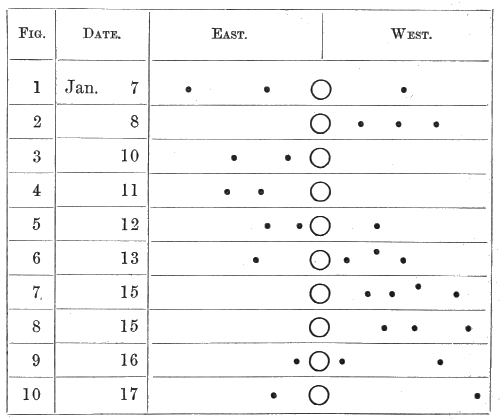
On the 7th day of January in the present year, 1610, in the first hour of the following night, when I was viewing the constellations of the heavens through a telescope, the planet Jupiter presented itself to my view, and as I had prepared for myself a very excellent instrument, I noticed a circumstance which I had never been able to notice before, owing to want of power in my other telescope, namely, that three little stars, small but very bright, were near the planet; and although I believed them to belong to the number of the fixed stars, yet they made me somewhat wonder, because they seemed to be arranged exactly in a straight line, parallel to the ecliptic, and to be brighter than the rest of the stars, equal to them in magnitude. The position of them with reference to one another and to Jupiter was as follows ...
And, in the first place, since they are sometimes behind, sometimes before Jupiter, at like distances, and withdraw from this planet towards the east and towards the west only within very narrow limits of divergence, and since they accompany this planet alike when its motion is retrograde and direct, it can be a matter of doubt to no one that they perform their revolutions about this planet .... Moreover, they revolve in unequal circles, which is evidently the conclusion to be drawn from the fact that I have never been permitted to see two satellites in conjunction when their distance from Jupiter was great, whereas near Jupiter two, three, and sometimes all (four), have been found closely packed together ...
Besides, we have a notable and splendid argument to remove the scruples of those who can tolerate the revolution of the planets round the Sun in the Copernican system, yet are so disturbed by the motion of one Moon about the Earth, while both accomplish an orbit of a year’s length about the Sun, that they consider that this theory of the constitution of the universe must be upset as impossible; for now we have not one planet only revolving about another, while both traverse a vast orbit about the Sun, but our sense of sight presents to us four satellites circling about Jupiter, like the Moon about the Earth, while the whole system travels over a mighty orbit about the Sun in the space of twelve years.
::: class image-w-480 !Original Configurations of Jupiter's Satellites by Galileo
The author’s primary purpose of the passage is to
This passage is adapted from Galileo Galilei, “The Sidereal Messenger,” first published in Padua, March 12, 1610.
I have now finished my brief account of the observations which I have thus far made with regard to the Moon, the Fixed Stars, and the Galaxy. There remains the matter, which seems to me to deserve to be considered the most important in this work, namely, that I should disclose and publish to the world the occasion of discovering and observing four PLANETS, never seen from the very beginning of the world up to our own times, their positions, and the observations made during the last two months about their movements and their changes of magnitude; and I summon all astronomers to apply themselves to examine and determine their periodic times, which it has not been permitted me to achieve up to this day, owing to the restriction of my time. I give them warning however again, so that they may not approach such an inquiry to no purpose, that they will want a very accurate telescope, and such as I have described in the beginning of this account.
On the 7th day of January in the present year, 1610, in the first hour of the following night, when I was viewing the constellations of the heavens through a telescope, the planet Jupiter presented itself to my view, and as I had prepared for myself a very excellent instrument, I noticed a circumstance which I had never been able to notice before, owing to want of power in my other telescope, namely, that three little stars, small but very bright, were near the planet; and although I believed them to belong to the number of the fixed stars, yet they made me somewhat wonder, because they seemed to be arranged exactly in a straight line, parallel to the ecliptic, and to be brighter than the rest of the stars, equal to them in magnitude. The position of them with reference to one another and to Jupiter was as follows ...
And, in the first place, since they are sometimes behind, sometimes before Jupiter, at like distances, and withdraw from this planet towards the east and towards the west only within very narrow limits of divergence, and since they accompany this planet alike when its motion is retrograde and direct, it can be a matter of doubt to no one that they perform their revolutions about this planet .... Moreover, they revolve in unequal circles, which is evidently the conclusion to be drawn from the fact that I have never been permitted to see two satellites in conjunction when their distance from Jupiter was great, whereas near Jupiter two, three, and sometimes all (four), have been found closely packed together ...
Besides, we have a notable and splendid argument to remove the scruples of those who can tolerate the revolution of the planets round the Sun in the Copernican system, yet are so disturbed by the motion of one Moon about the Earth, while both accomplish an orbit of a year’s length about the Sun, that they consider that this theory of the constitution of the universe must be upset as impossible; for now we have not one planet only revolving about another, while both traverse a vast orbit about the Sun, but our sense of sight presents to us four satellites circling about Jupiter, like the Moon about the Earth, while the whole system travels over a mighty orbit about the Sun in the space of twelve years.
::: class image-w-480 !Original Configurations of Jupiter's Satellites by Galileo
It can be inferred from the passage that the author most regrets which of the following?
This passage is adapted from Galileo Galilei, “The Sidereal Messenger,” first published in Padua, March 12, 1610.
I have now finished my brief account of the observations which I have thus far made with regard to the Moon, the Fixed Stars, and the Galaxy. There remains the matter, which seems to me to deserve to be considered the most important in this work, namely, that I should disclose and publish to the world the occasion of discovering and observing four PLANETS, never seen from the very beginning of the world up to our own times, their positions, and the observations made during the last two months about their movements and their changes of magnitude; and I summon all astronomers to apply themselves to examine and determine their periodic times, which it has not been permitted me to achieve up to this day, owing to the restriction of my time. I give them warning however again, so that they may not approach such an inquiry to no purpose, that they will want a very accurate telescope, and such as I have described in the beginning of this account.
On the 7th day of January in the present year, 1610, in the first hour of the following night, when I was viewing the constellations of the heavens through a telescope, the planet Jupiter presented itself to my view, and as I had prepared for myself a very excellent instrument, I noticed a circumstance which I had never been able to notice before, owing to want of power in my other telescope, namely, that three little stars, small but very bright, were near the planet; and although I believed them to belong to the number of the fixed stars, yet they made me somewhat wonder, because they seemed to be arranged exactly in a straight line, parallel to the ecliptic, and to be brighter than the rest of the stars, equal to them in magnitude. The position of them with reference to one another and to Jupiter was as follows ...
And, in the first place, since they are sometimes behind, sometimes before Jupiter, at like distances, and withdraw from this planet towards the east and towards the west only within very narrow limits of divergence, and since they accompany this planet alike when its motion is retrograde and direct, it can be a matter of doubt to no one that they perform their revolutions about this planet .... Moreover, they revolve in unequal circles, which is evidently the conclusion to be drawn from the fact that I have never been permitted to see two satellites in conjunction when their distance from Jupiter was great, whereas near Jupiter two, three, and sometimes all (four), have been found closely packed together ...
Besides, we have a notable and splendid argument to remove the scruples of those who can tolerate the revolution of the planets round the Sun in the Copernican system, yet are so disturbed by the motion of one Moon about the Earth, while both accomplish an orbit of a year’s length about the Sun, that they consider that this theory of the constitution of the universe must be upset as impossible; for now we have not one planet only revolving about another, while both traverse a vast orbit about the Sun, but our sense of sight presents to us four satellites circling about Jupiter, like the Moon about the Earth, while the whole system travels over a mighty orbit about the Sun in the space of twelve years.
::: class image-w-480 !Original Configurations of Jupiter's Satellites by Galileo
The author of the passage indicates that he had not been able to previously observe the phenomenon he describes due to
This passage is adapted from Galileo Galilei, “The Sidereal Messenger,” first published in Padua, March 12, 1610.
I have now finished my brief account of the observations which I have thus far made with regard to the Moon, the Fixed Stars, and the Galaxy. There remains the matter, which seems to me to deserve to be considered the most important in this work, namely, that I should disclose and publish to the world the occasion of discovering and observing four PLANETS, never seen from the very beginning of the world up to our own times, their positions, and the observations made during the last two months about their movements and their changes of magnitude; and I summon all astronomers to apply themselves to examine and determine their periodic times, which it has not been permitted me to achieve up to this day, owing to the restriction of my time. I give them warning however again, so that they may not approach such an inquiry to no purpose, that they will want a very accurate telescope, and such as I have described in the beginning of this account.
On the 7th day of January in the present year, 1610, in the first hour of the following night, when I was viewing the constellations of the heavens through a telescope, the planet Jupiter presented itself to my view, and as I had prepared for myself a very excellent instrument, I noticed a circumstance which I had never been able to notice before, owing to want of power in my other telescope, namely, that three little stars, small but very bright, were near the planet; and although I believed them to belong to the number of the fixed stars, yet they made me somewhat wonder, because they seemed to be arranged exactly in a straight line, parallel to the ecliptic, and to be brighter than the rest of the stars, equal to them in magnitude. The position of them with reference to one another and to Jupiter was as follows ...
And, in the first place, since they are sometimes behind, sometimes before Jupiter, at like distances, and withdraw from this planet towards the east and towards the west only within very narrow limits of divergence, and since they accompany this planet alike when its motion is retrograde and direct, it can be a matter of doubt to no one that they perform their revolutions about this planet .... Moreover, they revolve in unequal circles, which is evidently the conclusion to be drawn from the fact that I have never been permitted to see two satellites in conjunction when their distance from Jupiter was great, whereas near Jupiter two, three, and sometimes all (four), have been found closely packed together ...
Besides, we have a notable and splendid argument to remove the scruples of those who can tolerate the revolution of the planets round the Sun in the Copernican system, yet are so disturbed by the motion of one Moon about the Earth, while both accomplish an orbit of a year’s length about the Sun, that they consider that this theory of the constitution of the universe must be upset as impossible; for now we have not one planet only revolving about another, while both traverse a vast orbit about the Sun, but our sense of sight presents to us four satellites circling about Jupiter, like the Moon about the Earth, while the whole system travels over a mighty orbit about the Sun in the space of twelve years.
::: class image-w-480 !Original Configurations of Jupiter's Satellites by Galileo
Which lines in the passage best support the answer to the previous question?
This passage is adapted from Galileo Galilei, “The Sidereal Messenger,” first published in Padua, March 12, 1610.
I have now finished my brief account of the observations which I have thus far made with regard to the Moon, the Fixed Stars, and the Galaxy. There remains the matter, which seems to me to deserve to be considered the most important in this work, namely, that I should disclose and publish to the world the occasion of discovering and observing four PLANETS, never seen from the very beginning of the world up to our own times, their positions, and the observations made during the last two months about their movements and their changes of magnitude; and I summon all astronomers to apply themselves to examine and determine their periodic times, which it has not been permitted me to achieve up to this day, owing to the restriction of my time. I give them warning however again, so that they may not approach such an inquiry to no purpose, that they will want a very accurate telescope, and such as I have described in the beginning of this account.
On the 7th day of January in the present year, 1610, in the first hour of the following night, when I was viewing the constellations of the heavens through a telescope, the planet Jupiter presented itself to my view, and as I had prepared for myself a very excellent instrument, I noticed a circumstance which I had never been able to notice before, owing to want of power in my other telescope, namely, that three little stars, small but very bright, were near the planet; and although I believed them to belong to the number of the fixed stars, yet they made me somewhat wonder, because they seemed to be arranged exactly in a straight line, parallel to the ecliptic, and to be brighter than the rest of the stars, equal to them in magnitude. The position of them with reference to one another and to Jupiter was as follows ...
And, in the first place, since they are sometimes behind, sometimes before Jupiter, at like distances, and withdraw from this planet towards the east and towards the west only within very narrow limits of divergence, and since they accompany this planet alike when its motion is retrograde and direct, it can be a matter of doubt to no one that they perform their revolutions about this planet .... Moreover, they revolve in unequal circles, which is evidently the conclusion to be drawn from the fact that I have never been permitted to see two satellites in conjunction when their distance from Jupiter was great, whereas near Jupiter two, three, and sometimes all (four), have been found closely packed together ...
Besides, we have a notable and splendid argument to remove the scruples of those who can tolerate the revolution of the planets round the Sun in the Copernican system, yet are so disturbed by the motion of one Moon about the Earth, while both accomplish an orbit of a year’s length about the Sun, that they consider that this theory of the constitution of the universe must be upset as impossible; for now we have not one planet only revolving about another, while both traverse a vast orbit about the Sun, but our sense of sight presents to us four satellites circling about Jupiter, like the Moon about the Earth, while the whole system travels over a mighty orbit about the Sun in the space of twelve years.
::: class image-w-480 !Original Configurations of Jupiter's Satellites by Galileo
Over the course of the passage, the author moves from
This passage is adapted from Galileo Galilei, “The Sidereal Messenger,” first published in Padua, March 12, 1610.
I have now finished my brief account of the observations which I have thus far made with regard to the Moon, the Fixed Stars, and the Galaxy. There remains the matter, which seems to me to deserve to be considered the most important in this work, namely, that I should disclose and publish to the world the occasion of discovering and observing four PLANETS, never seen from the very beginning of the world up to our own times, their positions, and the observations made during the last two months about their movements and their changes of magnitude; and I summon all astronomers to apply themselves to examine and determine their periodic times, which it has not been permitted me to achieve up to this day, owing to the restriction of my time. I give them warning however again, so that they may not approach such an inquiry to no purpose, that they will want a very accurate telescope, and such as I have described in the beginning of this account.
On the 7th day of January in the present year, 1610, in the first hour of the following night, when I was viewing the constellations of the heavens through a telescope, the planet Jupiter presented itself to my view, and as I had prepared for myself a very excellent instrument, I noticed a circumstance which I had never been able to notice before, owing to want of power in my other telescope, namely, that three little stars, small but very bright, were near the planet; and although I believed them to belong to the number of the fixed stars, yet they made me somewhat wonder, because they seemed to be arranged exactly in a straight line, parallel to the ecliptic, and to be brighter than the rest of the stars, equal to them in magnitude. The position of them with reference to one another and to Jupiter was as follows ...
And, in the first place, since they are sometimes behind, sometimes before Jupiter, at like distances, and withdraw from this planet towards the east and towards the west only within very narrow limits of divergence, and since they accompany this planet alike when its motion is retrograde and direct, it can be a matter of doubt to no one that they perform their revolutions about this planet .... Moreover, they revolve in unequal circles, which is evidently the conclusion to be drawn from the fact that I have never been permitted to see two satellites in conjunction when their distance from Jupiter was great, whereas near Jupiter two, three, and sometimes all (four), have been found closely packed together ...
Besides, we have a notable and splendid argument to remove the scruples of those who can tolerate the revolution of the planets round the Sun in the Copernican system, yet are so disturbed by the motion of one Moon about the Earth, while both accomplish an orbit of a year’s length about the Sun, that they consider that this theory of the constitution of the universe must be upset as impossible; for now we have not one planet only revolving about another, while both traverse a vast orbit about the Sun, but our sense of sight presents to us four satellites circling about Jupiter, like the Moon about the Earth, while the whole system travels over a mighty orbit about the Sun in the space of twelve years.
::: class image-w-480 !Original Configurations of Jupiter's Satellites by Galileo
It can be inferred from the passage that other scientists
This passage is adapted from Galileo Galilei, “The Sidereal Messenger,” first published in Padua, March 12, 1610.
I have now finished my brief account of the observations which I have thus far made with regard to the Moon, the Fixed Stars, and the Galaxy. There remains the matter, which seems to me to deserve to be considered the most important in this work, namely, that I should disclose and publish to the world the occasion of discovering and observing four PLANETS, never seen from the very beginning of the world up to our own times, their positions, and the observations made during the last two months about their movements and their changes of magnitude; and I summon all astronomers to apply themselves to examine and determine their periodic times, which it has not been permitted me to achieve up to this day, owing to the restriction of my time. I give them warning however again, so that they may not approach such an inquiry to no purpose, that they will want a very accurate telescope, and such as I have described in the beginning of this account.
On the 7th day of January in the present year, 1610, in the first hour of the following night, when I was viewing the constellations of the heavens through a telescope, the planet Jupiter presented itself to my view, and as I had prepared for myself a very excellent instrument, I noticed a circumstance which I had never been able to notice before, owing to want of power in my other telescope, namely, that three little stars, small but very bright, were near the planet; and although I believed them to belong to the number of the fixed stars, yet they made me somewhat wonder, because they seemed to be arranged exactly in a straight line, parallel to the ecliptic, and to be brighter than the rest of the stars, equal to them in magnitude. The position of them with reference to one another and to Jupiter was as follows ...
And, in the first place, since they are sometimes behind, sometimes before Jupiter, at like distances, and withdraw from this planet towards the east and towards the west only within very narrow limits of divergence, and since they accompany this planet alike when its motion is retrograde and direct, it can be a matter of doubt to no one that they perform their revolutions about this planet .... Moreover, they revolve in unequal circles, which is evidently the conclusion to be drawn from the fact that I have never been permitted to see two satellites in conjunction when their distance from Jupiter was great, whereas near Jupiter two, three, and sometimes all (four), have been found closely packed together ...
Besides, we have a notable and splendid argument to remove the scruples of those who can tolerate the revolution of the planets round the Sun in the Copernican system, yet are so disturbed by the motion of one Moon about the Earth, while both accomplish an orbit of a year’s length about the Sun, that they consider that this theory of the constitution of the universe must be upset as impossible; for now we have not one planet only revolving about another, while both traverse a vast orbit about the Sun, but our sense of sight presents to us four satellites circling about Jupiter, like the Moon about the Earth, while the whole system travels over a mighty orbit about the Sun in the space of twelve years.
::: class image-w-480 !Original Configurations of Jupiter's Satellites by Galileo
In Paragraph 4, Sentence 1, the word "upset" most closely means
This passage is adapted from Galileo Galilei, “The Sidereal Messenger,” first published in Padua, March 12, 1610.
I have now finished my brief account of the observations which I have thus far made with regard to the Moon, the Fixed Stars, and the Galaxy. There remains the matter, which seems to me to deserve to be considered the most important in this work, namely, that I should disclose and publish to the world the occasion of discovering and observing four PLANETS, never seen from the very beginning of the world up to our own times, their positions, and the observations made during the last two months about their movements and their changes of magnitude; and I summon all astronomers to apply themselves to examine and determine their periodic times, which it has not been permitted me to achieve up to this day, owing to the restriction of my time. I give them warning however again, so that they may not approach such an inquiry to no purpose, that they will want a very accurate telescope, and such as I have described in the beginning of this account.
On the 7th day of January in the present year, 1610, in the first hour of the following night, when I was viewing the constellations of the heavens through a telescope, the planet Jupiter presented itself to my view, and as I had prepared for myself a very excellent instrument, I noticed a circumstance which I had never been able to notice before, owing to want of power in my other telescope, namely, that three little stars, small but very bright, were near the planet; and although I believed them to belong to the number of the fixed stars, yet they made me somewhat wonder, because they seemed to be arranged exactly in a straight line, parallel to the ecliptic, and to be brighter than the rest of the stars, equal to them in magnitude. The position of them with reference to one another and to Jupiter was as follows ...
And, in the first place, since they are sometimes behind, sometimes before Jupiter, at like distances, and withdraw from this planet towards the east and towards the west only within very narrow limits of divergence, and since they accompany this planet alike when its motion is retrograde and direct, it can be a matter of doubt to no one that they perform their revolutions about this planet .... Moreover, they revolve in unequal circles, which is evidently the conclusion to be drawn from the fact that I have never been permitted to see two satellites in conjunction when their distance from Jupiter was great, whereas near Jupiter two, three, and sometimes all (four), have been found closely packed together ...
Besides, we have a notable and splendid argument to remove the scruples of those who can tolerate the revolution of the planets round the Sun in the Copernican system, yet are so disturbed by the motion of one Moon about the Earth, while both accomplish an orbit of a year’s length about the Sun, that they consider that this theory of the constitution of the universe must be upset as impossible; for now we have not one planet only revolving about another, while both traverse a vast orbit about the Sun, but our sense of sight presents to us four satellites circling about Jupiter, like the Moon about the Earth, while the whole system travels over a mighty orbit about the Sun in the space of twelve years.
::: class image-w-480 !Original Configurations of Jupiter's Satellites by Galileo
Based on the figure below, on how many days did at least two satellites appear on the western side of Jupiter?
This passage is adapted from Galileo Galilei, “The Sidereal Messenger,” first published in Padua, March 12, 1610.
I have now finished my brief account of the observations which I have thus far made with regard to the Moon, the Fixed Stars, and the Galaxy. There remains the matter, which seems to me to deserve to be considered the most important in this work, namely, that I should disclose and publish to the world the occasion of discovering and observing four PLANETS, never seen from the very beginning of the world up to our own times, their positions, and the observations made during the last two months about their movements and their changes of magnitude; and I summon all astronomers to apply themselves to examine and determine their periodic times, which it has not been permitted me to achieve up to this day, owing to the restriction of my time. I give them warning however again, so that they may not approach such an inquiry to no purpose, that they will want a very accurate telescope, and such as I have described in the beginning of this account.
On the 7th day of January in the present year, 1610, in the first hour of the following night, when I was viewing the constellations of the heavens through a telescope, the planet Jupiter presented itself to my view, and as I had prepared for myself a very excellent instrument, I noticed a circumstance which I had never been able to notice before, owing to want of power in my other telescope, namely, that three little stars, small but very bright, were near the planet; and although I believed them to belong to the number of the fixed stars, yet they made me somewhat wonder, because they seemed to be arranged exactly in a straight line, parallel to the ecliptic, and to be brighter than the rest of the stars, equal to them in magnitude. The position of them with reference to one another and to Jupiter was as follows ...
And, in the first place, since they are sometimes behind, sometimes before Jupiter, at like distances, and withdraw from this planet towards the east and towards the west only within very narrow limits of divergence, and since they accompany this planet alike when its motion is retrograde and direct, it can be a matter of doubt to no one that they perform their revolutions about this planet .... Moreover, they revolve in unequal circles, which is evidently the conclusion to be drawn from the fact that I have never been permitted to see two satellites in conjunction when their distance from Jupiter was great, whereas near Jupiter two, three, and sometimes all (four), have been found closely packed together ...
Besides, we have a notable and splendid argument to remove the scruples of those who can tolerate the revolution of the planets round the Sun in the Copernican system, yet are so disturbed by the motion of one Moon about the Earth, while both accomplish an orbit of a year’s length about the Sun, that they consider that this theory of the constitution of the universe must be upset as impossible; for now we have not one planet only revolving about another, while both traverse a vast orbit about the Sun, but our sense of sight presents to us four satellites circling about Jupiter, like the Moon about the Earth, while the whole system travels over a mighty orbit about the Sun in the space of twelve years.
::: class image-w-480 !Original Configurations of Jupiter's Satellites by Galileo
Jupiter : satellites
This passage is adapted from Galileo Galilei, “The Sidereal Messenger,” first published in Padua, March 12, 1610.
I have now finished my brief account of the observations which I have thus far made with regard to the Moon, the Fixed Stars, and the Galaxy. There remains the matter, which seems to me to deserve to be considered the most important in this work, namely, that I should disclose and publish to the world the occasion of discovering and observing four PLANETS, never seen from the very beginning of the world up to our own times, their positions, and the observations made during the last two months about their movements and their changes of magnitude; and I summon all astronomers to apply themselves to examine and determine their periodic times, which it has not been permitted me to achieve up to this day, owing to the restriction of my time. I give them warning however again, so that they may not approach such an inquiry to no purpose, that they will want a very accurate telescope, and such as I have described in the beginning of this account.
On the 7th day of January in the present year, 1610, in the first hour of the following night, when I was viewing the constellations of the heavens through a telescope, the planet Jupiter presented itself to my view, and as I had prepared for myself a very excellent instrument, I noticed a circumstance which I had never been able to notice before, owing to want of power in my other telescope, namely, that three little stars, small but very bright, were near the planet; and although I believed them to belong to the number of the fixed stars, yet they made me somewhat wonder, because they seemed to be arranged exactly in a straight line, parallel to the ecliptic, and to be brighter than the rest of the stars, equal to them in magnitude. The position of them with reference to one another and to Jupiter was as follows ...
And, in the first place, since they are sometimes behind, sometimes before Jupiter, at like distances, and withdraw from this planet towards the east and towards the west only within very narrow limits of divergence, and since they accompany this planet alike when its motion is retrograde and direct, it can be a matter of doubt to no one that they perform their revolutions about this planet .... Moreover, they revolve in unequal circles, which is evidently the conclusion to be drawn from the fact that I have never been permitted to see two satellites in conjunction when their distance from Jupiter was great, whereas near Jupiter two, three, and sometimes all (four), have been found closely packed together ...
Besides, we have a notable and splendid argument to remove the scruples of those who can tolerate the revolution of the planets round the Sun in the Copernican system, yet are so disturbed by the motion of one Moon about the Earth, while both accomplish an orbit of a year’s length about the Sun, that they consider that this theory of the constitution of the universe must be upset as impossible; for now we have not one planet only revolving about another, while both traverse a vast orbit about the Sun, but our sense of sight presents to us four satellites circling about Jupiter, like the Moon about the Earth, while the whole system travels over a mighty orbit about the Sun in the space of twelve years.
::: class image-w-480 !Original Configurations of Jupiter's Satellites by Galileo
Copernican system : Lunar orbit
This passage is adapted from G.K. Chesterton, “What’s Wrong With the World,” first published in 1910.
A book of modern social inquiry has a shape that is somewhat sharply defined. It begins as a rule with an analysis, with statistics, tables of population, decrease of crime among Congregationalists, growth of hysteria among policemen, and similar ascertained facts; it ends with a chapter that is generally called "The Remedy." It is almost wholly due to this careful, solid, and scientific method that "The Remedy" is never found. For this scheme of medical question and answer is a blunder; the first great blunder of sociology. It is always called stating the disease before we find the cure. But it is the whole definition and dignity of man that in social matters we must actually find the cure before we find the disease.
The fallacy is one of the fifty fallacies that come from the modern madness for biological or bodily metaphors. It is convenient to speak of the Social Organism, just as it is convenient to speak of the British Lion. But Britain is no more an organism than Britain is a lion. The moment we begin to give a nation the unity and simplicity of an animal, we begin to think wildly. Because every man is a biped, fifty men are not a centipede… But of all the instances of error arising from this physical fancy, the worst is that we have before us: the habit of exhaustively describing a social sickness, and then propounding a social drug.
Now we do talk first about the disease in cases of bodily breakdown; and that for an excellent reason. Because, though there may be doubt about the way in which the body broke down, there is no doubt at all about the shape in which it should be built up again. No doctor proposes to produce a new kind of man, with a new arrangement of eyes or limbs. The hospital, by necessity, may send a man home with one leg less: but it will not (in a creative rapture) send him home with one leg extra. Medical science is content with the normal human body, and only seeks to restore it.
But social science is by no means always content with the normal human soul; it has all sorts of fancy souls for sale. Man as a social idealist will say "I am tired of being a Puritan; I want to be a Pagan," or "Beyond this dark probation of Individualism I see the shining paradise of Collectivism." Now in bodily ills there is none of this difference about the ultimate ideal. The patient may or may not want quinine; but he certainly wants health. …But exactly the whole difficulty in our public problems is that some men are aiming at cures which other men would regard as worse maladies; are offering ultimate conditions as states of health which others would uncompromisingly call states of disease.
I maintain, therefore, that the common sociological method is quite useless: that of first dissecting abject poverty or cataloguing prostitution. We all dislike abject poverty; but it might be another business if we began to discuss independent and dignified poverty. We all disapprove of prostitution; but we do not all approve of purity. The only way to discuss the social evil is to get at once to the social ideal. We can all see the national madness; but what is national sanity? ... What is wrong is that we do not ask what is right.
The author’s primary purpose of the passage is to
This passage is adapted from G.K. Chesterton, “What’s Wrong With the World,” first published in 1910.
A book of modern social inquiry has a shape that is somewhat sharply defined. It begins as a rule with an analysis, with statistics, tables of population, decrease of crime among Congregationalists, growth of hysteria among policemen, and similar ascertained facts; it ends with a chapter that is generally called "The Remedy." It is almost wholly due to this careful, solid, and scientific method that "The Remedy" is never found. For this scheme of medical question and answer is a blunder; the first great blunder of sociology. It is always called stating the disease before we find the cure. But it is the whole definition and dignity of man that in social matters we must actually find the cure before we find the disease.
The fallacy is one of the fifty fallacies that come from the modern madness for biological or bodily metaphors. It is convenient to speak of the Social Organism, just as it is convenient to speak of the British Lion. But Britain is no more an organism than Britain is a lion. The moment we begin to give a nation the unity and simplicity of an animal, we begin to think wildly. Because every man is a biped, fifty men are not a centipede… But of all the instances of error arising from this physical fancy, the worst is that we have before us: the habit of exhaustively describing a social sickness, and then propounding a social drug.
Now we do talk first about the disease in cases of bodily breakdown; and that for an excellent reason. Because, though there may be doubt about the way in which the body broke down, there is no doubt at all about the shape in which it should be built up again. No doctor proposes to produce a new kind of man, with a new arrangement of eyes or limbs. The hospital, by necessity, may send a man home with one leg less: but it will not (in a creative rapture) send him home with one leg extra. Medical science is content with the normal human body, and only seeks to restore it.
But social science is by no means always content with the normal human soul; it has all sorts of fancy souls for sale. Man as a social idealist will say "I am tired of being a Puritan; I want to be a Pagan," or "Beyond this dark probation of Individualism I see the shining paradise of Collectivism." Now in bodily ills there is none of this difference about the ultimate ideal. The patient may or may not want quinine; but he certainly wants health. …But exactly the whole difficulty in our public problems is that some men are aiming at cures which other men would regard as worse maladies; are offering ultimate conditions as states of health which others would uncompromisingly call states of disease.
I maintain, therefore, that the common sociological method is quite useless: that of first dissecting abject poverty or cataloguing prostitution. We all dislike abject poverty; but it might be another business if we began to discuss independent and dignified poverty. We all disapprove of prostitution; but we do not all approve of purity. The only way to discuss the social evil is to get at once to the social ideal. We can all see the national madness; but what is national sanity? ... What is wrong is that we do not ask what is right.
It can be inferred from the passage that the author believes which of the following about the scientific method?
This passage is adapted from G.K. Chesterton, “What’s Wrong With the World,” first published in 1910.
A book of modern social inquiry has a shape that is somewhat sharply defined. It begins as a rule with an analysis, with statistics, tables of population, decrease of crime among Congregationalists, growth of hysteria among policemen, and similar ascertained facts; it ends with a chapter that is generally called "The Remedy." It is almost wholly due to this careful, solid, and scientific method that "The Remedy" is never found. For this scheme of medical question and answer is a blunder; the first great blunder of sociology. It is always called stating the disease before we find the cure. But it is the whole definition and dignity of man that in social matters we must actually find the cure before we find the disease.
The fallacy is one of the fifty fallacies that come from the modern madness for biological or bodily metaphors. It is convenient to speak of the Social Organism, just as it is convenient to speak of the British Lion. But Britain is no more an organism than Britain is a lion. The moment we begin to give a nation the unity and simplicity of an animal, we begin to think wildly. Because every man is a biped, fifty men are not a centipede… But of all the instances of error arising from this physical fancy, the worst is that we have before us: the habit of exhaustively describing a social sickness, and then propounding a social drug.
Now we do talk first about the disease in cases of bodily breakdown; and that for an excellent reason. Because, though there may be doubt about the way in which the body broke down, there is no doubt at all about the shape in which it should be built up again. No doctor proposes to produce a new kind of man, with a new arrangement of eyes or limbs. The hospital, by necessity, may send a man home with one leg less: but it will not (in a creative rapture) send him home with one leg extra. Medical science is content with the normal human body, and only seeks to restore it.
But social science is by no means always content with the normal human soul; it has all sorts of fancy souls for sale. Man as a social idealist will say "I am tired of being a Puritan; I want to be a Pagan," or "Beyond this dark probation of Individualism I see the shining paradise of Collectivism." Now in bodily ills there is none of this difference about the ultimate ideal. The patient may or may not want quinine; but he certainly wants health. …But exactly the whole difficulty in our public problems is that some men are aiming at cures which other men would regard as worse maladies; are offering ultimate conditions as states of health which others would uncompromisingly call states of disease.
I maintain, therefore, that the common sociological method is quite useless: that of first dissecting abject poverty or cataloguing prostitution. We all dislike abject poverty; but it might be another business if we began to discuss independent and dignified poverty. We all disapprove of prostitution; but we do not all approve of purity. The only way to discuss the social evil is to get at once to the social ideal. We can all see the national madness; but what is national sanity? ... What is wrong is that we do not ask what is right.
In Paragraph 2, Sentence 5, the word "fancy" most closely means
This passage is adapted from G.K. Chesterton, “What’s Wrong With the World,” first published in 1910.
A book of modern social inquiry has a shape that is somewhat sharply defined. It begins as a rule with an analysis, with statistics, tables of population, decrease of crime among Congregationalists, growth of hysteria among policemen, and similar ascertained facts; it ends with a chapter that is generally called "The Remedy." It is almost wholly due to this careful, solid, and scientific method that "The Remedy" is never found. For this scheme of medical question and answer is a blunder; the first great blunder of sociology. It is always called stating the disease before we find the cure. But it is the whole definition and dignity of man that in social matters we must actually find the cure before we find the disease.
The fallacy is one of the fifty fallacies that come from the modern madness for biological or bodily metaphors. It is convenient to speak of the Social Organism, just as it is convenient to speak of the British Lion. But Britain is no more an organism than Britain is a lion. The moment we begin to give a nation the unity and simplicity of an animal, we begin to think wildly. Because every man is a biped, fifty men are not a centipede… But of all the instances of error arising from this physical fancy, the worst is that we have before us: the habit of exhaustively describing a social sickness, and then propounding a social drug.
Now we do talk first about the disease in cases of bodily breakdown; and that for an excellent reason. Because, though there may be doubt about the way in which the body broke down, there is no doubt at all about the shape in which it should be built up again. No doctor proposes to produce a new kind of man, with a new arrangement of eyes or limbs. The hospital, by necessity, may send a man home with one leg less: but it will not (in a creative rapture) send him home with one leg extra. Medical science is content with the normal human body, and only seeks to restore it.
But social science is by no means always content with the normal human soul; it has all sorts of fancy souls for sale. Man as a social idealist will say "I am tired of being a Puritan; I want to be a Pagan," or "Beyond this dark probation of Individualism I see the shining paradise of Collectivism." Now in bodily ills there is none of this difference about the ultimate ideal. The patient may or may not want quinine; but he certainly wants health. …But exactly the whole difficulty in our public problems is that some men are aiming at cures which other men would regard as worse maladies; are offering ultimate conditions as states of health which others would uncompromisingly call states of disease.
I maintain, therefore, that the common sociological method is quite useless: that of first dissecting abject poverty or cataloguing prostitution. We all dislike abject poverty; but it might be another business if we began to discuss independent and dignified poverty. We all disapprove of prostitution; but we do not all approve of purity. The only way to discuss the social evil is to get at once to the social ideal. We can all see the national madness; but what is national sanity? ... What is wrong is that we do not ask what is right.
In Paragraph 3, the author mentions disease and medical science in order to
This passage is adapted from G.K. Chesterton, “What’s Wrong With the World,” first published in 1910.
A book of modern social inquiry has a shape that is somewhat sharply defined. It begins as a rule with an analysis, with statistics, tables of population, decrease of crime among Congregationalists, growth of hysteria among policemen, and similar ascertained facts; it ends with a chapter that is generally called "The Remedy." It is almost wholly due to this careful, solid, and scientific method that "The Remedy" is never found. For this scheme of medical question and answer is a blunder; the first great blunder of sociology. It is always called stating the disease before we find the cure. But it is the whole definition and dignity of man that in social matters we must actually find the cure before we find the disease.
The fallacy is one of the fifty fallacies that come from the modern madness for biological or bodily metaphors. It is convenient to speak of the Social Organism, just as it is convenient to speak of the British Lion. But Britain is no more an organism than Britain is a lion. The moment we begin to give a nation the unity and simplicity of an animal, we begin to think wildly. Because every man is a biped, fifty men are not a centipede… But of all the instances of error arising from this physical fancy, the worst is that we have before us: the habit of exhaustively describing a social sickness, and then propounding a social drug.
Now we do talk first about the disease in cases of bodily breakdown; and that for an excellent reason. Because, though there may be doubt about the way in which the body broke down, there is no doubt at all about the shape in which it should be built up again. No doctor proposes to produce a new kind of man, with a new arrangement of eyes or limbs. The hospital, by necessity, may send a man home with one leg less: but it will not (in a creative rapture) send him home with one leg extra. Medical science is content with the normal human body, and only seeks to restore it.
But social science is by no means always content with the normal human soul; it has all sorts of fancy souls for sale. Man as a social idealist will say "I am tired of being a Puritan; I want to be a Pagan," or "Beyond this dark probation of Individualism I see the shining paradise of Collectivism." Now in bodily ills there is none of this difference about the ultimate ideal. The patient may or may not want quinine; but he certainly wants health. …But exactly the whole difficulty in our public problems is that some men are aiming at cures which other men would regard as worse maladies; are offering ultimate conditions as states of health which others would uncompromisingly call states of disease.
I maintain, therefore, that the common sociological method is quite useless: that of first dissecting abject poverty or cataloguing prostitution. We all dislike abject poverty; but it might be another business if we began to discuss independent and dignified poverty. We all disapprove of prostitution; but we do not all approve of purity. The only way to discuss the social evil is to get at once to the social ideal. We can all see the national madness; but what is national sanity? ... What is wrong is that we do not ask what is right.
The author’s tone throughout this passage is generally one of
This passage is adapted from G.K. Chesterton, “What’s Wrong With the World,” first published in 1910.
A book of modern social inquiry has a shape that is somewhat sharply defined. It begins as a rule with an analysis, with statistics, tables of population, decrease of crime among Congregationalists, growth of hysteria among policemen, and similar ascertained facts; it ends with a chapter that is generally called "The Remedy." It is almost wholly due to this careful, solid, and scientific method that "The Remedy" is never found. For this scheme of medical question and answer is a blunder; the first great blunder of sociology. It is always called stating the disease before we find the cure. But it is the whole definition and dignity of man that in social matters we must actually find the cure before we find the disease.
The fallacy is one of the fifty fallacies that come from the modern madness for biological or bodily metaphors. It is convenient to speak of the Social Organism, just as it is convenient to speak of the British Lion. But Britain is no more an organism than Britain is a lion. The moment we begin to give a nation the unity and simplicity of an animal, we begin to think wildly. Because every man is a biped, fifty men are not a centipede… But of all the instances of error arising from this physical fancy, the worst is that we have before us: the habit of exhaustively describing a social sickness, and then propounding a social drug.
Now we do talk first about the disease in cases of bodily breakdown; and that for an excellent reason. Because, though there may be doubt about the way in which the body broke down, there is no doubt at all about the shape in which it should be built up again. No doctor proposes to produce a new kind of man, with a new arrangement of eyes or limbs. The hospital, by necessity, may send a man home with one leg less: but it will not (in a creative rapture) send him home with one leg extra. Medical science is content with the normal human body, and only seeks to restore it.
But social science is by no means always content with the normal human soul; it has all sorts of fancy souls for sale. Man as a social idealist will say "I am tired of being a Puritan; I want to be a Pagan," or "Beyond this dark probation of Individualism I see the shining paradise of Collectivism." Now in bodily ills there is none of this difference about the ultimate ideal. The patient may or may not want quinine; but he certainly wants health. …But exactly the whole difficulty in our public problems is that some men are aiming at cures which other men would regard as worse maladies; are offering ultimate conditions as states of health which others would uncompromisingly call states of disease.
I maintain, therefore, that the common sociological method is quite useless: that of first dissecting abject poverty or cataloguing prostitution. We all dislike abject poverty; but it might be another business if we began to discuss independent and dignified poverty. We all disapprove of prostitution; but we do not all approve of purity. The only way to discuss the social evil is to get at once to the social ideal. We can all see the national madness; but what is national sanity? ... What is wrong is that we do not ask what is right.
According to the passage, social scientists agree about the general breakdown of society but struggle to
This passage is adapted from G.K. Chesterton, “What’s Wrong With the World,” first published in 1910.
A book of modern social inquiry has a shape that is somewhat sharply defined. It begins as a rule with an analysis, with statistics, tables of population, decrease of crime among Congregationalists, growth of hysteria among policemen, and similar ascertained facts; it ends with a chapter that is generally called "The Remedy." It is almost wholly due to this careful, solid, and scientific method that "The Remedy" is never found. For this scheme of medical question and answer is a blunder; the first great blunder of sociology. It is always called stating the disease before we find the cure. But it is the whole definition and dignity of man that in social matters we must actually find the cure before we find the disease.
The fallacy is one of the fifty fallacies that come from the modern madness for biological or bodily metaphors. It is convenient to speak of the Social Organism, just as it is convenient to speak of the British Lion. But Britain is no more an organism than Britain is a lion. The moment we begin to give a nation the unity and simplicity of an animal, we begin to think wildly. Because every man is a biped, fifty men are not a centipede… But of all the instances of error arising from this physical fancy, the worst is that we have before us: the habit of exhaustively describing a social sickness, and then propounding a social drug.
Now we do talk first about the disease in cases of bodily breakdown; and that for an excellent reason. Because, though there may be doubt about the way in which the body broke down, there is no doubt at all about the shape in which it should be built up again. No doctor proposes to produce a new kind of man, with a new arrangement of eyes or limbs. The hospital, by necessity, may send a man home with one leg less: but it will not (in a creative rapture) send him home with one leg extra. Medical science is content with the normal human body, and only seeks to restore it.
But social science is by no means always content with the normal human soul; it has all sorts of fancy souls for sale. Man as a social idealist will say "I am tired of being a Puritan; I want to be a Pagan," or "Beyond this dark probation of Individualism I see the shining paradise of Collectivism." Now in bodily ills there is none of this difference about the ultimate ideal. The patient may or may not want quinine; but he certainly wants health. …But exactly the whole difficulty in our public problems is that some men are aiming at cures which other men would regard as worse maladies; are offering ultimate conditions as states of health which others would uncompromisingly call states of disease.
I maintain, therefore, that the common sociological method is quite useless: that of first dissecting abject poverty or cataloguing prostitution. We all dislike abject poverty; but it might be another business if we began to discuss independent and dignified poverty. We all disapprove of prostitution; but we do not all approve of purity. The only way to discuss the social evil is to get at once to the social ideal. We can all see the national madness; but what is national sanity? ... What is wrong is that we do not ask what is right.
Which lines in the passage best support the answer to the previous question?
This passage is adapted from G.K. Chesterton, “What’s Wrong With the World,” first published in 1910.
A book of modern social inquiry has a shape that is somewhat sharply defined. It begins as a rule with an analysis, with statistics, tables of population, decrease of crime among Congregationalists, growth of hysteria among policemen, and similar ascertained facts; it ends with a chapter that is generally called "The Remedy." It is almost wholly due to this careful, solid, and scientific method that "The Remedy" is never found. For this scheme of medical question and answer is a blunder; the first great blunder of sociology. It is always called stating the disease before we find the cure. But it is the whole definition and dignity of man that in social matters we must actually find the cure before we find the disease.
The fallacy is one of the fifty fallacies that come from the modern madness for biological or bodily metaphors. It is convenient to speak of the Social Organism, just as it is convenient to speak of the British Lion. But Britain is no more an organism than Britain is a lion. The moment we begin to give a nation the unity and simplicity of an animal, we begin to think wildly. Because every man is a biped, fifty men are not a centipede… But of all the instances of error arising from this physical fancy, the worst is that we have before us: the habit of exhaustively describing a social sickness, and then propounding a social drug.
Now we do talk first about the disease in cases of bodily breakdown; and that for an excellent reason. Because, though there may be doubt about the way in which the body broke down, there is no doubt at all about the shape in which it should be built up again. No doctor proposes to produce a new kind of man, with a new arrangement of eyes or limbs. The hospital, by necessity, may send a man home with one leg less: but it will not (in a creative rapture) send him home with one leg extra. Medical science is content with the normal human body, and only seeks to restore it.
But social science is by no means always content with the normal human soul; it has all sorts of fancy souls for sale. Man as a social idealist will say "I am tired of being a Puritan; I want to be a Pagan," or "Beyond this dark probation of Individualism I see the shining paradise of Collectivism." Now in bodily ills there is none of this difference about the ultimate ideal. The patient may or may not want quinine; but he certainly wants health. …But exactly the whole difficulty in our public problems is that some men are aiming at cures which other men would regard as worse maladies; are offering ultimate conditions as states of health which others would uncompromisingly call states of disease.
I maintain, therefore, that the common sociological method is quite useless: that of first dissecting abject poverty or cataloguing prostitution. We all dislike abject poverty; but it might be another business if we began to discuss independent and dignified poverty. We all disapprove of prostitution; but we do not all approve of purity. The only way to discuss the social evil is to get at once to the social ideal. We can all see the national madness; but what is national sanity? ... What is wrong is that we do not ask what is right.
The author of the passage proposes that the proper way to evaluate societal problems and explore solutions to these problems is to
This passage is adapted from G.K. Chesterton, “What’s Wrong With the World,” first published in 1910.
A book of modern social inquiry has a shape that is somewhat sharply defined. It begins as a rule with an analysis, with statistics, tables of population, decrease of crime among Congregationalists, growth of hysteria among policemen, and similar ascertained facts; it ends with a chapter that is generally called "The Remedy." It is almost wholly due to this careful, solid, and scientific method that "The Remedy" is never found. For this scheme of medical question and answer is a blunder; the first great blunder of sociology. It is always called stating the disease before we find the cure. But it is the whole definition and dignity of man that in social matters we must actually find the cure before we find the disease.
The fallacy is one of the fifty fallacies that come from the modern madness for biological or bodily metaphors. It is convenient to speak of the Social Organism, just as it is convenient to speak of the British Lion. But Britain is no more an organism than Britain is a lion. The moment we begin to give a nation the unity and simplicity of an animal, we begin to think wildly. Because every man is a biped, fifty men are not a centipede… But of all the instances of error arising from this physical fancy, the worst is that we have before us: the habit of exhaustively describing a social sickness, and then propounding a social drug.
Now we do talk first about the disease in cases of bodily breakdown; and that for an excellent reason. Because, though there may be doubt about the way in which the body broke down, there is no doubt at all about the shape in which it should be built up again. No doctor proposes to produce a new kind of man, with a new arrangement of eyes or limbs. The hospital, by necessity, may send a man home with one leg less: but it will not (in a creative rapture) send him home with one leg extra. Medical science is content with the normal human body, and only seeks to restore it.
But social science is by no means always content with the normal human soul; it has all sorts of fancy souls for sale. Man as a social idealist will say "I am tired of being a Puritan; I want to be a Pagan," or "Beyond this dark probation of Individualism I see the shining paradise of Collectivism." Now in bodily ills there is none of this difference about the ultimate ideal. The patient may or may not want quinine; but he certainly wants health. …But exactly the whole difficulty in our public problems is that some men are aiming at cures which other men would regard as worse maladies; are offering ultimate conditions as states of health which others would uncompromisingly call states of disease.
I maintain, therefore, that the common sociological method is quite useless: that of first dissecting abject poverty or cataloguing prostitution. We all dislike abject poverty; but it might be another business if we began to discuss independent and dignified poverty. We all disapprove of prostitution; but we do not all approve of purity. The only way to discuss the social evil is to get at once to the social ideal. We can all see the national madness; but what is national sanity? ... What is wrong is that we do not ask what is right.
madness : sanity
This passage is adapted from G.K. Chesterton, “What’s Wrong With the World,” first published in 1910.
A book of modern social inquiry has a shape that is somewhat sharply defined. It begins as a rule with an analysis, with statistics, tables of population, decrease of crime among Congregationalists, growth of hysteria among policemen, and similar ascertained facts; it ends with a chapter that is generally called "The Remedy." It is almost wholly due to this careful, solid, and scientific method that "The Remedy" is never found. For this scheme of medical question and answer is a blunder; the first great blunder of sociology. It is always called stating the disease before we find the cure. But it is the whole definition and dignity of man that in social matters we must actually find the cure before we find the disease.
The fallacy is one of the fifty fallacies that come from the modern madness for biological or bodily metaphors. It is convenient to speak of the Social Organism, just as it is convenient to speak of the British Lion. But Britain is no more an organism than Britain is a lion. The moment we begin to give a nation the unity and simplicity of an animal, we begin to think wildly. Because every man is a biped, fifty men are not a centipede… But of all the instances of error arising from this physical fancy, the worst is that we have before us: the habit of exhaustively describing a social sickness, and then propounding a social drug.
Now we do talk first about the disease in cases of bodily breakdown; and that for an excellent reason. Because, though there may be doubt about the way in which the body broke down, there is no doubt at all about the shape in which it should be built up again. No doctor proposes to produce a new kind of man, with a new arrangement of eyes or limbs. The hospital, by necessity, may send a man home with one leg less: but it will not (in a creative rapture) send him home with one leg extra. Medical science is content with the normal human body, and only seeks to restore it.
But social science is by no means always content with the normal human soul; it has all sorts of fancy souls for sale. Man as a social idealist will say "I am tired of being a Puritan; I want to be a Pagan," or "Beyond this dark probation of Individualism I see the shining paradise of Collectivism." Now in bodily ills there is none of this difference about the ultimate ideal. The patient may or may not want quinine; but he certainly wants health. …But exactly the whole difficulty in our public problems is that some men are aiming at cures which other men would regard as worse maladies; are offering ultimate conditions as states of health which others would uncompromisingly call states of disease.
I maintain, therefore, that the common sociological method is quite useless: that of first dissecting abject poverty or cataloguing prostitution. We all dislike abject poverty; but it might be another business if we began to discuss independent and dignified poverty. We all disapprove of prostitution; but we do not all approve of purity. The only way to discuss the social evil is to get at once to the social ideal. We can all see the national madness; but what is national sanity? ... What is wrong is that we do not ask what is right.
British Lion : nation
Passage 1 is from Frederick Douglass, “What Has the Slave to Do with the Fourth of July”—the excerpt here discusses the Founding Fathers; Passage 2 is adapted from Elizabeth Bryant Johnston, “Frances Hodgson Burnett,” in Our Famous Women: Comprising the Lives of American Women Who Have Distinguished Themselves.
Passage 1
How circumspect, exact and proportionate were all their movements! How unlike the politicians of an hour! Their statesmanship looked beyond the passing moment, and stretched away in strength into the distant future. They seized upon eternal principles, and set a glorious example in their defense. Mark them!
Fully appreciating the hardship to be encountered, firmly believing in the right of their cause, honorably inviting the scrutiny of an on-looking world, reverently appealing to heaven to attest their sincerity, soundly comprehending the solemn responsibility they were about to assume, wisely measuring the terrible odds against them, your fathers, the fathers of this republic, did, most deliberately, under the inspiration of a glorious patriotism, and with a sublime faith in the great principles of justice and freedom, lay deep the corner-stone of the national superstructure, which has risen and still rises in grandeur around you.
Of this fundamental work, this day is the anniversary. Our eyes are met with demonstrations of joyous enthusiasm. Banners and pennants wave exultingly on the breeze. The din of business, too, is hushed. Even Mammon seems to have quitted his grasp on this day. The ear-piercing fife and the stirring drum unite their accents with the ascending peal of a thousand church bells. Prayers are made, hymns are sung, and sermons are preached in honor of this day; while the quick martial tramp of a great and multitudinous nation, echoed back by all the hills, valleys and mountains of a vast continent, bespeak the occasion one of thrilling and universal interest — a nation’s jubilee.
Passage 2
It will be conceded that the few incidents usually scattered through the years of a woman’s life are enclosed by two words: "opportunity" and "duty". Men make their opportunities; women accept the appointment of destiny. Therefore, their lines in life are more dependent on the accident of birth, and are longer under the governance of another will. Woman’s duty is her own, not limited by station, but may rather be called limitless, knowing only such bounds as mental and physical strength have set. In writing the life of a woman, these obstinate facts are encountered at the beginning—first, the scarcity of the event, and second, the ever-present realization that whatever is best, strongest, loveliest, and most worthy to be admired and imitated, is so delicately interwoven with the sacredness of domestic ties that the world may never know that life’s full beauty. Therefore, the drawing, tone, and color of a woman’s pen-portrait must be found in incidents rather than in important events ...
If called on to discriminate as to the characteristics of this eminent woman I shall call her personal courage the most distinguishing. She is delicate in her womanly instincts, modest in valuing her literary achievements, socially not ambitious of display, and right feminine in all her pleasures and avocations, yet possessing a coolness and courage in an emergency which is generally not a female attribute ...
Although she is certainly not indifferent to criticism, she is philosophical, accepting the abuse and the approval with equanimity; freely discussing reviews in her home circle—yet I feel at liberty to say that nothing yields her greater happiness than a realization that she has given solace or enjoyment to so many.
Over the course of Passage 1, the speaker moves from
Passage 1 is from Frederick Douglass, “What Has the Slave to Do with the Fourth of July”—the excerpt here discusses the Founding Fathers; Passage 2 is adapted from Elizabeth Bryant Johnston, “Frances Hodgson Burnett,” in Our Famous Women: Comprising the Lives of American Women Who Have Distinguished Themselves.
Passage 1
How circumspect, exact and proportionate were all their movements! How unlike the politicians of an hour! Their statesmanship looked beyond the passing moment, and stretched away in strength into the distant future. They seized upon eternal principles, and set a glorious example in their defense. Mark them!
Fully appreciating the hardship to be encountered, firmly believing in the right of their cause, honorably inviting the scrutiny of an on-looking world, reverently appealing to heaven to attest their sincerity, soundly comprehending the solemn responsibility they were about to assume, wisely measuring the terrible odds against them, your fathers, the fathers of this republic, did, most deliberately, under the inspiration of a glorious patriotism, and with a sublime faith in the great principles of justice and freedom, lay deep the corner-stone of the national superstructure, which has risen and still rises in grandeur around you.
Of this fundamental work, this day is the anniversary. Our eyes are met with demonstrations of joyous enthusiasm. Banners and pennants wave exultingly on the breeze. The din of business, too, is hushed. Even Mammon seems to have quitted his grasp on this day. The ear-piercing fife and the stirring drum unite their accents with the ascending peal of a thousand church bells. Prayers are made, hymns are sung, and sermons are preached in honor of this day; while the quick martial tramp of a great and multitudinous nation, echoed back by all the hills, valleys and mountains of a vast continent, bespeak the occasion one of thrilling and universal interest — a nation’s jubilee.
Passage 2
It will be conceded that the few incidents usually scattered through the years of a woman’s life are enclosed by two words: "opportunity" and "duty". Men make their opportunities; women accept the appointment of destiny. Therefore, their lines in life are more dependent on the accident of birth, and are longer under the governance of another will. Woman’s duty is her own, not limited by station, but may rather be called limitless, knowing only such bounds as mental and physical strength have set. In writing the life of a woman, these obstinate facts are encountered at the beginning—first, the scarcity of the event, and second, the ever-present realization that whatever is best, strongest, loveliest, and most worthy to be admired and imitated, is so delicately interwoven with the sacredness of domestic ties that the world may never know that life’s full beauty. Therefore, the drawing, tone, and color of a woman’s pen-portrait must be found in incidents rather than in important events ...
If called on to discriminate as to the characteristics of this eminent woman I shall call her personal courage the most distinguishing. She is delicate in her womanly instincts, modest in valuing her literary achievements, socially not ambitious of display, and right feminine in all her pleasures and avocations, yet possessing a coolness and courage in an emergency which is generally not a female attribute ...
Although she is certainly not indifferent to criticism, she is philosophical, accepting the abuse and the approval with equanimity; freely discussing reviews in her home circle—yet I feel at liberty to say that nothing yields her greater happiness than a realization that she has given solace or enjoyment to so many.
It can be inferred that the author of Passage 1 believes the nation’s founders succeeded
Passage 1 is from Frederick Douglass, “What Has the Slave to Do with the Fourth of July”—the excerpt here discusses the Founding Fathers; Passage 2 is adapted from Elizabeth Bryant Johnston, “Frances Hodgson Burnett,” in Our Famous Women: Comprising the Lives of American Women Who Have Distinguished Themselves.
Passage 1
How circumspect, exact and proportionate were all their movements! How unlike the politicians of an hour! Their statesmanship looked beyond the passing moment, and stretched away in strength into the distant future. They seized upon eternal principles, and set a glorious example in their defense. Mark them!
Fully appreciating the hardship to be encountered, firmly believing in the right of their cause, honorably inviting the scrutiny of an on-looking world, reverently appealing to heaven to attest their sincerity, soundly comprehending the solemn responsibility they were about to assume, wisely measuring the terrible odds against them, your fathers, the fathers of this republic, did, most deliberately, under the inspiration of a glorious patriotism, and with a sublime faith in the great principles of justice and freedom, lay deep the corner-stone of the national superstructure, which has risen and still rises in grandeur around you.
Of this fundamental work, this day is the anniversary. Our eyes are met with demonstrations of joyous enthusiasm. Banners and pennants wave exultingly on the breeze. The din of business, too, is hushed. Even Mammon seems to have quitted his grasp on this day. The ear-piercing fife and the stirring drum unite their accents with the ascending peal of a thousand church bells. Prayers are made, hymns are sung, and sermons are preached in honor of this day; while the quick martial tramp of a great and multitudinous nation, echoed back by all the hills, valleys and mountains of a vast continent, bespeak the occasion one of thrilling and universal interest — a nation’s jubilee.
Passage 2
It will be conceded that the few incidents usually scattered through the years of a woman’s life are enclosed by two words: "opportunity" and "duty". Men make their opportunities; women accept the appointment of destiny. Therefore, their lines in life are more dependent on the accident of birth, and are longer under the governance of another will. Woman’s duty is her own, not limited by station, but may rather be called limitless, knowing only such bounds as mental and physical strength have set. In writing the life of a woman, these obstinate facts are encountered at the beginning—first, the scarcity of the event, and second, the ever-present realization that whatever is best, strongest, loveliest, and most worthy to be admired and imitated, is so delicately interwoven with the sacredness of domestic ties that the world may never know that life’s full beauty. Therefore, the drawing, tone, and color of a woman’s pen-portrait must be found in incidents rather than in important events ...
If called on to discriminate as to the characteristics of this eminent woman I shall call her personal courage the most distinguishing. She is delicate in her womanly instincts, modest in valuing her literary achievements, socially not ambitious of display, and right feminine in all her pleasures and avocations, yet possessing a coolness and courage in an emergency which is generally not a female attribute ...
Although she is certainly not indifferent to criticism, she is philosophical, accepting the abuse and the approval with equanimity; freely discussing reviews in her home circle—yet I feel at liberty to say that nothing yields her greater happiness than a realization that she has given solace or enjoyment to so many.
In the third paragraph of Passage 1, the author’s reference to "Mammon" is meant to invoke
Passage 1 is from Frederick Douglass, “What Has the Slave to Do with the Fourth of July”—the excerpt here discusses the Founding Fathers; Passage 2 is adapted from Elizabeth Bryant Johnston, “Frances Hodgson Burnett,” in Our Famous Women: Comprising the Lives of American Women Who Have Distinguished Themselves.
Passage 1
How circumspect, exact and proportionate were all their movements! How unlike the politicians of an hour! Their statesmanship looked beyond the passing moment, and stretched away in strength into the distant future. They seized upon eternal principles, and set a glorious example in their defense. Mark them!
Fully appreciating the hardship to be encountered, firmly believing in the right of their cause, honorably inviting the scrutiny of an on-looking world, reverently appealing to heaven to attest their sincerity, soundly comprehending the solemn responsibility they were about to assume, wisely measuring the terrible odds against them, your fathers, the fathers of this republic, did, most deliberately, under the inspiration of a glorious patriotism, and with a sublime faith in the great principles of justice and freedom, lay deep the corner-stone of the national superstructure, which has risen and still rises in grandeur around you.
Of this fundamental work, this day is the anniversary. Our eyes are met with demonstrations of joyous enthusiasm. Banners and pennants wave exultingly on the breeze. The din of business, too, is hushed. Even Mammon seems to have quitted his grasp on this day. The ear-piercing fife and the stirring drum unite their accents with the ascending peal of a thousand church bells. Prayers are made, hymns are sung, and sermons are preached in honor of this day; while the quick martial tramp of a great and multitudinous nation, echoed back by all the hills, valleys and mountains of a vast continent, bespeak the occasion one of thrilling and universal interest — a nation’s jubilee.
Passage 2
It will be conceded that the few incidents usually scattered through the years of a woman’s life are enclosed by two words: "opportunity" and "duty". Men make their opportunities; women accept the appointment of destiny. Therefore, their lines in life are more dependent on the accident of birth, and are longer under the governance of another will. Woman’s duty is her own, not limited by station, but may rather be called limitless, knowing only such bounds as mental and physical strength have set. In writing the life of a woman, these obstinate facts are encountered at the beginning—first, the scarcity of the event, and second, the ever-present realization that whatever is best, strongest, loveliest, and most worthy to be admired and imitated, is so delicately interwoven with the sacredness of domestic ties that the world may never know that life’s full beauty. Therefore, the drawing, tone, and color of a woman’s pen-portrait must be found in incidents rather than in important events ...
If called on to discriminate as to the characteristics of this eminent woman I shall call her personal courage the most distinguishing. She is delicate in her womanly instincts, modest in valuing her literary achievements, socially not ambitious of display, and right feminine in all her pleasures and avocations, yet possessing a coolness and courage in an emergency which is generally not a female attribute ...
Although she is certainly not indifferent to criticism, she is philosophical, accepting the abuse and the approval with equanimity; freely discussing reviews in her home circle—yet I feel at liberty to say that nothing yields her greater happiness than a realization that she has given solace or enjoyment to so many.
In Passage 2, Paragraph 1, Sentence 5, the word "obstinate" most closely means
Passage 1 is from Frederick Douglass, “What Has the Slave to Do with the Fourth of July”—the excerpt here discusses the Founding Fathers; Passage 2 is adapted from Elizabeth Bryant Johnston, “Frances Hodgson Burnett,” in Our Famous Women: Comprising the Lives of American Women Who Have Distinguished Themselves.
Passage 1
How circumspect, exact and proportionate were all their movements! How unlike the politicians of an hour! Their statesmanship looked beyond the passing moment, and stretched away in strength into the distant future. They seized upon eternal principles, and set a glorious example in their defense. Mark them!
Fully appreciating the hardship to be encountered, firmly believing in the right of their cause, honorably inviting the scrutiny of an on-looking world, reverently appealing to heaven to attest their sincerity, soundly comprehending the solemn responsibility they were about to assume, wisely measuring the terrible odds against them, your fathers, the fathers of this republic, did, most deliberately, under the inspiration of a glorious patriotism, and with a sublime faith in the great principles of justice and freedom, lay deep the corner-stone of the national superstructure, which has risen and still rises in grandeur around you.
Of this fundamental work, this day is the anniversary. Our eyes are met with demonstrations of joyous enthusiasm. Banners and pennants wave exultingly on the breeze. The din of business, too, is hushed. Even Mammon seems to have quitted his grasp on this day. The ear-piercing fife and the stirring drum unite their accents with the ascending peal of a thousand church bells. Prayers are made, hymns are sung, and sermons are preached in honor of this day; while the quick martial tramp of a great and multitudinous nation, echoed back by all the hills, valleys and mountains of a vast continent, bespeak the occasion one of thrilling and universal interest — a nation’s jubilee.
Passage 2
It will be conceded that the few incidents usually scattered through the years of a woman’s life are enclosed by two words: "opportunity" and "duty". Men make their opportunities; women accept the appointment of destiny. Therefore, their lines in life are more dependent on the accident of birth, and are longer under the governance of another will. Woman’s duty is her own, not limited by station, but may rather be called limitless, knowing only such bounds as mental and physical strength have set. In writing the life of a woman, these obstinate facts are encountered at the beginning—first, the scarcity of the event, and second, the ever-present realization that whatever is best, strongest, loveliest, and most worthy to be admired and imitated, is so delicately interwoven with the sacredness of domestic ties that the world may never know that life’s full beauty. Therefore, the drawing, tone, and color of a woman’s pen-portrait must be found in incidents rather than in important events ...
If called on to discriminate as to the characteristics of this eminent woman I shall call her personal courage the most distinguishing. She is delicate in her womanly instincts, modest in valuing her literary achievements, socially not ambitious of display, and right feminine in all her pleasures and avocations, yet possessing a coolness and courage in an emergency which is generally not a female attribute ...
Although she is certainly not indifferent to criticism, she is philosophical, accepting the abuse and the approval with equanimity; freely discussing reviews in her home circle—yet I feel at liberty to say that nothing yields her greater happiness than a realization that she has given solace or enjoyment to so many.
According to Passage 2, one difference between women and men is that women
Passage 1 is from Frederick Douglass, “What Has the Slave to Do with the Fourth of July”—the excerpt here discusses the Founding Fathers; Passage 2 is adapted from Elizabeth Bryant Johnston, “Frances Hodgson Burnett,” in Our Famous Women: Comprising the Lives of American Women Who Have Distinguished Themselves.
Passage 1
How circumspect, exact and proportionate were all their movements! How unlike the politicians of an hour! Their statesmanship looked beyond the passing moment, and stretched away in strength into the distant future. They seized upon eternal principles, and set a glorious example in their defense. Mark them!
Fully appreciating the hardship to be encountered, firmly believing in the right of their cause, honorably inviting the scrutiny of an on-looking world, reverently appealing to heaven to attest their sincerity, soundly comprehending the solemn responsibility they were about to assume, wisely measuring the terrible odds against them, your fathers, the fathers of this republic, did, most deliberately, under the inspiration of a glorious patriotism, and with a sublime faith in the great principles of justice and freedom, lay deep the corner-stone of the national superstructure, which has risen and still rises in grandeur around you.
Of this fundamental work, this day is the anniversary. Our eyes are met with demonstrations of joyous enthusiasm. Banners and pennants wave exultingly on the breeze. The din of business, too, is hushed. Even Mammon seems to have quitted his grasp on this day. The ear-piercing fife and the stirring drum unite their accents with the ascending peal of a thousand church bells. Prayers are made, hymns are sung, and sermons are preached in honor of this day; while the quick martial tramp of a great and multitudinous nation, echoed back by all the hills, valleys and mountains of a vast continent, bespeak the occasion one of thrilling and universal interest — a nation’s jubilee.
Passage 2
It will be conceded that the few incidents usually scattered through the years of a woman’s life are enclosed by two words: "opportunity" and "duty". Men make their opportunities; women accept the appointment of destiny. Therefore, their lines in life are more dependent on the accident of birth, and are longer under the governance of another will. Woman’s duty is her own, not limited by station, but may rather be called limitless, knowing only such bounds as mental and physical strength have set. In writing the life of a woman, these obstinate facts are encountered at the beginning—first, the scarcity of the event, and second, the ever-present realization that whatever is best, strongest, loveliest, and most worthy to be admired and imitated, is so delicately interwoven with the sacredness of domestic ties that the world may never know that life’s full beauty. Therefore, the drawing, tone, and color of a woman’s pen-portrait must be found in incidents rather than in important events ...
If called on to discriminate as to the characteristics of this eminent woman I shall call her personal courage the most distinguishing. She is delicate in her womanly instincts, modest in valuing her literary achievements, socially not ambitious of display, and right feminine in all her pleasures and avocations, yet possessing a coolness and courage in an emergency which is generally not a female attribute ...
Although she is certainly not indifferent to criticism, she is philosophical, accepting the abuse and the approval with equanimity; freely discussing reviews in her home circle—yet I feel at liberty to say that nothing yields her greater happiness than a realization that she has given solace or enjoyment to so many.
Which lines in the passage best support the answer to the previous question?
Passage 1 is from Frederick Douglass, “What Has the Slave to Do with the Fourth of July”—the excerpt here discusses the Founding Fathers; Passage 2 is adapted from Elizabeth Bryant Johnston, “Frances Hodgson Burnett,” in Our Famous Women: Comprising the Lives of American Women Who Have Distinguished Themselves.
Passage 1
How circumspect, exact and proportionate were all their movements! How unlike the politicians of an hour! Their statesmanship looked beyond the passing moment, and stretched away in strength into the distant future. They seized upon eternal principles, and set a glorious example in their defense. Mark them!
Fully appreciating the hardship to be encountered, firmly believing in the right of their cause, honorably inviting the scrutiny of an on-looking world, reverently appealing to heaven to attest their sincerity, soundly comprehending the solemn responsibility they were about to assume, wisely measuring the terrible odds against them, your fathers, the fathers of this republic, did, most deliberately, under the inspiration of a glorious patriotism, and with a sublime faith in the great principles of justice and freedom, lay deep the corner-stone of the national superstructure, which has risen and still rises in grandeur around you.
Of this fundamental work, this day is the anniversary. Our eyes are met with demonstrations of joyous enthusiasm. Banners and pennants wave exultingly on the breeze. The din of business, too, is hushed. Even Mammon seems to have quitted his grasp on this day. The ear-piercing fife and the stirring drum unite their accents with the ascending peal of a thousand church bells. Prayers are made, hymns are sung, and sermons are preached in honor of this day; while the quick martial tramp of a great and multitudinous nation, echoed back by all the hills, valleys and mountains of a vast continent, bespeak the occasion one of thrilling and universal interest — a nation’s jubilee.
Passage 2
It will be conceded that the few incidents usually scattered through the years of a woman’s life are enclosed by two words: "opportunity" and "duty". Men make their opportunities; women accept the appointment of destiny. Therefore, their lines in life are more dependent on the accident of birth, and are longer under the governance of another will. Woman’s duty is her own, not limited by station, but may rather be called limitless, knowing only such bounds as mental and physical strength have set. In writing the life of a woman, these obstinate facts are encountered at the beginning—first, the scarcity of the event, and second, the ever-present realization that whatever is best, strongest, loveliest, and most worthy to be admired and imitated, is so delicately interwoven with the sacredness of domestic ties that the world may never know that life’s full beauty. Therefore, the drawing, tone, and color of a woman’s pen-portrait must be found in incidents rather than in important events ...
If called on to discriminate as to the characteristics of this eminent woman I shall call her personal courage the most distinguishing. She is delicate in her womanly instincts, modest in valuing her literary achievements, socially not ambitious of display, and right feminine in all her pleasures and avocations, yet possessing a coolness and courage in an emergency which is generally not a female attribute ...
Although she is certainly not indifferent to criticism, she is philosophical, accepting the abuse and the approval with equanimity; freely discussing reviews in her home circle—yet I feel at liberty to say that nothing yields her greater happiness than a realization that she has given solace or enjoyment to so many.
Both authors view their subjects with
Passage 1 is from Frederick Douglass, “What Has the Slave to Do with the Fourth of July”—the excerpt here discusses the Founding Fathers; Passage 2 is adapted from Elizabeth Bryant Johnston, “Frances Hodgson Burnett,” in Our Famous Women: Comprising the Lives of American Women Who Have Distinguished Themselves.
Passage 1
How circumspect, exact and proportionate were all their movements! How unlike the politicians of an hour! Their statesmanship looked beyond the passing moment, and stretched away in strength into the distant future. They seized upon eternal principles, and set a glorious example in their defense. Mark them!
Fully appreciating the hardship to be encountered, firmly believing in the right of their cause, honorably inviting the scrutiny of an on-looking world, reverently appealing to heaven to attest their sincerity, soundly comprehending the solemn responsibility they were about to assume, wisely measuring the terrible odds against them, your fathers, the fathers of this republic, did, most deliberately, under the inspiration of a glorious patriotism, and with a sublime faith in the great principles of justice and freedom, lay deep the corner-stone of the national superstructure, which has risen and still rises in grandeur around you.
Of this fundamental work, this day is the anniversary. Our eyes are met with demonstrations of joyous enthusiasm. Banners and pennants wave exultingly on the breeze. The din of business, too, is hushed. Even Mammon seems to have quitted his grasp on this day. The ear-piercing fife and the stirring drum unite their accents with the ascending peal of a thousand church bells. Prayers are made, hymns are sung, and sermons are preached in honor of this day; while the quick martial tramp of a great and multitudinous nation, echoed back by all the hills, valleys and mountains of a vast continent, bespeak the occasion one of thrilling and universal interest — a nation’s jubilee.
Passage 2
It will be conceded that the few incidents usually scattered through the years of a woman’s life are enclosed by two words: "opportunity" and "duty". Men make their opportunities; women accept the appointment of destiny. Therefore, their lines in life are more dependent on the accident of birth, and are longer under the governance of another will. Woman’s duty is her own, not limited by station, but may rather be called limitless, knowing only such bounds as mental and physical strength have set. In writing the life of a woman, these obstinate facts are encountered at the beginning—first, the scarcity of the event, and second, the ever-present realization that whatever is best, strongest, loveliest, and most worthy to be admired and imitated, is so delicately interwoven with the sacredness of domestic ties that the world may never know that life’s full beauty. Therefore, the drawing, tone, and color of a woman’s pen-portrait must be found in incidents rather than in important events ...
If called on to discriminate as to the characteristics of this eminent woman I shall call her personal courage the most distinguishing. She is delicate in her womanly instincts, modest in valuing her literary achievements, socially not ambitious of display, and right feminine in all her pleasures and avocations, yet possessing a coolness and courage in an emergency which is generally not a female attribute ...
Although she is certainly not indifferent to criticism, she is philosophical, accepting the abuse and the approval with equanimity; freely discussing reviews in her home circle—yet I feel at liberty to say that nothing yields her greater happiness than a realization that she has given solace or enjoyment to so many.
Both the authors of Passage 1 and Passage 2 touch on
Passage 1 is from Frederick Douglass, “What Has the Slave to Do with the Fourth of July”—the excerpt here discusses the Founding Fathers; Passage 2 is adapted from Elizabeth Bryant Johnston, “Frances Hodgson Burnett,” in Our Famous Women: Comprising the Lives of American Women Who Have Distinguished Themselves.
Passage 1
How circumspect, exact and proportionate were all their movements! How unlike the politicians of an hour! Their statesmanship looked beyond the passing moment, and stretched away in strength into the distant future. They seized upon eternal principles, and set a glorious example in their defense. Mark them!
Fully appreciating the hardship to be encountered, firmly believing in the right of their cause, honorably inviting the scrutiny of an on-looking world, reverently appealing to heaven to attest their sincerity, soundly comprehending the solemn responsibility they were about to assume, wisely measuring the terrible odds against them, your fathers, the fathers of this republic, did, most deliberately, under the inspiration of a glorious patriotism, and with a sublime faith in the great principles of justice and freedom, lay deep the corner-stone of the national superstructure, which has risen and still rises in grandeur around you.
Of this fundamental work, this day is the anniversary. Our eyes are met with demonstrations of joyous enthusiasm. Banners and pennants wave exultingly on the breeze. The din of business, too, is hushed. Even Mammon seems to have quitted his grasp on this day. The ear-piercing fife and the stirring drum unite their accents with the ascending peal of a thousand church bells. Prayers are made, hymns are sung, and sermons are preached in honor of this day; while the quick martial tramp of a great and multitudinous nation, echoed back by all the hills, valleys and mountains of a vast continent, bespeak the occasion one of thrilling and universal interest — a nation’s jubilee.
Passage 2
It will be conceded that the few incidents usually scattered through the years of a woman’s life are enclosed by two words: "opportunity" and "duty". Men make their opportunities; women accept the appointment of destiny. Therefore, their lines in life are more dependent on the accident of birth, and are longer under the governance of another will. Woman’s duty is her own, not limited by station, but may rather be called limitless, knowing only such bounds as mental and physical strength have set. In writing the life of a woman, these obstinate facts are encountered at the beginning—first, the scarcity of the event, and second, the ever-present realization that whatever is best, strongest, loveliest, and most worthy to be admired and imitated, is so delicately interwoven with the sacredness of domestic ties that the world may never know that life’s full beauty. Therefore, the drawing, tone, and color of a woman’s pen-portrait must be found in incidents rather than in important events ...
If called on to discriminate as to the characteristics of this eminent woman I shall call her personal courage the most distinguishing. She is delicate in her womanly instincts, modest in valuing her literary achievements, socially not ambitious of display, and right feminine in all her pleasures and avocations, yet possessing a coolness and courage in an emergency which is generally not a female attribute ...
Although she is certainly not indifferent to criticism, she is philosophical, accepting the abuse and the approval with equanimity; freely discussing reviews in her home circle—yet I feel at liberty to say that nothing yields her greater happiness than a realization that she has given solace or enjoyment to so many.
The following analogy is based on Passage 1.
fife and drum : jubilee
Passage 1 is from Frederick Douglass, “What Has the Slave to Do with the Fourth of July”—the excerpt here discusses the Founding Fathers; Passage 2 is adapted from Elizabeth Bryant Johnston, “Frances Hodgson Burnett,” in Our Famous Women: Comprising the Lives of American Women Who Have Distinguished Themselves.
Passage 1
How circumspect, exact and proportionate were all their movements! How unlike the politicians of an hour! Their statesmanship looked beyond the passing moment, and stretched away in strength into the distant future. They seized upon eternal principles, and set a glorious example in their defense. Mark them!
Fully appreciating the hardship to be encountered, firmly believing in the right of their cause, honorably inviting the scrutiny of an on-looking world, reverently appealing to heaven to attest their sincerity, soundly comprehending the solemn responsibility they were about to assume, wisely measuring the terrible odds against them, your fathers, the fathers of this republic, did, most deliberately, under the inspiration of a glorious patriotism, and with a sublime faith in the great principles of justice and freedom, lay deep the corner-stone of the national superstructure, which has risen and still rises in grandeur around you.
Of this fundamental work, this day is the anniversary. Our eyes are met with demonstrations of joyous enthusiasm. Banners and pennants wave exultingly on the breeze. The din of business, too, is hushed. Even Mammon seems to have quitted his grasp on this day. The ear-piercing fife and the stirring drum unite their accents with the ascending peal of a thousand church bells. Prayers are made, hymns are sung, and sermons are preached in honor of this day; while the quick martial tramp of a great and multitudinous nation, echoed back by all the hills, valleys and mountains of a vast continent, bespeak the occasion one of thrilling and universal interest — a nation’s jubilee.
Passage 2
It will be conceded that the few incidents usually scattered through the years of a woman’s life are enclosed by two words: "opportunity" and "duty". Men make their opportunities; women accept the appointment of destiny. Therefore, their lines in life are more dependent on the accident of birth, and are longer under the governance of another will. Woman’s duty is her own, not limited by station, but may rather be called limitless, knowing only such bounds as mental and physical strength have set. In writing the life of a woman, these obstinate facts are encountered at the beginning—first, the scarcity of the event, and second, the ever-present realization that whatever is best, strongest, loveliest, and most worthy to be admired and imitated, is so delicately interwoven with the sacredness of domestic ties that the world may never know that life’s full beauty. Therefore, the drawing, tone, and color of a woman’s pen-portrait must be found in incidents rather than in important events ...
If called on to discriminate as to the characteristics of this eminent woman I shall call her personal courage the most distinguishing. She is delicate in her womanly instincts, modest in valuing her literary achievements, socially not ambitious of display, and right feminine in all her pleasures and avocations, yet possessing a coolness and courage in an emergency which is generally not a female attribute ...
Although she is certainly not indifferent to criticism, she is philosophical, accepting the abuse and the approval with equanimity; freely discussing reviews in her home circle—yet I feel at liberty to say that nothing yields her greater happiness than a realization that she has given solace or enjoyment to so many.
The following analogy is based on Passage 2.
opportunity : duty
Adapted from Averroes, "A Decisive Discourse on the Relation between Religion and Philosophy" (Project Gutenberg).
Now, it being [1] established that the Law makes the observation and consideration of creation obligatory—and consideration is nothing but to make explicit the implicit—this can only be done through reason. [2] However, we must look into creation with the reason. Moreover, it is obvious that the observation which the Law approves and encourages must be of the most perfect [3] type; performed with the most perfect kind of reasoning. As the Law emphasizes the knowledge of God and His creation by inference, it is incumbent on any who wish to know God and His whole creation by inference, to learn the kinds of inference, [4] its conditions, and that which distinguishes philosophy from dialectic and exhortation from syllogism. [5] This is impossible unless one possesses knowledge beforehand of the various kinds of reasoning and learns to distinguish between reasoning and what is not reasoning. This cannot be done except one knows its different parts, that is, the different kinds of premises.
Hence, for a believer in the Law and a follower of it, it is necessary to know these things before he begins to look into creation, for they are like instruments for observation. For, just as a student [6] discovers; by the study of the law–the necessity of a knowledge of legal reasoning with all its kinds and distinctions, a student will find out by observing in the creation the necessity of metaphysical reasoning. Indeed, he has a greater claim [7] on it then the jurist. For if a jurist argues the necessity of legal reasoning from the saying of God: "Wherefore take example from them O ye who have eyes," a student of divinity has a better right to establish the same from it on behalf of metaphysical reasoning.
One cannot maintain that this kind of reasoning is an innovation in religion because it did not exist in the early days of Islam. For legal reasoning and its kinds are things which [8] are invented also in later ages, and no one thinks they are innovations. Such should also be our attitude towards philosophical reasoning. There is another reason why it should be so, but this is not the proper place to mention it. A large number of the followers of this religion confirm philosophical reasoning, all except a small worthless minority, who argue from religious ordinances. Now, as it is established that the Law makes the consideration of philosophical reasoning and its kinds as necessary as legal reasoning, if none of our predecessors has made an effort to inquire into it, [9] we should begin to do it, and so help them, until the knowledge is complete. For if it is difficult or rather impossible for one person to acquaint himself single-handedly with all things which it is necessary to know in legal matters, it is still more difficult in the case of philosophical reasoning. [10] And, if before us, somebody has inquired into it, we should derive help from what he has said. It is quite immaterial whether that man is our co-religionist or not; for the instrument by which purification is perfected is not made uncertain in its usefulness, by its being in the hands of one of our own party, or of a foreigner, if it possesses the attributes of truth. By these latter we mean those Ancients who investigated these things before the advent of Islam.
established
Adapted from Averroes, "A Decisive Discourse on the Relation between Religion and Philosophy" (Project Gutenberg).
Now, it being [1] established that the Law makes the observation and consideration of creation obligatory—and consideration is nothing but to make explicit the implicit—this can only be done through reason. [2] However, we must look into creation with the reason. Moreover, it is obvious that the observation which the Law approves and encourages must be of the most perfect [3] type; performed with the most perfect kind of reasoning. As the Law emphasizes the knowledge of God and His creation by inference, it is incumbent on any who wish to know God and His whole creation by inference, to learn the kinds of inference, [4] its conditions, and that which distinguishes philosophy from dialectic and exhortation from syllogism. [5] This is impossible unless one possesses knowledge beforehand of the various kinds of reasoning and learns to distinguish between reasoning and what is not reasoning. This cannot be done except one knows its different parts, that is, the different kinds of premises.
Hence, for a believer in the Law and a follower of it, it is necessary to know these things before he begins to look into creation, for they are like instruments for observation. For, just as a student [6] discovers; by the study of the law–the necessity of a knowledge of legal reasoning with all its kinds and distinctions, a student will find out by observing in the creation the necessity of metaphysical reasoning. Indeed, he has a greater claim [7] on it then the jurist. For if a jurist argues the necessity of legal reasoning from the saying of God: "Wherefore take example from them O ye who have eyes," a student of divinity has a better right to establish the same from it on behalf of metaphysical reasoning.
One cannot maintain that this kind of reasoning is an innovation in religion because it did not exist in the early days of Islam. For legal reasoning and its kinds are things which [8] are invented also in later ages, and no one thinks they are innovations. Such should also be our attitude towards philosophical reasoning. There is another reason why it should be so, but this is not the proper place to mention it. A large number of the followers of this religion confirm philosophical reasoning, all except a small worthless minority, who argue from religious ordinances. Now, as it is established that the Law makes the consideration of philosophical reasoning and its kinds as necessary as legal reasoning, if none of our predecessors has made an effort to inquire into it, [9] we should begin to do it, and so help them, until the knowledge is complete. For if it is difficult or rather impossible for one person to acquaint himself single-handedly with all things which it is necessary to know in legal matters, it is still more difficult in the case of philosophical reasoning. [10] And, if before us, somebody has inquired into it, we should derive help from what he has said. It is quite immaterial whether that man is our co-religionist or not; for the instrument by which purification is perfected is not made uncertain in its usefulness, by its being in the hands of one of our own party, or of a foreigner, if it possesses the attributes of truth. By these latter we mean those Ancients who investigated these things before the advent of Islam.
However
Adapted from Averroes, "A Decisive Discourse on the Relation between Religion and Philosophy" (Project Gutenberg).
Now, it being [1] established that the Law makes the observation and consideration of creation obligatory—and consideration is nothing but to make explicit the implicit—this can only be done through reason. [2] However, we must look into creation with the reason. Moreover, it is obvious that the observation which the Law approves and encourages must be of the most perfect [3] type; performed with the most perfect kind of reasoning. As the Law emphasizes the knowledge of God and His creation by inference, it is incumbent on any who wish to know God and His whole creation by inference, to learn the kinds of inference, [4] its conditions, and that which distinguishes philosophy from dialectic and exhortation from syllogism. [5] This is impossible unless one possesses knowledge beforehand of the various kinds of reasoning and learns to distinguish between reasoning and what is not reasoning. This cannot be done except one knows its different parts, that is, the different kinds of premises.
Hence, for a believer in the Law and a follower of it, it is necessary to know these things before he begins to look into creation, for they are like instruments for observation. For, just as a student [6] discovers; by the study of the law–the necessity of a knowledge of legal reasoning with all its kinds and distinctions, a student will find out by observing in the creation the necessity of metaphysical reasoning. Indeed, he has a greater claim [7] on it then the jurist. For if a jurist argues the necessity of legal reasoning from the saying of God: "Wherefore take example from them O ye who have eyes," a student of divinity has a better right to establish the same from it on behalf of metaphysical reasoning.
One cannot maintain that this kind of reasoning is an innovation in religion because it did not exist in the early days of Islam. For legal reasoning and its kinds are things which [8] are invented also in later ages, and no one thinks they are innovations. Such should also be our attitude towards philosophical reasoning. There is another reason why it should be so, but this is not the proper place to mention it. A large number of the followers of this religion confirm philosophical reasoning, all except a small worthless minority, who argue from religious ordinances. Now, as it is established that the Law makes the consideration of philosophical reasoning and its kinds as necessary as legal reasoning, if none of our predecessors has made an effort to inquire into it, [9] we should begin to do it, and so help them, until the knowledge is complete. For if it is difficult or rather impossible for one person to acquaint himself single-handedly with all things which it is necessary to know in legal matters, it is still more difficult in the case of philosophical reasoning. [10] And, if before us, somebody has inquired into it, we should derive help from what he has said. It is quite immaterial whether that man is our co-religionist or not; for the instrument by which purification is perfected is not made uncertain in its usefulness, by its being in the hands of one of our own party, or of a foreigner, if it possesses the attributes of truth. By these latter we mean those Ancients who investigated these things before the advent of Islam.
type; performed
Adapted from Averroes, "A Decisive Discourse on the Relation between Religion and Philosophy" (Project Gutenberg).
Now, it being [1] established that the Law makes the observation and consideration of creation obligatory—and consideration is nothing but to make explicit the implicit—this can only be done through reason. [2] However, we must look into creation with the reason. Moreover, it is obvious that the observation which the Law approves and encourages must be of the most perfect [3] type; performed with the most perfect kind of reasoning. As the Law emphasizes the knowledge of God and His creation by inference, it is incumbent on any who wish to know God and His whole creation by inference, to learn the kinds of inference, [4] its conditions, and that which distinguishes philosophy from dialectic and exhortation from syllogism. [5] This is impossible unless one possesses knowledge beforehand of the various kinds of reasoning and learns to distinguish between reasoning and what is not reasoning. This cannot be done except one knows its different parts, that is, the different kinds of premises.
Hence, for a believer in the Law and a follower of it, it is necessary to know these things before he begins to look into creation, for they are like instruments for observation. For, just as a student [6] discovers; by the study of the law–the necessity of a knowledge of legal reasoning with all its kinds and distinctions, a student will find out by observing in the creation the necessity of metaphysical reasoning. Indeed, he has a greater claim [7] on it then the jurist. For if a jurist argues the necessity of legal reasoning from the saying of God: "Wherefore take example from them O ye who have eyes," a student of divinity has a better right to establish the same from it on behalf of metaphysical reasoning.
One cannot maintain that this kind of reasoning is an innovation in religion because it did not exist in the early days of Islam. For legal reasoning and its kinds are things which [8] are invented also in later ages, and no one thinks they are innovations. Such should also be our attitude towards philosophical reasoning. There is another reason why it should be so, but this is not the proper place to mention it. A large number of the followers of this religion confirm philosophical reasoning, all except a small worthless minority, who argue from religious ordinances. Now, as it is established that the Law makes the consideration of philosophical reasoning and its kinds as necessary as legal reasoning, if none of our predecessors has made an effort to inquire into it, [9] we should begin to do it, and so help them, until the knowledge is complete. For if it is difficult or rather impossible for one person to acquaint himself single-handedly with all things which it is necessary to know in legal matters, it is still more difficult in the case of philosophical reasoning. [10] And, if before us, somebody has inquired into it, we should derive help from what he has said. It is quite immaterial whether that man is our co-religionist or not; for the instrument by which purification is perfected is not made uncertain in its usefulness, by its being in the hands of one of our own party, or of a foreigner, if it possesses the attributes of truth. By these latter we mean those Ancients who investigated these things before the advent of Islam.
its
Adapted from Averroes, "A Decisive Discourse on the Relation between Religion and Philosophy" (Project Gutenberg).
Now, it being [1] established that the Law makes the observation and consideration of creation obligatory—and consideration is nothing but to make explicit the implicit—this can only be done through reason. [2] However, we must look into creation with the reason. Moreover, it is obvious that the observation which the Law approves and encourages must be of the most perfect [3] type; performed with the most perfect kind of reasoning. As the Law emphasizes the knowledge of God and His creation by inference, it is incumbent on any who wish to know God and His whole creation by inference, to learn the kinds of inference, [4] its conditions, and that which distinguishes philosophy from dialectic and exhortation from syllogism. [5] This is impossible unless one possesses knowledge beforehand of the various kinds of reasoning and learns to distinguish between reasoning and what is not reasoning. This cannot be done except one knows its different parts, that is, the different kinds of premises.
Hence, for a believer in the Law and a follower of it, it is necessary to know these things before he begins to look into creation, for they are like instruments for observation. For, just as a student [6] discovers; by the study of the law–the necessity of a knowledge of legal reasoning with all its kinds and distinctions, a student will find out by observing in the creation the necessity of metaphysical reasoning. Indeed, he has a greater claim [7] on it then the jurist. For if a jurist argues the necessity of legal reasoning from the saying of God: "Wherefore take example from them O ye who have eyes," a student of divinity has a better right to establish the same from it on behalf of metaphysical reasoning.
One cannot maintain that this kind of reasoning is an innovation in religion because it did not exist in the early days of Islam. For legal reasoning and its kinds are things which [8] are invented also in later ages, and no one thinks they are innovations. Such should also be our attitude towards philosophical reasoning. There is another reason why it should be so, but this is not the proper place to mention it. A large number of the followers of this religion confirm philosophical reasoning, all except a small worthless minority, who argue from religious ordinances. Now, as it is established that the Law makes the consideration of philosophical reasoning and its kinds as necessary as legal reasoning, if none of our predecessors has made an effort to inquire into it, [9] we should begin to do it, and so help them, until the knowledge is complete. For if it is difficult or rather impossible for one person to acquaint himself single-handedly with all things which it is necessary to know in legal matters, it is still more difficult in the case of philosophical reasoning. [10] And, if before us, somebody has inquired into it, we should derive help from what he has said. It is quite immaterial whether that man is our co-religionist or not; for the instrument by which purification is perfected is not made uncertain in its usefulness, by its being in the hands of one of our own party, or of a foreigner, if it possesses the attributes of truth. By these latter we mean those Ancients who investigated these things before the advent of Islam.
Which of the following choices matches the tone of the passage?
This is impossible unless one possesses knowledge beforehand of the various kinds of reasoning and learns to distinguish between reasoning and what is not reasoning.
Adapted from Averroes, "A Decisive Discourse on the Relation between Religion and Philosophy" (Project Gutenberg).
Now, it being [1] established that the Law makes the observation and consideration of creation obligatory—and consideration is nothing but to make explicit the implicit—this can only be done through reason. [2] However, we must look into creation with the reason. Moreover, it is obvious that the observation which the Law approves and encourages must be of the most perfect [3] type; performed with the most perfect kind of reasoning. As the Law emphasizes the knowledge of God and His creation by inference, it is incumbent on any who wish to know God and His whole creation by inference, to learn the kinds of inference, [4] its conditions, and that which distinguishes philosophy from dialectic and exhortation from syllogism. [5] This is impossible unless one possesses knowledge beforehand of the various kinds of reasoning and learns to distinguish between reasoning and what is not reasoning. This cannot be done except one knows its different parts, that is, the different kinds of premises.
Hence, for a believer in the Law and a follower of it, it is necessary to know these things before he begins to look into creation, for they are like instruments for observation. For, just as a student [6] discovers; by the study of the law–the necessity of a knowledge of legal reasoning with all its kinds and distinctions, a student will find out by observing in the creation the necessity of metaphysical reasoning. Indeed, he has a greater claim [7] on it then the jurist. For if a jurist argues the necessity of legal reasoning from the saying of God: "Wherefore take example from them O ye who have eyes," a student of divinity has a better right to establish the same from it on behalf of metaphysical reasoning.
One cannot maintain that this kind of reasoning is an innovation in religion because it did not exist in the early days of Islam. For legal reasoning and its kinds are things which [8] are invented also in later ages, and no one thinks they are innovations. Such should also be our attitude towards philosophical reasoning. There is another reason why it should be so, but this is not the proper place to mention it. A large number of the followers of this religion confirm philosophical reasoning, all except a small worthless minority, who argue from religious ordinances. Now, as it is established that the Law makes the consideration of philosophical reasoning and its kinds as necessary as legal reasoning, if none of our predecessors has made an effort to inquire into it, [9] we should begin to do it, and so help them, until the knowledge is complete. For if it is difficult or rather impossible for one person to acquaint himself single-handedly with all things which it is necessary to know in legal matters, it is still more difficult in the case of philosophical reasoning. [10] And, if before us, somebody has inquired into it, we should derive help from what he has said. It is quite immaterial whether that man is our co-religionist or not; for the instrument by which purification is perfected is not made uncertain in its usefulness, by its being in the hands of one of our own party, or of a foreigner, if it possesses the attributes of truth. By these latter we mean those Ancients who investigated these things before the advent of Islam.
discovers by
Adapted from Averroes, "A Decisive Discourse on the Relation between Religion and Philosophy" (Project Gutenberg).
Now, it being [1] established that the Law makes the observation and consideration of creation obligatory—and consideration is nothing but to make explicit the implicit—this can only be done through reason. [2] However, we must look into creation with the reason. Moreover, it is obvious that the observation which the Law approves and encourages must be of the most perfect [3] type; performed with the most perfect kind of reasoning. As the Law emphasizes the knowledge of God and His creation by inference, it is incumbent on any who wish to know God and His whole creation by inference, to learn the kinds of inference, [4] its conditions, and that which distinguishes philosophy from dialectic and exhortation from syllogism. [5] This is impossible unless one possesses knowledge beforehand of the various kinds of reasoning and learns to distinguish between reasoning and what is not reasoning. This cannot be done except one knows its different parts, that is, the different kinds of premises.
Hence, for a believer in the Law and a follower of it, it is necessary to know these things before he begins to look into creation, for they are like instruments for observation. For, just as a student [6] discovers; by the study of the law–the necessity of a knowledge of legal reasoning with all its kinds and distinctions, a student will find out by observing in the creation the necessity of metaphysical reasoning. Indeed, he has a greater claim [7] on it then the jurist. For if a jurist argues the necessity of legal reasoning from the saying of God: "Wherefore take example from them O ye who have eyes," a student of divinity has a better right to establish the same from it on behalf of metaphysical reasoning.
One cannot maintain that this kind of reasoning is an innovation in religion because it did not exist in the early days of Islam. For legal reasoning and its kinds are things which [8] are invented also in later ages, and no one thinks they are innovations. Such should also be our attitude towards philosophical reasoning. There is another reason why it should be so, but this is not the proper place to mention it. A large number of the followers of this religion confirm philosophical reasoning, all except a small worthless minority, who argue from religious ordinances. Now, as it is established that the Law makes the consideration of philosophical reasoning and its kinds as necessary as legal reasoning, if none of our predecessors has made an effort to inquire into it, [9] we should begin to do it, and so help them, until the knowledge is complete. For if it is difficult or rather impossible for one person to acquaint himself single-handedly with all things which it is necessary to know in legal matters, it is still more difficult in the case of philosophical reasoning. [10] And, if before us, somebody has inquired into it, we should derive help from what he has said. It is quite immaterial whether that man is our co-religionist or not; for the instrument by which purification is perfected is not made uncertain in its usefulness, by its being in the hands of one of our own party, or of a foreigner, if it possesses the attributes of truth. By these latter we mean those Ancients who investigated these things before the advent of Islam.
on it then
Adapted from Averroes, "A Decisive Discourse on the Relation between Religion and Philosophy" (Project Gutenberg).
Now, it being [1] established that the Law makes the observation and consideration of creation obligatory—and consideration is nothing but to make explicit the implicit—this can only be done through reason. [2] However, we must look into creation with the reason. Moreover, it is obvious that the observation which the Law approves and encourages must be of the most perfect [3] type; performed with the most perfect kind of reasoning. As the Law emphasizes the knowledge of God and His creation by inference, it is incumbent on any who wish to know God and His whole creation by inference, to learn the kinds of inference, [4] its conditions, and that which distinguishes philosophy from dialectic and exhortation from syllogism. [5] This is impossible unless one possesses knowledge beforehand of the various kinds of reasoning and learns to distinguish between reasoning and what is not reasoning. This cannot be done except one knows its different parts, that is, the different kinds of premises.
Hence, for a believer in the Law and a follower of it, it is necessary to know these things before he begins to look into creation, for they are like instruments for observation. For, just as a student [6] discovers; by the study of the law–the necessity of a knowledge of legal reasoning with all its kinds and distinctions, a student will find out by observing in the creation the necessity of metaphysical reasoning. Indeed, he has a greater claim [7] on it then the jurist. For if a jurist argues the necessity of legal reasoning from the saying of God: "Wherefore take example from them O ye who have eyes," a student of divinity has a better right to establish the same from it on behalf of metaphysical reasoning.
One cannot maintain that this kind of reasoning is an innovation in religion because it did not exist in the early days of Islam. For legal reasoning and its kinds are things which [8] are invented also in later ages, and no one thinks they are innovations. Such should also be our attitude towards philosophical reasoning. There is another reason why it should be so, but this is not the proper place to mention it. A large number of the followers of this religion confirm philosophical reasoning, all except a small worthless minority, who argue from religious ordinances. Now, as it is established that the Law makes the consideration of philosophical reasoning and its kinds as necessary as legal reasoning, if none of our predecessors has made an effort to inquire into it, [9] we should begin to do it, and so help them, until the knowledge is complete. For if it is difficult or rather impossible for one person to acquaint himself single-handedly with all things which it is necessary to know in legal matters, it is still more difficult in the case of philosophical reasoning. [10] And, if before us, somebody has inquired into it, we should derive help from what he has said. It is quite immaterial whether that man is our co-religionist or not; for the instrument by which purification is perfected is not made uncertain in its usefulness, by its being in the hands of one of our own party, or of a foreigner, if it possesses the attributes of truth. By these latter we mean those Ancients who investigated these things before the advent of Islam.
are invented
Adapted from Averroes, "A Decisive Discourse on the Relation between Religion and Philosophy" (Project Gutenberg).
Now, it being [1] established that the Law makes the observation and consideration of creation obligatory—and consideration is nothing but to make explicit the implicit—this can only be done through reason. [2] However, we must look into creation with the reason. Moreover, it is obvious that the observation which the Law approves and encourages must be of the most perfect [3] type; performed with the most perfect kind of reasoning. As the Law emphasizes the knowledge of God and His creation by inference, it is incumbent on any who wish to know God and His whole creation by inference, to learn the kinds of inference, [4] its conditions, and that which distinguishes philosophy from dialectic and exhortation from syllogism. [5] This is impossible unless one possesses knowledge beforehand of the various kinds of reasoning and learns to distinguish between reasoning and what is not reasoning. This cannot be done except one knows its different parts, that is, the different kinds of premises.
Hence, for a believer in the Law and a follower of it, it is necessary to know these things before he begins to look into creation, for they are like instruments for observation. For, just as a student [6] discovers; by the study of the law–the necessity of a knowledge of legal reasoning with all its kinds and distinctions, a student will find out by observing in the creation the necessity of metaphysical reasoning. Indeed, he has a greater claim [7] on it then the jurist. For if a jurist argues the necessity of legal reasoning from the saying of God: "Wherefore take example from them O ye who have eyes," a student of divinity has a better right to establish the same from it on behalf of metaphysical reasoning.
One cannot maintain that this kind of reasoning is an innovation in religion because it did not exist in the early days of Islam. For legal reasoning and its kinds are things which [8] are invented also in later ages, and no one thinks they are innovations. Such should also be our attitude towards philosophical reasoning. There is another reason why it should be so, but this is not the proper place to mention it. A large number of the followers of this religion confirm philosophical reasoning, all except a small worthless minority, who argue from religious ordinances. Now, as it is established that the Law makes the consideration of philosophical reasoning and its kinds as necessary as legal reasoning, if none of our predecessors has made an effort to inquire into it, [9] we should begin to do it, and so help them, until the knowledge is complete. For if it is difficult or rather impossible for one person to acquaint himself single-handedly with all things which it is necessary to know in legal matters, it is still more difficult in the case of philosophical reasoning. [10] And, if before us, somebody has inquired into it, we should derive help from what he has said. It is quite immaterial whether that man is our co-religionist or not; for the instrument by which purification is perfected is not made uncertain in its usefulness, by its being in the hands of one of our own party, or of a foreigner, if it possesses the attributes of truth. By these latter we mean those Ancients who investigated these things before the advent of Islam.
we should begin to do it, and so help them, until the knowledge is complete
Adapted from Averroes, "A Decisive Discourse on the Relation between Religion and Philosophy" (Project Gutenberg).
Now, it being [1] established that the Law makes the observation and consideration of creation obligatory—and consideration is nothing but to make explicit the implicit—this can only be done through reason. [2] However, we must look into creation with the reason. Moreover, it is obvious that the observation which the Law approves and encourages must be of the most perfect [3] type; performed with the most perfect kind of reasoning. As the Law emphasizes the knowledge of God and His creation by inference, it is incumbent on any who wish to know God and His whole creation by inference, to learn the kinds of inference, [4] its conditions, and that which distinguishes philosophy from dialectic and exhortation from syllogism. [5] This is impossible unless one possesses knowledge beforehand of the various kinds of reasoning and learns to distinguish between reasoning and what is not reasoning. This cannot be done except one knows its different parts, that is, the different kinds of premises.
Hence, for a believer in the Law and a follower of it, it is necessary to know these things before he begins to look into creation, for they are like instruments for observation. For, just as a student [6] discovers; by the study of the law–the necessity of a knowledge of legal reasoning with all its kinds and distinctions, a student will find out by observing in the creation the necessity of metaphysical reasoning. Indeed, he has a greater claim [7] on it then the jurist. For if a jurist argues the necessity of legal reasoning from the saying of God: "Wherefore take example from them O ye who have eyes," a student of divinity has a better right to establish the same from it on behalf of metaphysical reasoning.
One cannot maintain that this kind of reasoning is an innovation in religion because it did not exist in the early days of Islam. For legal reasoning and its kinds are things which [8] are invented also in later ages, and no one thinks they are innovations. Such should also be our attitude towards philosophical reasoning. There is another reason why it should be so, but this is not the proper place to mention it. A large number of the followers of this religion confirm philosophical reasoning, all except a small worthless minority, who argue from religious ordinances. Now, as it is established that the Law makes the consideration of philosophical reasoning and its kinds as necessary as legal reasoning, if none of our predecessors has made an effort to inquire into it, [9] we should begin to do it, and so help them, until the knowledge is complete. For if it is difficult or rather impossible for one person to acquaint himself single-handedly with all things which it is necessary to know in legal matters, it is still more difficult in the case of philosophical reasoning. [10] And, if before us, somebody has inquired into it, we should derive help from what he has said. It is quite immaterial whether that man is our co-religionist or not; for the instrument by which purification is perfected is not made uncertain in its usefulness, by its being in the hands of one of our own party, or of a foreigner, if it possesses the attributes of truth. By these latter we mean those Ancients who investigated these things before the advent of Islam.
The author is thinking of including the following sentence at spot [10] in the passage:
With great individual effort, however, I have mastered it.
Should the author make this addition?
Adapted from Homer, "The Dictionary of Greek and Roman Biology and Mythology" (1870).
The whole of antiquity [11] anonymously conceived of the Iliad and the Odyssey as the productions of a certain individual, called Homer. No doubt of this fact ever entered the mind of any of the [12] ancients; and even a large number of other poems were attributed to the same author. This opinion continued unshaken down to the year 1795, when F. A. Wolf wrote his famous Prolegomena, in which he endeavoured to show that the Iliad and Odyssey were not two complete poems, but small, separate, independent epic songs, celebrating single exploits of the heroes, [13] and these lays were for the first time written down and united, as the Iliad and Odyssey, by Peisistratus, the tyrant of Athens. This opinion, startling and [14] paradoxically as it seemed, was not entirely new. Casaubon had already doubted the common opinion regarding Homer, and the great Bentley had said expressly that "Homer wrote a sequel of songs and rhapsodies. These loose songs were not collected together in the form of an epic poem till about 500 years after" (Letter by Phileleutherus Lipsiensis). Some French writers, Perrault and Hedelin, and the Italian Vico, had made similar conjectures, but all these were forgotten and overborne by the common and general opinion, and the more easily, as these bold conjectures had been thrown out almost at hazard, and without sound arguments to support them. [15] When therefore, Wolf's Prolegomena appeared, the whole literary world was startled by the boldness and novelty of his positions. His book, [16] of course, excited great opposition, but no one has to this day been able to refute the principal arguments of that great critic, and to re-establish the old opinion, which he overthrew. His views, however, have been materially modified by [17] proscribed discussions, so that now we can almost venture to say that the question is settled. [18] We will first state Wolf's principal arguments, and the chief objections of his opponents. We endeavour to discover the most probable result of all these inquiries.
In 1770, R. Wood published a book (On the Original Genius of Homer) in which he mooted the question whether the Homeric poems had originally been written or not. [19] Wolf took this idea. But the most important assistance which he obtained was from the discovery and publication of the famous Venetian scholia by Villoison (1788). These valuable scholia, in giving us some insight into the studies of the Alexandrine critics, furnished materials and an historical basis for Wolf's inquiries. The point from which Wolf started was, as we have said, the idea that the Homeric poems were originally not written. To prove this, he entered into a minute and accurate discussion concerning the age of the art of writing. He set aside, as groundless fables, the traditions which ascribed the invention or introduction of this art to Cadmus, Cecrops, Orpheus, Linus, or Palamedes. Then, allowing that letters were known in Greece at a very early [20] period—he justly insisted upon the great difference which exists between the knowledge of the letters and their general use for works of literature. Wolf allows that all these considerations do not prove that no use at all was made of the art of writing as early as the seventh and eighth centuries B.C., which would be particularly improbable in the case of the lyric poets, such as Archilochus, Alcman, Pisander, and Arion, but that before the time of the seven sages, that is, the time when prose writing first originated, the art was not so common that we can suppose it to have been employed for such extensive works as the poems of Homer.
anonymously
Adapted from Homer, "The Dictionary of Greek and Roman Biology and Mythology" (1870).
The whole of antiquity [11] anonymously conceived of the Iliad and the Odyssey as the productions of a certain individual, called Homer. No doubt of this fact ever entered the mind of any of the [12] ancients; and even a large number of other poems were attributed to the same author. This opinion continued unshaken down to the year 1795, when F. A. Wolf wrote his famous Prolegomena, in which he endeavoured to show that the Iliad and Odyssey were not two complete poems, but small, separate, independent epic songs, celebrating single exploits of the heroes, [13] and these lays were for the first time written down and united, as the Iliad and Odyssey, by Peisistratus, the tyrant of Athens. This opinion, startling and [14] paradoxically as it seemed, was not entirely new. Casaubon had already doubted the common opinion regarding Homer, and the great Bentley had said expressly that "Homer wrote a sequel of songs and rhapsodies. These loose songs were not collected together in the form of an epic poem till about 500 years after" (Letter by Phileleutherus Lipsiensis). Some French writers, Perrault and Hedelin, and the Italian Vico, had made similar conjectures, but all these were forgotten and overborne by the common and general opinion, and the more easily, as these bold conjectures had been thrown out almost at hazard, and without sound arguments to support them. [15] When therefore, Wolf's Prolegomena appeared, the whole literary world was startled by the boldness and novelty of his positions. His book, [16] of course, excited great opposition, but no one has to this day been able to refute the principal arguments of that great critic, and to re-establish the old opinion, which he overthrew. His views, however, have been materially modified by [17] proscribed discussions, so that now we can almost venture to say that the question is settled. [18] We will first state Wolf's principal arguments, and the chief objections of his opponents. We endeavour to discover the most probable result of all these inquiries.
In 1770, R. Wood published a book (On the Original Genius of Homer) in which he mooted the question whether the Homeric poems had originally been written or not. [19] Wolf took this idea. But the most important assistance which he obtained was from the discovery and publication of the famous Venetian scholia by Villoison (1788). These valuable scholia, in giving us some insight into the studies of the Alexandrine critics, furnished materials and an historical basis for Wolf's inquiries. The point from which Wolf started was, as we have said, the idea that the Homeric poems were originally not written. To prove this, he entered into a minute and accurate discussion concerning the age of the art of writing. He set aside, as groundless fables, the traditions which ascribed the invention or introduction of this art to Cadmus, Cecrops, Orpheus, Linus, or Palamedes. Then, allowing that letters were known in Greece at a very early [20] period—he justly insisted upon the great difference which exists between the knowledge of the letters and their general use for works of literature. Wolf allows that all these considerations do not prove that no use at all was made of the art of writing as early as the seventh and eighth centuries B.C., which would be particularly improbable in the case of the lyric poets, such as Archilochus, Alcman, Pisander, and Arion, but that before the time of the seven sages, that is, the time when prose writing first originated, the art was not so common that we can suppose it to have been employed for such extensive works as the poems of Homer.
ancients; and
Adapted from Homer, "The Dictionary of Greek and Roman Biology and Mythology" (1870).
The whole of antiquity [11] anonymously conceived of the Iliad and the Odyssey as the productions of a certain individual, called Homer. No doubt of this fact ever entered the mind of any of the [12] ancients; and even a large number of other poems were attributed to the same author. This opinion continued unshaken down to the year 1795, when F. A. Wolf wrote his famous Prolegomena, in which he endeavoured to show that the Iliad and Odyssey were not two complete poems, but small, separate, independent epic songs, celebrating single exploits of the heroes, [13] and these lays were for the first time written down and united, as the Iliad and Odyssey, by Peisistratus, the tyrant of Athens. This opinion, startling and [14] paradoxically as it seemed, was not entirely new. Casaubon had already doubted the common opinion regarding Homer, and the great Bentley had said expressly that "Homer wrote a sequel of songs and rhapsodies. These loose songs were not collected together in the form of an epic poem till about 500 years after" (Letter by Phileleutherus Lipsiensis). Some French writers, Perrault and Hedelin, and the Italian Vico, had made similar conjectures, but all these were forgotten and overborne by the common and general opinion, and the more easily, as these bold conjectures had been thrown out almost at hazard, and without sound arguments to support them. [15] When therefore, Wolf's Prolegomena appeared, the whole literary world was startled by the boldness and novelty of his positions. His book, [16] of course, excited great opposition, but no one has to this day been able to refute the principal arguments of that great critic, and to re-establish the old opinion, which he overthrew. His views, however, have been materially modified by [17] proscribed discussions, so that now we can almost venture to say that the question is settled. [18] We will first state Wolf's principal arguments, and the chief objections of his opponents. We endeavour to discover the most probable result of all these inquiries.
In 1770, R. Wood published a book (On the Original Genius of Homer) in which he mooted the question whether the Homeric poems had originally been written or not. [19] Wolf took this idea. But the most important assistance which he obtained was from the discovery and publication of the famous Venetian scholia by Villoison (1788). These valuable scholia, in giving us some insight into the studies of the Alexandrine critics, furnished materials and an historical basis for Wolf's inquiries. The point from which Wolf started was, as we have said, the idea that the Homeric poems were originally not written. To prove this, he entered into a minute and accurate discussion concerning the age of the art of writing. He set aside, as groundless fables, the traditions which ascribed the invention or introduction of this art to Cadmus, Cecrops, Orpheus, Linus, or Palamedes. Then, allowing that letters were known in Greece at a very early [20] period—he justly insisted upon the great difference which exists between the knowledge of the letters and their general use for works of literature. Wolf allows that all these considerations do not prove that no use at all was made of the art of writing as early as the seventh and eighth centuries B.C., which would be particularly improbable in the case of the lyric poets, such as Archilochus, Alcman, Pisander, and Arion, but that before the time of the seven sages, that is, the time when prose writing first originated, the art was not so common that we can suppose it to have been employed for such extensive works as the poems of Homer.
and
Adapted from Homer, "The Dictionary of Greek and Roman Biology and Mythology" (1870).
The whole of antiquity [11] anonymously conceived of the Iliad and the Odyssey as the productions of a certain individual, called Homer. No doubt of this fact ever entered the mind of any of the [12] ancients; and even a large number of other poems were attributed to the same author. This opinion continued unshaken down to the year 1795, when F. A. Wolf wrote his famous Prolegomena, in which he endeavoured to show that the Iliad and Odyssey were not two complete poems, but small, separate, independent epic songs, celebrating single exploits of the heroes, [13] and these lays were for the first time written down and united, as the Iliad and Odyssey, by Peisistratus, the tyrant of Athens. This opinion, startling and [14] paradoxically as it seemed, was not entirely new. Casaubon had already doubted the common opinion regarding Homer, and the great Bentley had said expressly that "Homer wrote a sequel of songs and rhapsodies. These loose songs were not collected together in the form of an epic poem till about 500 years after" (Letter by Phileleutherus Lipsiensis). Some French writers, Perrault and Hedelin, and the Italian Vico, had made similar conjectures, but all these were forgotten and overborne by the common and general opinion, and the more easily, as these bold conjectures had been thrown out almost at hazard, and without sound arguments to support them. [15] When therefore, Wolf's Prolegomena appeared, the whole literary world was startled by the boldness and novelty of his positions. His book, [16] of course, excited great opposition, but no one has to this day been able to refute the principal arguments of that great critic, and to re-establish the old opinion, which he overthrew. His views, however, have been materially modified by [17] proscribed discussions, so that now we can almost venture to say that the question is settled. [18] We will first state Wolf's principal arguments, and the chief objections of his opponents. We endeavour to discover the most probable result of all these inquiries.
In 1770, R. Wood published a book (On the Original Genius of Homer) in which he mooted the question whether the Homeric poems had originally been written or not. [19] Wolf took this idea. But the most important assistance which he obtained was from the discovery and publication of the famous Venetian scholia by Villoison (1788). These valuable scholia, in giving us some insight into the studies of the Alexandrine critics, furnished materials and an historical basis for Wolf's inquiries. The point from which Wolf started was, as we have said, the idea that the Homeric poems were originally not written. To prove this, he entered into a minute and accurate discussion concerning the age of the art of writing. He set aside, as groundless fables, the traditions which ascribed the invention or introduction of this art to Cadmus, Cecrops, Orpheus, Linus, or Palamedes. Then, allowing that letters were known in Greece at a very early [20] period—he justly insisted upon the great difference which exists between the knowledge of the letters and their general use for works of literature. Wolf allows that all these considerations do not prove that no use at all was made of the art of writing as early as the seventh and eighth centuries B.C., which would be particularly improbable in the case of the lyric poets, such as Archilochus, Alcman, Pisander, and Arion, but that before the time of the seven sages, that is, the time when prose writing first originated, the art was not so common that we can suppose it to have been employed for such extensive works as the poems of Homer.
paradoxically
Adapted from Homer, "The Dictionary of Greek and Roman Biology and Mythology" (1870).
The whole of antiquity [11] anonymously conceived of the Iliad and the Odyssey as the productions of a certain individual, called Homer. No doubt of this fact ever entered the mind of any of the [12] ancients; and even a large number of other poems were attributed to the same author. This opinion continued unshaken down to the year 1795, when F. A. Wolf wrote his famous Prolegomena, in which he endeavoured to show that the Iliad and Odyssey were not two complete poems, but small, separate, independent epic songs, celebrating single exploits of the heroes, [13] and these lays were for the first time written down and united, as the Iliad and Odyssey, by Peisistratus, the tyrant of Athens. This opinion, startling and [14] paradoxically as it seemed, was not entirely new. Casaubon had already doubted the common opinion regarding Homer, and the great Bentley had said expressly that "Homer wrote a sequel of songs and rhapsodies. These loose songs were not collected together in the form of an epic poem till about 500 years after" (Letter by Phileleutherus Lipsiensis). Some French writers, Perrault and Hedelin, and the Italian Vico, had made similar conjectures, but all these were forgotten and overborne by the common and general opinion, and the more easily, as these bold conjectures had been thrown out almost at hazard, and without sound arguments to support them. [15] When therefore, Wolf's Prolegomena appeared, the whole literary world was startled by the boldness and novelty of his positions. His book, [16] of course, excited great opposition, but no one has to this day been able to refute the principal arguments of that great critic, and to re-establish the old opinion, which he overthrew. His views, however, have been materially modified by [17] proscribed discussions, so that now we can almost venture to say that the question is settled. [18] We will first state Wolf's principal arguments, and the chief objections of his opponents. We endeavour to discover the most probable result of all these inquiries.
In 1770, R. Wood published a book (On the Original Genius of Homer) in which he mooted the question whether the Homeric poems had originally been written or not. [19] Wolf took this idea. But the most important assistance which he obtained was from the discovery and publication of the famous Venetian scholia by Villoison (1788). These valuable scholia, in giving us some insight into the studies of the Alexandrine critics, furnished materials and an historical basis for Wolf's inquiries. The point from which Wolf started was, as we have said, the idea that the Homeric poems were originally not written. To prove this, he entered into a minute and accurate discussion concerning the age of the art of writing. He set aside, as groundless fables, the traditions which ascribed the invention or introduction of this art to Cadmus, Cecrops, Orpheus, Linus, or Palamedes. Then, allowing that letters were known in Greece at a very early [20] period—he justly insisted upon the great difference which exists between the knowledge of the letters and their general use for works of literature. Wolf allows that all these considerations do not prove that no use at all was made of the art of writing as early as the seventh and eighth centuries B.C., which would be particularly improbable in the case of the lyric poets, such as Archilochus, Alcman, Pisander, and Arion, but that before the time of the seven sages, that is, the time when prose writing first originated, the art was not so common that we can suppose it to have been employed for such extensive works as the poems of Homer.
When therefore, Wolf's
Adapted from Homer, "The Dictionary of Greek and Roman Biology and Mythology" (1870).
The whole of antiquity [11] anonymously conceived of the Iliad and the Odyssey as the productions of a certain individual, called Homer. No doubt of this fact ever entered the mind of any of the [12] ancients; and even a large number of other poems were attributed to the same author. This opinion continued unshaken down to the year 1795, when F. A. Wolf wrote his famous Prolegomena, in which he endeavoured to show that the Iliad and Odyssey were not two complete poems, but small, separate, independent epic songs, celebrating single exploits of the heroes, [13] and these lays were for the first time written down and united, as the Iliad and Odyssey, by Peisistratus, the tyrant of Athens. This opinion, startling and [14] paradoxically as it seemed, was not entirely new. Casaubon had already doubted the common opinion regarding Homer, and the great Bentley had said expressly that "Homer wrote a sequel of songs and rhapsodies. These loose songs were not collected together in the form of an epic poem till about 500 years after" (Letter by Phileleutherus Lipsiensis). Some French writers, Perrault and Hedelin, and the Italian Vico, had made similar conjectures, but all these were forgotten and overborne by the common and general opinion, and the more easily, as these bold conjectures had been thrown out almost at hazard, and without sound arguments to support them. [15] When therefore, Wolf's Prolegomena appeared, the whole literary world was startled by the boldness and novelty of his positions. His book, [16] of course, excited great opposition, but no one has to this day been able to refute the principal arguments of that great critic, and to re-establish the old opinion, which he overthrew. His views, however, have been materially modified by [17] proscribed discussions, so that now we can almost venture to say that the question is settled. [18] We will first state Wolf's principal arguments, and the chief objections of his opponents. We endeavour to discover the most probable result of all these inquiries.
In 1770, R. Wood published a book (On the Original Genius of Homer) in which he mooted the question whether the Homeric poems had originally been written or not. [19] Wolf took this idea. But the most important assistance which he obtained was from the discovery and publication of the famous Venetian scholia by Villoison (1788). These valuable scholia, in giving us some insight into the studies of the Alexandrine critics, furnished materials and an historical basis for Wolf's inquiries. The point from which Wolf started was, as we have said, the idea that the Homeric poems were originally not written. To prove this, he entered into a minute and accurate discussion concerning the age of the art of writing. He set aside, as groundless fables, the traditions which ascribed the invention or introduction of this art to Cadmus, Cecrops, Orpheus, Linus, or Palamedes. Then, allowing that letters were known in Greece at a very early [20] period—he justly insisted upon the great difference which exists between the knowledge of the letters and their general use for works of literature. Wolf allows that all these considerations do not prove that no use at all was made of the art of writing as early as the seventh and eighth centuries B.C., which would be particularly improbable in the case of the lyric poets, such as Archilochus, Alcman, Pisander, and Arion, but that before the time of the seven sages, that is, the time when prose writing first originated, the art was not so common that we can suppose it to have been employed for such extensive works as the poems of Homer.
of course
Adapted from Homer, "The Dictionary of Greek and Roman Biology and Mythology" (1870).
The whole of antiquity [11] anonymously conceived of the Iliad and the Odyssey as the productions of a certain individual, called Homer. No doubt of this fact ever entered the mind of any of the [12] ancients; and even a large number of other poems were attributed to the same author. This opinion continued unshaken down to the year 1795, when F. A. Wolf wrote his famous Prolegomena, in which he endeavoured to show that the Iliad and Odyssey were not two complete poems, but small, separate, independent epic songs, celebrating single exploits of the heroes, [13] and these lays were for the first time written down and united, as the Iliad and Odyssey, by Peisistratus, the tyrant of Athens. This opinion, startling and [14] paradoxically as it seemed, was not entirely new. Casaubon had already doubted the common opinion regarding Homer, and the great Bentley had said expressly that "Homer wrote a sequel of songs and rhapsodies. These loose songs were not collected together in the form of an epic poem till about 500 years after" (Letter by Phileleutherus Lipsiensis). Some French writers, Perrault and Hedelin, and the Italian Vico, had made similar conjectures, but all these were forgotten and overborne by the common and general opinion, and the more easily, as these bold conjectures had been thrown out almost at hazard, and without sound arguments to support them. [15] When therefore, Wolf's Prolegomena appeared, the whole literary world was startled by the boldness and novelty of his positions. His book, [16] of course, excited great opposition, but no one has to this day been able to refute the principal arguments of that great critic, and to re-establish the old opinion, which he overthrew. His views, however, have been materially modified by [17] proscribed discussions, so that now we can almost venture to say that the question is settled. [18] We will first state Wolf's principal arguments, and the chief objections of his opponents. We endeavour to discover the most probable result of all these inquiries.
In 1770, R. Wood published a book (On the Original Genius of Homer) in which he mooted the question whether the Homeric poems had originally been written or not. [19] Wolf took this idea. But the most important assistance which he obtained was from the discovery and publication of the famous Venetian scholia by Villoison (1788). These valuable scholia, in giving us some insight into the studies of the Alexandrine critics, furnished materials and an historical basis for Wolf's inquiries. The point from which Wolf started was, as we have said, the idea that the Homeric poems were originally not written. To prove this, he entered into a minute and accurate discussion concerning the age of the art of writing. He set aside, as groundless fables, the traditions which ascribed the invention or introduction of this art to Cadmus, Cecrops, Orpheus, Linus, or Palamedes. Then, allowing that letters were known in Greece at a very early [20] period—he justly insisted upon the great difference which exists between the knowledge of the letters and their general use for works of literature. Wolf allows that all these considerations do not prove that no use at all was made of the art of writing as early as the seventh and eighth centuries B.C., which would be particularly improbable in the case of the lyric poets, such as Archilochus, Alcman, Pisander, and Arion, but that before the time of the seven sages, that is, the time when prose writing first originated, the art was not so common that we can suppose it to have been employed for such extensive works as the poems of Homer.
proscribed
Adapted from Homer, "The Dictionary of Greek and Roman Biology and Mythology" (1870).
The whole of antiquity [11] anonymously conceived of the Iliad and the Odyssey as the productions of a certain individual, called Homer. No doubt of this fact ever entered the mind of any of the [12] ancients; and even a large number of other poems were attributed to the same author. This opinion continued unshaken down to the year 1795, when F. A. Wolf wrote his famous Prolegomena, in which he endeavoured to show that the Iliad and Odyssey were not two complete poems, but small, separate, independent epic songs, celebrating single exploits of the heroes, [13] and these lays were for the first time written down and united, as the Iliad and Odyssey, by Peisistratus, the tyrant of Athens. This opinion, startling and [14] paradoxically as it seemed, was not entirely new. Casaubon had already doubted the common opinion regarding Homer, and the great Bentley had said expressly that "Homer wrote a sequel of songs and rhapsodies. These loose songs were not collected together in the form of an epic poem till about 500 years after" (Letter by Phileleutherus Lipsiensis). Some French writers, Perrault and Hedelin, and the Italian Vico, had made similar conjectures, but all these were forgotten and overborne by the common and general opinion, and the more easily, as these bold conjectures had been thrown out almost at hazard, and without sound arguments to support them. [15] When therefore, Wolf's Prolegomena appeared, the whole literary world was startled by the boldness and novelty of his positions. His book, [16] of course, excited great opposition, but no one has to this day been able to refute the principal arguments of that great critic, and to re-establish the old opinion, which he overthrew. His views, however, have been materially modified by [17] proscribed discussions, so that now we can almost venture to say that the question is settled. [18] We will first state Wolf's principal arguments, and the chief objections of his opponents. We endeavour to discover the most probable result of all these inquiries.
In 1770, R. Wood published a book (On the Original Genius of Homer) in which he mooted the question whether the Homeric poems had originally been written or not. [19] Wolf took this idea. But the most important assistance which he obtained was from the discovery and publication of the famous Venetian scholia by Villoison (1788). These valuable scholia, in giving us some insight into the studies of the Alexandrine critics, furnished materials and an historical basis for Wolf's inquiries. The point from which Wolf started was, as we have said, the idea that the Homeric poems were originally not written. To prove this, he entered into a minute and accurate discussion concerning the age of the art of writing. He set aside, as groundless fables, the traditions which ascribed the invention or introduction of this art to Cadmus, Cecrops, Orpheus, Linus, or Palamedes. Then, allowing that letters were known in Greece at a very early [20] period—he justly insisted upon the great difference which exists between the knowledge of the letters and their general use for works of literature. Wolf allows that all these considerations do not prove that no use at all was made of the art of writing as early as the seventh and eighth centuries B.C., which would be particularly improbable in the case of the lyric poets, such as Archilochus, Alcman, Pisander, and Arion, but that before the time of the seven sages, that is, the time when prose writing first originated, the art was not so common that we can suppose it to have been employed for such extensive works as the poems of Homer.
The writer wants to combine the two underlined sentences. Which choice best accomplishes this?
Adapted from Homer, "The Dictionary of Greek and Roman Biology and Mythology" (1870).
The whole of antiquity [11] anonymously conceived of the Iliad and the Odyssey as the productions of a certain individual, called Homer. No doubt of this fact ever entered the mind of any of the [12] ancients; and even a large number of other poems were attributed to the same author. This opinion continued unshaken down to the year 1795, when F. A. Wolf wrote his famous Prolegomena, in which he endeavoured to show that the Iliad and Odyssey were not two complete poems, but small, separate, independent epic songs, celebrating single exploits of the heroes, [13] and these lays were for the first time written down and united, as the Iliad and Odyssey, by Peisistratus, the tyrant of Athens. This opinion, startling and [14] paradoxically as it seemed, was not entirely new. Casaubon had already doubted the common opinion regarding Homer, and the great Bentley had said expressly that "Homer wrote a sequel of songs and rhapsodies. These loose songs were not collected together in the form of an epic poem till about 500 years after" (Letter by Phileleutherus Lipsiensis). Some French writers, Perrault and Hedelin, and the Italian Vico, had made similar conjectures, but all these were forgotten and overborne by the common and general opinion, and the more easily, as these bold conjectures had been thrown out almost at hazard, and without sound arguments to support them. [15] When therefore, Wolf's Prolegomena appeared, the whole literary world was startled by the boldness and novelty of his positions. His book, [16] of course, excited great opposition, but no one has to this day been able to refute the principal arguments of that great critic, and to re-establish the old opinion, which he overthrew. His views, however, have been materially modified by [17] proscribed discussions, so that now we can almost venture to say that the question is settled. [18] We will first state Wolf's principal arguments, and the chief objections of his opponents. We endeavour to discover the most probable result of all these inquiries.
In 1770, R. Wood published a book (On the Original Genius of Homer) in which he mooted the question whether the Homeric poems had originally been written or not. [19] Wolf took this idea. But the most important assistance which he obtained was from the discovery and publication of the famous Venetian scholia by Villoison (1788). These valuable scholia, in giving us some insight into the studies of the Alexandrine critics, furnished materials and an historical basis for Wolf's inquiries. The point from which Wolf started was, as we have said, the idea that the Homeric poems were originally not written. To prove this, he entered into a minute and accurate discussion concerning the age of the art of writing. He set aside, as groundless fables, the traditions which ascribed the invention or introduction of this art to Cadmus, Cecrops, Orpheus, Linus, or Palamedes. Then, allowing that letters were known in Greece at a very early [20] period—he justly insisted upon the great difference which exists between the knowledge of the letters and their general use for works of literature. Wolf allows that all these considerations do not prove that no use at all was made of the art of writing as early as the seventh and eighth centuries B.C., which would be particularly improbable in the case of the lyric poets, such as Archilochus, Alcman, Pisander, and Arion, but that before the time of the seven sages, that is, the time when prose writing first originated, the art was not so common that we can suppose it to have been employed for such extensive works as the poems of Homer.
Which of the following choices represents the clearest and most concise way to convey all of the information in the sentence?
Wolf took this idea.
Adapted from Homer, "The Dictionary of Greek and Roman Biology and Mythology" (1870).
The whole of antiquity [11] anonymously conceived of the Iliad and the Odyssey as the productions of a certain individual, called Homer. No doubt of this fact ever entered the mind of any of the [12] ancients; and even a large number of other poems were attributed to the same author. This opinion continued unshaken down to the year 1795, when F. A. Wolf wrote his famous Prolegomena, in which he endeavoured to show that the Iliad and Odyssey were not two complete poems, but small, separate, independent epic songs, celebrating single exploits of the heroes, [13] and these lays were for the first time written down and united, as the Iliad and Odyssey, by Peisistratus, the tyrant of Athens. This opinion, startling and [14] paradoxically as it seemed, was not entirely new. Casaubon had already doubted the common opinion regarding Homer, and the great Bentley had said expressly that "Homer wrote a sequel of songs and rhapsodies. These loose songs were not collected together in the form of an epic poem till about 500 years after" (Letter by Phileleutherus Lipsiensis). Some French writers, Perrault and Hedelin, and the Italian Vico, had made similar conjectures, but all these were forgotten and overborne by the common and general opinion, and the more easily, as these bold conjectures had been thrown out almost at hazard, and without sound arguments to support them. [15] When therefore, Wolf's Prolegomena appeared, the whole literary world was startled by the boldness and novelty of his positions. His book, [16] of course, excited great opposition, but no one has to this day been able to refute the principal arguments of that great critic, and to re-establish the old opinion, which he overthrew. His views, however, have been materially modified by [17] proscribed discussions, so that now we can almost venture to say that the question is settled. [18] We will first state Wolf's principal arguments, and the chief objections of his opponents. We endeavour to discover the most probable result of all these inquiries.
In 1770, R. Wood published a book (On the Original Genius of Homer) in which he mooted the question whether the Homeric poems had originally been written or not. [19] Wolf took this idea. But the most important assistance which he obtained was from the discovery and publication of the famous Venetian scholia by Villoison (1788). These valuable scholia, in giving us some insight into the studies of the Alexandrine critics, furnished materials and an historical basis for Wolf's inquiries. The point from which Wolf started was, as we have said, the idea that the Homeric poems were originally not written. To prove this, he entered into a minute and accurate discussion concerning the age of the art of writing. He set aside, as groundless fables, the traditions which ascribed the invention or introduction of this art to Cadmus, Cecrops, Orpheus, Linus, or Palamedes. Then, allowing that letters were known in Greece at a very early [20] period—he justly insisted upon the great difference which exists between the knowledge of the letters and their general use for works of literature. Wolf allows that all these considerations do not prove that no use at all was made of the art of writing as early as the seventh and eighth centuries B.C., which would be particularly improbable in the case of the lyric poets, such as Archilochus, Alcman, Pisander, and Arion, but that before the time of the seven sages, that is, the time when prose writing first originated, the art was not so common that we can suppose it to have been employed for such extensive works as the poems of Homer.
period--he
Adapted from "The Inverse Relations between Risks and Benefits." PLOS Journal Online.
In the classical view of rational choice, a judgment of a technology or an activity’s risk and benefits would either be independent or [21] correspondence to an expectation of a positive relationship. Prior research has demonstrated that judgments of technologies’ risks and benefits are inversely related and that these judgments are based on affect. Previously, researchers have investigated factors, such as expertise, as a possible exemption from affect-based [22] judgments, however, findings are not conclusive. This paper examined the role of need for cognition (NFC) in judgments of technologies’ risks and benefits; as NFC was previously found a good predictor of rational decision making and accurate judgments, we have expected high NFC to be less prompt to inversely related judgments of technologies’ risks and benefits. Our findings, however, provide strong support for an inverse relation (negative correlation) between judgments of risks and benefits across five technologies among individuals with a high need for cognition (NFC), which [23] indicates a rational information processing system. Individuals with low NFC, [24] hence, perceived harms and benefits for all of the technologies to be positively related.
A model of moderated moderation was utilized to evaluate the robustness of our findings, with attitude as the primary moderator and technology type as the secondary moderator. Specifically, using a three-way interaction analysis, we found that: first, people are most prone to inverse-relation judgments when they are high on NFC; second, inverse relation in risks and benefits evaluation is most likely among those with high NFC at all levels of attitude (from unfavorable through [25] negative to favorable); and third, the attitude relation was found to be significant in all scenarios. Attitude strength and magnitude [26] are determined to be specific to technologies and their corresponding consequences (humans and the environment). [27] These results hold even when controlling for demographics and when the dependent variable is in a square root or log format.
Moreover, our findings might suggest a diminished role of affective evaluation in risk-benefit judgments on technologies, which is in accordance with the [28] extinct literature. In particular, it was previously reported that, regardless of favorable or unfavorable affect, technologies’ risks and benefits were found to be judged as positively related. [29] In a similar way, we find neither a negative correlation between risks and benefits among those with low NFC nor a high distance (inverse relation) in our three-way interaction model. Regardless of attitude towards technology, the low NFC group estimated risks and benefits as [30] positivity related. It has to be mentioned that in the presented study we only measure general attitudes towards technologies. Thus, conclusions have to be made with caution and with the understanding that the direct relation between affect and NFC and their impact on the (inverse) relation between risk and benefit future will be better understood with further research.
correspondence
Adapted from "The Inverse Relations between Risks and Benefits." PLOS Journal Online.
In the classical view of rational choice, a judgment of a technology or an activity’s risk and benefits would either be independent or [21] correspondence to an expectation of a positive relationship. Prior research has demonstrated that judgments of technologies’ risks and benefits are inversely related and that these judgments are based on affect. Previously, researchers have investigated factors, such as expertise, as a possible exemption from affect-based [22] judgments, however, findings are not conclusive. This paper examined the role of need for cognition (NFC) in judgments of technologies’ risks and benefits; as NFC was previously found a good predictor of rational decision making and accurate judgments, we have expected high NFC to be less prompt to inversely related judgments of technologies’ risks and benefits. Our findings, however, provide strong support for an inverse relation (negative correlation) between judgments of risks and benefits across five technologies among individuals with a high need for cognition (NFC), which [23] indicates a rational information processing system. Individuals with low NFC, [24] hence, perceived harms and benefits for all of the technologies to be positively related.
A model of moderated moderation was utilized to evaluate the robustness of our findings, with attitude as the primary moderator and technology type as the secondary moderator. Specifically, using a three-way interaction analysis, we found that: first, people are most prone to inverse-relation judgments when they are high on NFC; second, inverse relation in risks and benefits evaluation is most likely among those with high NFC at all levels of attitude (from unfavorable through [25] negative to favorable); and third, the attitude relation was found to be significant in all scenarios. Attitude strength and magnitude [26] are determined to be specific to technologies and their corresponding consequences (humans and the environment). [27] These results hold even when controlling for demographics and when the dependent variable is in a square root or log format.
Moreover, our findings might suggest a diminished role of affective evaluation in risk-benefit judgments on technologies, which is in accordance with the [28] extinct literature. In particular, it was previously reported that, regardless of favorable or unfavorable affect, technologies’ risks and benefits were found to be judged as positively related. [29] In a similar way, we find neither a negative correlation between risks and benefits among those with low NFC nor a high distance (inverse relation) in our three-way interaction model. Regardless of attitude towards technology, the low NFC group estimated risks and benefits as [30] positivity related. It has to be mentioned that in the presented study we only measure general attitudes towards technologies. Thus, conclusions have to be made with caution and with the understanding that the direct relation between affect and NFC and their impact on the (inverse) relation between risk and benefit future will be better understood with further research.
judgments, however
Adapted from "The Inverse Relations between Risks and Benefits." PLOS Journal Online.
In the classical view of rational choice, a judgment of a technology or an activity’s risk and benefits would either be independent or [21] correspondence to an expectation of a positive relationship. Prior research has demonstrated that judgments of technologies’ risks and benefits are inversely related and that these judgments are based on affect. Previously, researchers have investigated factors, such as expertise, as a possible exemption from affect-based [22] judgments, however, findings are not conclusive. This paper examined the role of need for cognition (NFC) in judgments of technologies’ risks and benefits; as NFC was previously found a good predictor of rational decision making and accurate judgments, we have expected high NFC to be less prompt to inversely related judgments of technologies’ risks and benefits. Our findings, however, provide strong support for an inverse relation (negative correlation) between judgments of risks and benefits across five technologies among individuals with a high need for cognition (NFC), which [23] indicates a rational information processing system. Individuals with low NFC, [24] hence, perceived harms and benefits for all of the technologies to be positively related.
A model of moderated moderation was utilized to evaluate the robustness of our findings, with attitude as the primary moderator and technology type as the secondary moderator. Specifically, using a three-way interaction analysis, we found that: first, people are most prone to inverse-relation judgments when they are high on NFC; second, inverse relation in risks and benefits evaluation is most likely among those with high NFC at all levels of attitude (from unfavorable through [25] negative to favorable); and third, the attitude relation was found to be significant in all scenarios. Attitude strength and magnitude [26] are determined to be specific to technologies and their corresponding consequences (humans and the environment). [27] These results hold even when controlling for demographics and when the dependent variable is in a square root or log format.
Moreover, our findings might suggest a diminished role of affective evaluation in risk-benefit judgments on technologies, which is in accordance with the [28] extinct literature. In particular, it was previously reported that, regardless of favorable or unfavorable affect, technologies’ risks and benefits were found to be judged as positively related. [29] In a similar way, we find neither a negative correlation between risks and benefits among those with low NFC nor a high distance (inverse relation) in our three-way interaction model. Regardless of attitude towards technology, the low NFC group estimated risks and benefits as [30] positivity related. It has to be mentioned that in the presented study we only measure general attitudes towards technologies. Thus, conclusions have to be made with caution and with the understanding that the direct relation between affect and NFC and their impact on the (inverse) relation between risk and benefit future will be better understood with further research.
indicates
Adapted from "The Inverse Relations between Risks and Benefits." PLOS Journal Online.
In the classical view of rational choice, a judgment of a technology or an activity’s risk and benefits would either be independent or [21] correspondence to an expectation of a positive relationship. Prior research has demonstrated that judgments of technologies’ risks and benefits are inversely related and that these judgments are based on affect. Previously, researchers have investigated factors, such as expertise, as a possible exemption from affect-based [22] judgments, however, findings are not conclusive. This paper examined the role of need for cognition (NFC) in judgments of technologies’ risks and benefits; as NFC was previously found a good predictor of rational decision making and accurate judgments, we have expected high NFC to be less prompt to inversely related judgments of technologies’ risks and benefits. Our findings, however, provide strong support for an inverse relation (negative correlation) between judgments of risks and benefits across five technologies among individuals with a high need for cognition (NFC), which [23] indicates a rational information processing system. Individuals with low NFC, [24] hence, perceived harms and benefits for all of the technologies to be positively related.
A model of moderated moderation was utilized to evaluate the robustness of our findings, with attitude as the primary moderator and technology type as the secondary moderator. Specifically, using a three-way interaction analysis, we found that: first, people are most prone to inverse-relation judgments when they are high on NFC; second, inverse relation in risks and benefits evaluation is most likely among those with high NFC at all levels of attitude (from unfavorable through [25] negative to favorable); and third, the attitude relation was found to be significant in all scenarios. Attitude strength and magnitude [26] are determined to be specific to technologies and their corresponding consequences (humans and the environment). [27] These results hold even when controlling for demographics and when the dependent variable is in a square root or log format.
Moreover, our findings might suggest a diminished role of affective evaluation in risk-benefit judgments on technologies, which is in accordance with the [28] extinct literature. In particular, it was previously reported that, regardless of favorable or unfavorable affect, technologies’ risks and benefits were found to be judged as positively related. [29] In a similar way, we find neither a negative correlation between risks and benefits among those with low NFC nor a high distance (inverse relation) in our three-way interaction model. Regardless of attitude towards technology, the low NFC group estimated risks and benefits as [30] positivity related. It has to be mentioned that in the presented study we only measure general attitudes towards technologies. Thus, conclusions have to be made with caution and with the understanding that the direct relation between affect and NFC and their impact on the (inverse) relation between risk and benefit future will be better understood with further research.
hence
Adapted from "The Inverse Relations between Risks and Benefits." PLOS Journal Online.
In the classical view of rational choice, a judgment of a technology or an activity’s risk and benefits would either be independent or [21] correspondence to an expectation of a positive relationship. Prior research has demonstrated that judgments of technologies’ risks and benefits are inversely related and that these judgments are based on affect. Previously, researchers have investigated factors, such as expertise, as a possible exemption from affect-based [22] judgments, however, findings are not conclusive. This paper examined the role of need for cognition (NFC) in judgments of technologies’ risks and benefits; as NFC was previously found a good predictor of rational decision making and accurate judgments, we have expected high NFC to be less prompt to inversely related judgments of technologies’ risks and benefits. Our findings, however, provide strong support for an inverse relation (negative correlation) between judgments of risks and benefits across five technologies among individuals with a high need for cognition (NFC), which [23] indicates a rational information processing system. Individuals with low NFC, [24] hence, perceived harms and benefits for all of the technologies to be positively related.
A model of moderated moderation was utilized to evaluate the robustness of our findings, with attitude as the primary moderator and technology type as the secondary moderator. Specifically, using a three-way interaction analysis, we found that: first, people are most prone to inverse-relation judgments when they are high on NFC; second, inverse relation in risks and benefits evaluation is most likely among those with high NFC at all levels of attitude (from unfavorable through [25] negative to favorable); and third, the attitude relation was found to be significant in all scenarios. Attitude strength and magnitude [26] are determined to be specific to technologies and their corresponding consequences (humans and the environment). [27] These results hold even when controlling for demographics and when the dependent variable is in a square root or log format.
Moreover, our findings might suggest a diminished role of affective evaluation in risk-benefit judgments on technologies, which is in accordance with the [28] extinct literature. In particular, it was previously reported that, regardless of favorable or unfavorable affect, technologies’ risks and benefits were found to be judged as positively related. [29] In a similar way, we find neither a negative correlation between risks and benefits among those with low NFC nor a high distance (inverse relation) in our three-way interaction model. Regardless of attitude towards technology, the low NFC group estimated risks and benefits as [30] positivity related. It has to be mentioned that in the presented study we only measure general attitudes towards technologies. Thus, conclusions have to be made with caution and with the understanding that the direct relation between affect and NFC and their impact on the (inverse) relation between risk and benefit future will be better understood with further research.
negative
Adapted from "The Inverse Relations between Risks and Benefits." PLOS Journal Online.
In the classical view of rational choice, a judgment of a technology or an activity’s risk and benefits would either be independent or [21] correspondence to an expectation of a positive relationship. Prior research has demonstrated that judgments of technologies’ risks and benefits are inversely related and that these judgments are based on affect. Previously, researchers have investigated factors, such as expertise, as a possible exemption from affect-based [22] judgments, however, findings are not conclusive. This paper examined the role of need for cognition (NFC) in judgments of technologies’ risks and benefits; as NFC was previously found a good predictor of rational decision making and accurate judgments, we have expected high NFC to be less prompt to inversely related judgments of technologies’ risks and benefits. Our findings, however, provide strong support for an inverse relation (negative correlation) between judgments of risks and benefits across five technologies among individuals with a high need for cognition (NFC), which [23] indicates a rational information processing system. Individuals with low NFC, [24] hence, perceived harms and benefits for all of the technologies to be positively related.
A model of moderated moderation was utilized to evaluate the robustness of our findings, with attitude as the primary moderator and technology type as the secondary moderator. Specifically, using a three-way interaction analysis, we found that: first, people are most prone to inverse-relation judgments when they are high on NFC; second, inverse relation in risks and benefits evaluation is most likely among those with high NFC at all levels of attitude (from unfavorable through [25] negative to favorable); and third, the attitude relation was found to be significant in all scenarios. Attitude strength and magnitude [26] are determined to be specific to technologies and their corresponding consequences (humans and the environment). [27] These results hold even when controlling for demographics and when the dependent variable is in a square root or log format.
Moreover, our findings might suggest a diminished role of affective evaluation in risk-benefit judgments on technologies, which is in accordance with the [28] extinct literature. In particular, it was previously reported that, regardless of favorable or unfavorable affect, technologies’ risks and benefits were found to be judged as positively related. [29] In a similar way, we find neither a negative correlation between risks and benefits among those with low NFC nor a high distance (inverse relation) in our three-way interaction model. Regardless of attitude towards technology, the low NFC group estimated risks and benefits as [30] positivity related. It has to be mentioned that in the presented study we only measure general attitudes towards technologies. Thus, conclusions have to be made with caution and with the understanding that the direct relation between affect and NFC and their impact on the (inverse) relation between risk and benefit future will be better understood with further research.
are
Adapted from "The Inverse Relations between Risks and Benefits." PLOS Journal Online.
In the classical view of rational choice, a judgment of a technology or an activity’s risk and benefits would either be independent or [21] correspondence to an expectation of a positive relationship. Prior research has demonstrated that judgments of technologies’ risks and benefits are inversely related and that these judgments are based on affect. Previously, researchers have investigated factors, such as expertise, as a possible exemption from affect-based [22] judgments, however, findings are not conclusive. This paper examined the role of need for cognition (NFC) in judgments of technologies’ risks and benefits; as NFC was previously found a good predictor of rational decision making and accurate judgments, we have expected high NFC to be less prompt to inversely related judgments of technologies’ risks and benefits. Our findings, however, provide strong support for an inverse relation (negative correlation) between judgments of risks and benefits across five technologies among individuals with a high need for cognition (NFC), which [23] indicates a rational information processing system. Individuals with low NFC, [24] hence, perceived harms and benefits for all of the technologies to be positively related.
A model of moderated moderation was utilized to evaluate the robustness of our findings, with attitude as the primary moderator and technology type as the secondary moderator. Specifically, using a three-way interaction analysis, we found that: first, people are most prone to inverse-relation judgments when they are high on NFC; second, inverse relation in risks and benefits evaluation is most likely among those with high NFC at all levels of attitude (from unfavorable through [25] negative to favorable); and third, the attitude relation was found to be significant in all scenarios. Attitude strength and magnitude [26] are determined to be specific to technologies and their corresponding consequences (humans and the environment). [27] These results hold even when controlling for demographics and when the dependent variable is in a square root or log format.
Moreover, our findings might suggest a diminished role of affective evaluation in risk-benefit judgments on technologies, which is in accordance with the [28] extinct literature. In particular, it was previously reported that, regardless of favorable or unfavorable affect, technologies’ risks and benefits were found to be judged as positively related. [29] In a similar way, we find neither a negative correlation between risks and benefits among those with low NFC nor a high distance (inverse relation) in our three-way interaction model. Regardless of attitude towards technology, the low NFC group estimated risks and benefits as [30] positivity related. It has to be mentioned that in the presented study we only measure general attitudes towards technologies. Thus, conclusions have to be made with caution and with the understanding that the direct relation between affect and NFC and their impact on the (inverse) relation between risk and benefit future will be better understood with further research.
Which of the following choices represents the clearest and most concise way to convey all of the information in the sentence?
These results hold even when controlling for demographics
Adapted from "The Inverse Relations between Risks and Benefits." PLOS Journal Online.
In the classical view of rational choice, a judgment of a technology or an activity’s risk and benefits would either be independent or [21] correspondence to an expectation of a positive relationship. Prior research has demonstrated that judgments of technologies’ risks and benefits are inversely related and that these judgments are based on affect. Previously, researchers have investigated factors, such as expertise, as a possible exemption from affect-based [22] judgments, however, findings are not conclusive. This paper examined the role of need for cognition (NFC) in judgments of technologies’ risks and benefits; as NFC was previously found a good predictor of rational decision making and accurate judgments, we have expected high NFC to be less prompt to inversely related judgments of technologies’ risks and benefits. Our findings, however, provide strong support for an inverse relation (negative correlation) between judgments of risks and benefits across five technologies among individuals with a high need for cognition (NFC), which [23] indicates a rational information processing system. Individuals with low NFC, [24] hence, perceived harms and benefits for all of the technologies to be positively related.
A model of moderated moderation was utilized to evaluate the robustness of our findings, with attitude as the primary moderator and technology type as the secondary moderator. Specifically, using a three-way interaction analysis, we found that: first, people are most prone to inverse-relation judgments when they are high on NFC; second, inverse relation in risks and benefits evaluation is most likely among those with high NFC at all levels of attitude (from unfavorable through [25] negative to favorable); and third, the attitude relation was found to be significant in all scenarios. Attitude strength and magnitude [26] are determined to be specific to technologies and their corresponding consequences (humans and the environment). [27] These results hold even when controlling for demographics and when the dependent variable is in a square root or log format.
Moreover, our findings might suggest a diminished role of affective evaluation in risk-benefit judgments on technologies, which is in accordance with the [28] extinct literature. In particular, it was previously reported that, regardless of favorable or unfavorable affect, technologies’ risks and benefits were found to be judged as positively related. [29] In a similar way, we find neither a negative correlation between risks and benefits among those with low NFC nor a high distance (inverse relation) in our three-way interaction model. Regardless of attitude towards technology, the low NFC group estimated risks and benefits as [30] positivity related. It has to be mentioned that in the presented study we only measure general attitudes towards technologies. Thus, conclusions have to be made with caution and with the understanding that the direct relation between affect and NFC and their impact on the (inverse) relation between risk and benefit future will be better understood with further research.
extinct
Adapted from "The Inverse Relations between Risks and Benefits." PLOS Journal Online.
In the classical view of rational choice, a judgment of a technology or an activity’s risk and benefits would either be independent or [21] correspondence to an expectation of a positive relationship. Prior research has demonstrated that judgments of technologies’ risks and benefits are inversely related and that these judgments are based on affect. Previously, researchers have investigated factors, such as expertise, as a possible exemption from affect-based [22] judgments, however, findings are not conclusive. This paper examined the role of need for cognition (NFC) in judgments of technologies’ risks and benefits; as NFC was previously found a good predictor of rational decision making and accurate judgments, we have expected high NFC to be less prompt to inversely related judgments of technologies’ risks and benefits. Our findings, however, provide strong support for an inverse relation (negative correlation) between judgments of risks and benefits across five technologies among individuals with a high need for cognition (NFC), which [23] indicates a rational information processing system. Individuals with low NFC, [24] hence, perceived harms and benefits for all of the technologies to be positively related.
A model of moderated moderation was utilized to evaluate the robustness of our findings, with attitude as the primary moderator and technology type as the secondary moderator. Specifically, using a three-way interaction analysis, we found that: first, people are most prone to inverse-relation judgments when they are high on NFC; second, inverse relation in risks and benefits evaluation is most likely among those with high NFC at all levels of attitude (from unfavorable through [25] negative to favorable); and third, the attitude relation was found to be significant in all scenarios. Attitude strength and magnitude [26] are determined to be specific to technologies and their corresponding consequences (humans and the environment). [27] These results hold even when controlling for demographics and when the dependent variable is in a square root or log format.
Moreover, our findings might suggest a diminished role of affective evaluation in risk-benefit judgments on technologies, which is in accordance with the [28] extinct literature. In particular, it was previously reported that, regardless of favorable or unfavorable affect, technologies’ risks and benefits were found to be judged as positively related. [29] In a similar way, we find neither a negative correlation between risks and benefits among those with low NFC nor a high distance (inverse relation) in our three-way interaction model. Regardless of attitude towards technology, the low NFC group estimated risks and benefits as [30] positivity related. It has to be mentioned that in the presented study we only measure general attitudes towards technologies. Thus, conclusions have to be made with caution and with the understanding that the direct relation between affect and NFC and their impact on the (inverse) relation between risk and benefit future will be better understood with further research.
In a similar way
Adapted from "The Inverse Relations between Risks and Benefits." PLOS Journal Online.
In the classical view of rational choice, a judgment of a technology or an activity’s risk and benefits would either be independent or [21] correspondence to an expectation of a positive relationship. Prior research has demonstrated that judgments of technologies’ risks and benefits are inversely related and that these judgments are based on affect. Previously, researchers have investigated factors, such as expertise, as a possible exemption from affect-based [22] judgments, however, findings are not conclusive. This paper examined the role of need for cognition (NFC) in judgments of technologies’ risks and benefits; as NFC was previously found a good predictor of rational decision making and accurate judgments, we have expected high NFC to be less prompt to inversely related judgments of technologies’ risks and benefits. Our findings, however, provide strong support for an inverse relation (negative correlation) between judgments of risks and benefits across five technologies among individuals with a high need for cognition (NFC), which [23] indicates a rational information processing system. Individuals with low NFC, [24] hence, perceived harms and benefits for all of the technologies to be positively related.
A model of moderated moderation was utilized to evaluate the robustness of our findings, with attitude as the primary moderator and technology type as the secondary moderator. Specifically, using a three-way interaction analysis, we found that: first, people are most prone to inverse-relation judgments when they are high on NFC; second, inverse relation in risks and benefits evaluation is most likely among those with high NFC at all levels of attitude (from unfavorable through [25] negative to favorable); and third, the attitude relation was found to be significant in all scenarios. Attitude strength and magnitude [26] are determined to be specific to technologies and their corresponding consequences (humans and the environment). [27] These results hold even when controlling for demographics and when the dependent variable is in a square root or log format.
Moreover, our findings might suggest a diminished role of affective evaluation in risk-benefit judgments on technologies, which is in accordance with the [28] extinct literature. In particular, it was previously reported that, regardless of favorable or unfavorable affect, technologies’ risks and benefits were found to be judged as positively related. [29] In a similar way, we find neither a negative correlation between risks and benefits among those with low NFC nor a high distance (inverse relation) in our three-way interaction model. Regardless of attitude towards technology, the low NFC group estimated risks and benefits as [30] positivity related. It has to be mentioned that in the presented study we only measure general attitudes towards technologies. Thus, conclusions have to be made with caution and with the understanding that the direct relation between affect and NFC and their impact on the (inverse) relation between risk and benefit future will be better understood with further research.
positivity
From Martin Luther King, Jr., "Letter from a Birmingham Jail."
In spite of my shattered dreams of the past, I [31] have come to Birmingham with the hope that the white religious leadership of this community would see the justice of our cause and with deep moral concern serve as the channel through which our just grievances could get to the power structure. I had hoped that each of you would understand. But again I have been disappointed. I have heard numerous religious leaders of the South call upon their worshipers to comply with a desegregation decision because it is the law, [32] so I have longed to hear white ministers say, follow this decree because integration is morally right and the Negro is your brother. In the midst of blatant injustices inflicted upon the Negro, I have watched white churches stand on the sidelines and merely mouth pious irrelevancies and sanctimonious [33] trivialities. In the midst of a mighty struggle to rid our nation of racial and economic injustice, I have heard so many ministers say, "Those are social issues which the gospel has nothing to do with," and I have watched so many churches commit themselves to a completely otherworldly religion which made a strange distinction between bodies and souls, the [34] the church and the state.
There was a time when the church was very powerful. It was during that period that the early Christians rejoiced when they were deemed worthy to suffer for what they believed. [35] In those days the church was not merely the thermostat that transformed the mores of society; it was a thermometer that recorded the ideas and principles of popular opinion. Wherever the early Christians entered a town the power structure got disturbed and immediately sought to convict them for being "disturbers of the peace" and "outside agitators." But they went on with the conviction that they were "a colony of heaven" and [36] had to obey God rather than man. They were small in number but big in commitment. They were too God-intoxicated to be "astronomically intimidated." They brought an end to such ancient evils as infanticide and gladiatorial contest. [37] Things are different now. The contemporary church is so often a weak, ineffectual voice with an uncertain sound. It is so often the arch supporter of the status quo. Far from being disturbed by the presence of the church, the power structure of the average community is [38] consoled by the church's often vocal sanction of things as they are. But the judgment of God is upon the church as never before. If the church of today does not recapture the sacrificial spirit of the early church, it will lose its authentic ring, forfeit the loyalty of millions, and be dismissed as an irrelevant social club with no meaning for the twentieth century. I meet young people every day whose disappointment with the church has risen to [39] utter apathy. I hope the church as a whole will meet the challenge of this decisive hour. But even if the church does not come to the aid of justice, I have no despair about the future. I have no fear about the outcome of our struggle in Birmingham, even if our motives are presently misunderstood. We will reach the goal of freedom in Birmingham and all over the nation, because the goal of America is freedom. Abused and scorned though we may be, our destiny is tied up with the destiny of America. Before the Pilgrims landed at Plymouth, we were here. Before the pen of Jefferson scratched across the pages of history the majestic word of the Declaration of Independence, we were here. For more than two centuries our foreparents labored here without [40] wages they made cotton king; and they built the homes of their masters in the midst of brutal injustice and shameful humiliation—and yet out of a bottomless vitality our people continue to thrive and develop. If the inexpressible cruelties of slavery could not stop us, the opposition we now face will surely fail. We will win our freedom because the sacred heritage of our nation and the eternal will of God are embodied in our echoing demands.
have come
From Martin Luther King, Jr., "Letter from a Birmingham Jail."
In spite of my shattered dreams of the past, I [31] have come to Birmingham with the hope that the white religious leadership of this community would see the justice of our cause and with deep moral concern serve as the channel through which our just grievances could get to the power structure. I had hoped that each of you would understand. But again I have been disappointed. I have heard numerous religious leaders of the South call upon their worshipers to comply with a desegregation decision because it is the law, [32] so I have longed to hear white ministers say, follow this decree because integration is morally right and the Negro is your brother. In the midst of blatant injustices inflicted upon the Negro, I have watched white churches stand on the sidelines and merely mouth pious irrelevancies and sanctimonious [33] trivialities. In the midst of a mighty struggle to rid our nation of racial and economic injustice, I have heard so many ministers say, "Those are social issues which the gospel has nothing to do with," and I have watched so many churches commit themselves to a completely otherworldly religion which made a strange distinction between bodies and souls, the [34] the church and the state.
There was a time when the church was very powerful. It was during that period that the early Christians rejoiced when they were deemed worthy to suffer for what they believed. [35] In those days the church was not merely the thermostat that transformed the mores of society; it was a thermometer that recorded the ideas and principles of popular opinion. Wherever the early Christians entered a town the power structure got disturbed and immediately sought to convict them for being "disturbers of the peace" and "outside agitators." But they went on with the conviction that they were "a colony of heaven" and [36] had to obey God rather than man. They were small in number but big in commitment. They were too God-intoxicated to be "astronomically intimidated." They brought an end to such ancient evils as infanticide and gladiatorial contest. [37] Things are different now. The contemporary church is so often a weak, ineffectual voice with an uncertain sound. It is so often the arch supporter of the status quo. Far from being disturbed by the presence of the church, the power structure of the average community is [38] consoled by the church's often vocal sanction of things as they are. But the judgment of God is upon the church as never before. If the church of today does not recapture the sacrificial spirit of the early church, it will lose its authentic ring, forfeit the loyalty of millions, and be dismissed as an irrelevant social club with no meaning for the twentieth century. I meet young people every day whose disappointment with the church has risen to [39] utter apathy. I hope the church as a whole will meet the challenge of this decisive hour. But even if the church does not come to the aid of justice, I have no despair about the future. I have no fear about the outcome of our struggle in Birmingham, even if our motives are presently misunderstood. We will reach the goal of freedom in Birmingham and all over the nation, because the goal of America is freedom. Abused and scorned though we may be, our destiny is tied up with the destiny of America. Before the Pilgrims landed at Plymouth, we were here. Before the pen of Jefferson scratched across the pages of history the majestic word of the Declaration of Independence, we were here. For more than two centuries our foreparents labored here without [40] wages they made cotton king; and they built the homes of their masters in the midst of brutal injustice and shameful humiliation—and yet out of a bottomless vitality our people continue to thrive and develop. If the inexpressible cruelties of slavery could not stop us, the opposition we now face will surely fail. We will win our freedom because the sacred heritage of our nation and the eternal will of God are embodied in our echoing demands.
so
From Martin Luther King, Jr., "Letter from a Birmingham Jail."
In spite of my shattered dreams of the past, I [31] have come to Birmingham with the hope that the white religious leadership of this community would see the justice of our cause and with deep moral concern serve as the channel through which our just grievances could get to the power structure. I had hoped that each of you would understand. But again I have been disappointed. I have heard numerous religious leaders of the South call upon their worshipers to comply with a desegregation decision because it is the law, [32] so I have longed to hear white ministers say, follow this decree because integration is morally right and the Negro is your brother. In the midst of blatant injustices inflicted upon the Negro, I have watched white churches stand on the sidelines and merely mouth pious irrelevancies and sanctimonious [33] trivialities. In the midst of a mighty struggle to rid our nation of racial and economic injustice, I have heard so many ministers say, "Those are social issues which the gospel has nothing to do with," and I have watched so many churches commit themselves to a completely otherworldly religion which made a strange distinction between bodies and souls, the [34] the church and the state.
There was a time when the church was very powerful. It was during that period that the early Christians rejoiced when they were deemed worthy to suffer for what they believed. [35] In those days the church was not merely the thermostat that transformed the mores of society; it was a thermometer that recorded the ideas and principles of popular opinion. Wherever the early Christians entered a town the power structure got disturbed and immediately sought to convict them for being "disturbers of the peace" and "outside agitators." But they went on with the conviction that they were "a colony of heaven" and [36] had to obey God rather than man. They were small in number but big in commitment. They were too God-intoxicated to be "astronomically intimidated." They brought an end to such ancient evils as infanticide and gladiatorial contest. [37] Things are different now. The contemporary church is so often a weak, ineffectual voice with an uncertain sound. It is so often the arch supporter of the status quo. Far from being disturbed by the presence of the church, the power structure of the average community is [38] consoled by the church's often vocal sanction of things as they are. But the judgment of God is upon the church as never before. If the church of today does not recapture the sacrificial spirit of the early church, it will lose its authentic ring, forfeit the loyalty of millions, and be dismissed as an irrelevant social club with no meaning for the twentieth century. I meet young people every day whose disappointment with the church has risen to [39] utter apathy. I hope the church as a whole will meet the challenge of this decisive hour. But even if the church does not come to the aid of justice, I have no despair about the future. I have no fear about the outcome of our struggle in Birmingham, even if our motives are presently misunderstood. We will reach the goal of freedom in Birmingham and all over the nation, because the goal of America is freedom. Abused and scorned though we may be, our destiny is tied up with the destiny of America. Before the Pilgrims landed at Plymouth, we were here. Before the pen of Jefferson scratched across the pages of history the majestic word of the Declaration of Independence, we were here. For more than two centuries our foreparents labored here without [40] wages they made cotton king; and they built the homes of their masters in the midst of brutal injustice and shameful humiliation—and yet out of a bottomless vitality our people continue to thrive and develop. If the inexpressible cruelties of slavery could not stop us, the opposition we now face will surely fail. We will win our freedom because the sacred heritage of our nation and the eternal will of God are embodied in our echoing demands.
trivialities
From Martin Luther King, Jr., "Letter from a Birmingham Jail."
In spite of my shattered dreams of the past, I [31] have come to Birmingham with the hope that the white religious leadership of this community would see the justice of our cause and with deep moral concern serve as the channel through which our just grievances could get to the power structure. I had hoped that each of you would understand. But again I have been disappointed. I have heard numerous religious leaders of the South call upon their worshipers to comply with a desegregation decision because it is the law, [32] so I have longed to hear white ministers say, follow this decree because integration is morally right and the Negro is your brother. In the midst of blatant injustices inflicted upon the Negro, I have watched white churches stand on the sidelines and merely mouth pious irrelevancies and sanctimonious [33] trivialities. In the midst of a mighty struggle to rid our nation of racial and economic injustice, I have heard so many ministers say, "Those are social issues which the gospel has nothing to do with," and I have watched so many churches commit themselves to a completely otherworldly religion which made a strange distinction between bodies and souls, the [34] the church and the state.
There was a time when the church was very powerful. It was during that period that the early Christians rejoiced when they were deemed worthy to suffer for what they believed. [35] In those days the church was not merely the thermostat that transformed the mores of society; it was a thermometer that recorded the ideas and principles of popular opinion. Wherever the early Christians entered a town the power structure got disturbed and immediately sought to convict them for being "disturbers of the peace" and "outside agitators." But they went on with the conviction that they were "a colony of heaven" and [36] had to obey God rather than man. They were small in number but big in commitment. They were too God-intoxicated to be "astronomically intimidated." They brought an end to such ancient evils as infanticide and gladiatorial contest. [37] Things are different now. The contemporary church is so often a weak, ineffectual voice with an uncertain sound. It is so often the arch supporter of the status quo. Far from being disturbed by the presence of the church, the power structure of the average community is [38] consoled by the church's often vocal sanction of things as they are. But the judgment of God is upon the church as never before. If the church of today does not recapture the sacrificial spirit of the early church, it will lose its authentic ring, forfeit the loyalty of millions, and be dismissed as an irrelevant social club with no meaning for the twentieth century. I meet young people every day whose disappointment with the church has risen to [39] utter apathy. I hope the church as a whole will meet the challenge of this decisive hour. But even if the church does not come to the aid of justice, I have no despair about the future. I have no fear about the outcome of our struggle in Birmingham, even if our motives are presently misunderstood. We will reach the goal of freedom in Birmingham and all over the nation, because the goal of America is freedom. Abused and scorned though we may be, our destiny is tied up with the destiny of America. Before the Pilgrims landed at Plymouth, we were here. Before the pen of Jefferson scratched across the pages of history the majestic word of the Declaration of Independence, we were here. For more than two centuries our foreparents labored here without [40] wages they made cotton king; and they built the homes of their masters in the midst of brutal injustice and shameful humiliation—and yet out of a bottomless vitality our people continue to thrive and develop. If the inexpressible cruelties of slavery could not stop us, the opposition we now face will surely fail. We will win our freedom because the sacred heritage of our nation and the eternal will of God are embodied in our echoing demands.
the church and the state
From Martin Luther King, Jr., "Letter from a Birmingham Jail."
In spite of my shattered dreams of the past, I [31] have come to Birmingham with the hope that the white religious leadership of this community would see the justice of our cause and with deep moral concern serve as the channel through which our just grievances could get to the power structure. I had hoped that each of you would understand. But again I have been disappointed. I have heard numerous religious leaders of the South call upon their worshipers to comply with a desegregation decision because it is the law, [32] so I have longed to hear white ministers say, follow this decree because integration is morally right and the Negro is your brother. In the midst of blatant injustices inflicted upon the Negro, I have watched white churches stand on the sidelines and merely mouth pious irrelevancies and sanctimonious [33] trivialities. In the midst of a mighty struggle to rid our nation of racial and economic injustice, I have heard so many ministers say, "Those are social issues which the gospel has nothing to do with," and I have watched so many churches commit themselves to a completely otherworldly religion which made a strange distinction between bodies and souls, the [34] the church and the state.
There was a time when the church was very powerful. It was during that period that the early Christians rejoiced when they were deemed worthy to suffer for what they believed. [35] In those days the church was not merely the thermostat that transformed the mores of society; it was a thermometer that recorded the ideas and principles of popular opinion. Wherever the early Christians entered a town the power structure got disturbed and immediately sought to convict them for being "disturbers of the peace" and "outside agitators." But they went on with the conviction that they were "a colony of heaven" and [36] had to obey God rather than man. They were small in number but big in commitment. They were too God-intoxicated to be "astronomically intimidated." They brought an end to such ancient evils as infanticide and gladiatorial contest. [37] Things are different now. The contemporary church is so often a weak, ineffectual voice with an uncertain sound. It is so often the arch supporter of the status quo. Far from being disturbed by the presence of the church, the power structure of the average community is [38] consoled by the church's often vocal sanction of things as they are. But the judgment of God is upon the church as never before. If the church of today does not recapture the sacrificial spirit of the early church, it will lose its authentic ring, forfeit the loyalty of millions, and be dismissed as an irrelevant social club with no meaning for the twentieth century. I meet young people every day whose disappointment with the church has risen to [39] utter apathy. I hope the church as a whole will meet the challenge of this decisive hour. But even if the church does not come to the aid of justice, I have no despair about the future. I have no fear about the outcome of our struggle in Birmingham, even if our motives are presently misunderstood. We will reach the goal of freedom in Birmingham and all over the nation, because the goal of America is freedom. Abused and scorned though we may be, our destiny is tied up with the destiny of America. Before the Pilgrims landed at Plymouth, we were here. Before the pen of Jefferson scratched across the pages of history the majestic word of the Declaration of Independence, we were here. For more than two centuries our foreparents labored here without [40] wages they made cotton king; and they built the homes of their masters in the midst of brutal injustice and shameful humiliation—and yet out of a bottomless vitality our people continue to thrive and develop. If the inexpressible cruelties of slavery could not stop us, the opposition we now face will surely fail. We will win our freedom because the sacred heritage of our nation and the eternal will of God are embodied in our echoing demands.
In those days the church was not merely the thermostat that transformed the mores of society; it was a thermometer that recorded the ideas and principles of popular opinion
From Martin Luther King, Jr., "Letter from a Birmingham Jail."
In spite of my shattered dreams of the past, I [31] have come to Birmingham with the hope that the white religious leadership of this community would see the justice of our cause and with deep moral concern serve as the channel through which our just grievances could get to the power structure. I had hoped that each of you would understand. But again I have been disappointed. I have heard numerous religious leaders of the South call upon their worshipers to comply with a desegregation decision because it is the law, [32] so I have longed to hear white ministers say, follow this decree because integration is morally right and the Negro is your brother. In the midst of blatant injustices inflicted upon the Negro, I have watched white churches stand on the sidelines and merely mouth pious irrelevancies and sanctimonious [33] trivialities. In the midst of a mighty struggle to rid our nation of racial and economic injustice, I have heard so many ministers say, "Those are social issues which the gospel has nothing to do with," and I have watched so many churches commit themselves to a completely otherworldly religion which made a strange distinction between bodies and souls, the [34] the church and the state.
There was a time when the church was very powerful. It was during that period that the early Christians rejoiced when they were deemed worthy to suffer for what they believed. [35] In those days the church was not merely the thermostat that transformed the mores of society; it was a thermometer that recorded the ideas and principles of popular opinion. Wherever the early Christians entered a town the power structure got disturbed and immediately sought to convict them for being "disturbers of the peace" and "outside agitators." But they went on with the conviction that they were "a colony of heaven" and [36] had to obey God rather than man. They were small in number but big in commitment. They were too God-intoxicated to be "astronomically intimidated." They brought an end to such ancient evils as infanticide and gladiatorial contest. [37] Things are different now. The contemporary church is so often a weak, ineffectual voice with an uncertain sound. It is so often the arch supporter of the status quo. Far from being disturbed by the presence of the church, the power structure of the average community is [38] consoled by the church's often vocal sanction of things as they are. But the judgment of God is upon the church as never before. If the church of today does not recapture the sacrificial spirit of the early church, it will lose its authentic ring, forfeit the loyalty of millions, and be dismissed as an irrelevant social club with no meaning for the twentieth century. I meet young people every day whose disappointment with the church has risen to [39] utter apathy. I hope the church as a whole will meet the challenge of this decisive hour. But even if the church does not come to the aid of justice, I have no despair about the future. I have no fear about the outcome of our struggle in Birmingham, even if our motives are presently misunderstood. We will reach the goal of freedom in Birmingham and all over the nation, because the goal of America is freedom. Abused and scorned though we may be, our destiny is tied up with the destiny of America. Before the Pilgrims landed at Plymouth, we were here. Before the pen of Jefferson scratched across the pages of history the majestic word of the Declaration of Independence, we were here. For more than two centuries our foreparents labored here without [40] wages they made cotton king; and they built the homes of their masters in the midst of brutal injustice and shameful humiliation—and yet out of a bottomless vitality our people continue to thrive and develop. If the inexpressible cruelties of slavery could not stop us, the opposition we now face will surely fail. We will win our freedom because the sacred heritage of our nation and the eternal will of God are embodied in our echoing demands.
had
From Martin Luther King, Jr., "Letter from a Birmingham Jail."
In spite of my shattered dreams of the past, I [31] have come to Birmingham with the hope that the white religious leadership of this community would see the justice of our cause and with deep moral concern serve as the channel through which our just grievances could get to the power structure. I had hoped that each of you would understand. But again I have been disappointed. I have heard numerous religious leaders of the South call upon their worshipers to comply with a desegregation decision because it is the law, [32] so I have longed to hear white ministers say, follow this decree because integration is morally right and the Negro is your brother. In the midst of blatant injustices inflicted upon the Negro, I have watched white churches stand on the sidelines and merely mouth pious irrelevancies and sanctimonious [33] trivialities. In the midst of a mighty struggle to rid our nation of racial and economic injustice, I have heard so many ministers say, "Those are social issues which the gospel has nothing to do with," and I have watched so many churches commit themselves to a completely otherworldly religion which made a strange distinction between bodies and souls, the [34] the church and the state.
There was a time when the church was very powerful. It was during that period that the early Christians rejoiced when they were deemed worthy to suffer for what they believed. [35] In those days the church was not merely the thermostat that transformed the mores of society; it was a thermometer that recorded the ideas and principles of popular opinion. Wherever the early Christians entered a town the power structure got disturbed and immediately sought to convict them for being "disturbers of the peace" and "outside agitators." But they went on with the conviction that they were "a colony of heaven" and [36] had to obey God rather than man. They were small in number but big in commitment. They were too God-intoxicated to be "astronomically intimidated." They brought an end to such ancient evils as infanticide and gladiatorial contest. [37] Things are different now. The contemporary church is so often a weak, ineffectual voice with an uncertain sound. It is so often the arch supporter of the status quo. Far from being disturbed by the presence of the church, the power structure of the average community is [38] consoled by the church's often vocal sanction of things as they are. But the judgment of God is upon the church as never before. If the church of today does not recapture the sacrificial spirit of the early church, it will lose its authentic ring, forfeit the loyalty of millions, and be dismissed as an irrelevant social club with no meaning for the twentieth century. I meet young people every day whose disappointment with the church has risen to [39] utter apathy. I hope the church as a whole will meet the challenge of this decisive hour. But even if the church does not come to the aid of justice, I have no despair about the future. I have no fear about the outcome of our struggle in Birmingham, even if our motives are presently misunderstood. We will reach the goal of freedom in Birmingham and all over the nation, because the goal of America is freedom. Abused and scorned though we may be, our destiny is tied up with the destiny of America. Before the Pilgrims landed at Plymouth, we were here. Before the pen of Jefferson scratched across the pages of history the majestic word of the Declaration of Independence, we were here. For more than two centuries our foreparents labored here without [40] wages they made cotton king; and they built the homes of their masters in the midst of brutal injustice and shameful humiliation—and yet out of a bottomless vitality our people continue to thrive and develop. If the inexpressible cruelties of slavery could not stop us, the opposition we now face will surely fail. We will win our freedom because the sacred heritage of our nation and the eternal will of God are embodied in our echoing demands.
The writer wishes to combine the two underlined sentences. Which choice best accomplishes this?
From Martin Luther King, Jr., "Letter from a Birmingham Jail."
In spite of my shattered dreams of the past, I [31] have come to Birmingham with the hope that the white religious leadership of this community would see the justice of our cause and with deep moral concern serve as the channel through which our just grievances could get to the power structure. I had hoped that each of you would understand. But again I have been disappointed. I have heard numerous religious leaders of the South call upon their worshipers to comply with a desegregation decision because it is the law, [32] so I have longed to hear white ministers say, follow this decree because integration is morally right and the Negro is your brother. In the midst of blatant injustices inflicted upon the Negro, I have watched white churches stand on the sidelines and merely mouth pious irrelevancies and sanctimonious [33] trivialities. In the midst of a mighty struggle to rid our nation of racial and economic injustice, I have heard so many ministers say, "Those are social issues which the gospel has nothing to do with," and I have watched so many churches commit themselves to a completely otherworldly religion which made a strange distinction between bodies and souls, the [34] the church and the state.
There was a time when the church was very powerful. It was during that period that the early Christians rejoiced when they were deemed worthy to suffer for what they believed. [35] In those days the church was not merely the thermostat that transformed the mores of society; it was a thermometer that recorded the ideas and principles of popular opinion. Wherever the early Christians entered a town the power structure got disturbed and immediately sought to convict them for being "disturbers of the peace" and "outside agitators." But they went on with the conviction that they were "a colony of heaven" and [36] had to obey God rather than man. They were small in number but big in commitment. They were too God-intoxicated to be "astronomically intimidated." They brought an end to such ancient evils as infanticide and gladiatorial contest. [37] Things are different now. The contemporary church is so often a weak, ineffectual voice with an uncertain sound. It is so often the arch supporter of the status quo. Far from being disturbed by the presence of the church, the power structure of the average community is [38] consoled by the church's often vocal sanction of things as they are. But the judgment of God is upon the church as never before. If the church of today does not recapture the sacrificial spirit of the early church, it will lose its authentic ring, forfeit the loyalty of millions, and be dismissed as an irrelevant social club with no meaning for the twentieth century. I meet young people every day whose disappointment with the church has risen to [39] utter apathy. I hope the church as a whole will meet the challenge of this decisive hour. But even if the church does not come to the aid of justice, I have no despair about the future. I have no fear about the outcome of our struggle in Birmingham, even if our motives are presently misunderstood. We will reach the goal of freedom in Birmingham and all over the nation, because the goal of America is freedom. Abused and scorned though we may be, our destiny is tied up with the destiny of America. Before the Pilgrims landed at Plymouth, we were here. Before the pen of Jefferson scratched across the pages of history the majestic word of the Declaration of Independence, we were here. For more than two centuries our foreparents labored here without [40] wages they made cotton king; and they built the homes of their masters in the midst of brutal injustice and shameful humiliation—and yet out of a bottomless vitality our people continue to thrive and develop. If the inexpressible cruelties of slavery could not stop us, the opposition we now face will surely fail. We will win our freedom because the sacred heritage of our nation and the eternal will of God are embodied in our echoing demands.
consoled
From Martin Luther King, Jr., "Letter from a Birmingham Jail."
In spite of my shattered dreams of the past, I [31] have come to Birmingham with the hope that the white religious leadership of this community would see the justice of our cause and with deep moral concern serve as the channel through which our just grievances could get to the power structure. I had hoped that each of you would understand. But again I have been disappointed. I have heard numerous religious leaders of the South call upon their worshipers to comply with a desegregation decision because it is the law, [32] so I have longed to hear white ministers say, follow this decree because integration is morally right and the Negro is your brother. In the midst of blatant injustices inflicted upon the Negro, I have watched white churches stand on the sidelines and merely mouth pious irrelevancies and sanctimonious [33] trivialities. In the midst of a mighty struggle to rid our nation of racial and economic injustice, I have heard so many ministers say, "Those are social issues which the gospel has nothing to do with," and I have watched so many churches commit themselves to a completely otherworldly religion which made a strange distinction between bodies and souls, the [34] the church and the state.
There was a time when the church was very powerful. It was during that period that the early Christians rejoiced when they were deemed worthy to suffer for what they believed. [35] In those days the church was not merely the thermostat that transformed the mores of society; it was a thermometer that recorded the ideas and principles of popular opinion. Wherever the early Christians entered a town the power structure got disturbed and immediately sought to convict them for being "disturbers of the peace" and "outside agitators." But they went on with the conviction that they were "a colony of heaven" and [36] had to obey God rather than man. They were small in number but big in commitment. They were too God-intoxicated to be "astronomically intimidated." They brought an end to such ancient evils as infanticide and gladiatorial contest. [37] Things are different now. The contemporary church is so often a weak, ineffectual voice with an uncertain sound. It is so often the arch supporter of the status quo. Far from being disturbed by the presence of the church, the power structure of the average community is [38] consoled by the church's often vocal sanction of things as they are. But the judgment of God is upon the church as never before. If the church of today does not recapture the sacrificial spirit of the early church, it will lose its authentic ring, forfeit the loyalty of millions, and be dismissed as an irrelevant social club with no meaning for the twentieth century. I meet young people every day whose disappointment with the church has risen to [39] utter apathy. I hope the church as a whole will meet the challenge of this decisive hour. But even if the church does not come to the aid of justice, I have no despair about the future. I have no fear about the outcome of our struggle in Birmingham, even if our motives are presently misunderstood. We will reach the goal of freedom in Birmingham and all over the nation, because the goal of America is freedom. Abused and scorned though we may be, our destiny is tied up with the destiny of America. Before the Pilgrims landed at Plymouth, we were here. Before the pen of Jefferson scratched across the pages of history the majestic word of the Declaration of Independence, we were here. For more than two centuries our foreparents labored here without [40] wages they made cotton king; and they built the homes of their masters in the midst of brutal injustice and shameful humiliation—and yet out of a bottomless vitality our people continue to thrive and develop. If the inexpressible cruelties of slavery could not stop us, the opposition we now face will surely fail. We will win our freedom because the sacred heritage of our nation and the eternal will of God are embodied in our echoing demands.
utter apathy
From Martin Luther King, Jr., "Letter from a Birmingham Jail."
In spite of my shattered dreams of the past, I [31] have come to Birmingham with the hope that the white religious leadership of this community would see the justice of our cause and with deep moral concern serve as the channel through which our just grievances could get to the power structure. I had hoped that each of you would understand. But again I have been disappointed. I have heard numerous religious leaders of the South call upon their worshipers to comply with a desegregation decision because it is the law, [32] so I have longed to hear white ministers say, follow this decree because integration is morally right and the Negro is your brother. In the midst of blatant injustices inflicted upon the Negro, I have watched white churches stand on the sidelines and merely mouth pious irrelevancies and sanctimonious [33] trivialities. In the midst of a mighty struggle to rid our nation of racial and economic injustice, I have heard so many ministers say, "Those are social issues which the gospel has nothing to do with," and I have watched so many churches commit themselves to a completely otherworldly religion which made a strange distinction between bodies and souls, the [34] the church and the state.
There was a time when the church was very powerful. It was during that period that the early Christians rejoiced when they were deemed worthy to suffer for what they believed. [35] In those days the church was not merely the thermostat that transformed the mores of society; it was a thermometer that recorded the ideas and principles of popular opinion. Wherever the early Christians entered a town the power structure got disturbed and immediately sought to convict them for being "disturbers of the peace" and "outside agitators." But they went on with the conviction that they were "a colony of heaven" and [36] had to obey God rather than man. They were small in number but big in commitment. They were too God-intoxicated to be "astronomically intimidated." They brought an end to such ancient evils as infanticide and gladiatorial contest. [37] Things are different now. The contemporary church is so often a weak, ineffectual voice with an uncertain sound. It is so often the arch supporter of the status quo. Far from being disturbed by the presence of the church, the power structure of the average community is [38] consoled by the church's often vocal sanction of things as they are. But the judgment of God is upon the church as never before. If the church of today does not recapture the sacrificial spirit of the early church, it will lose its authentic ring, forfeit the loyalty of millions, and be dismissed as an irrelevant social club with no meaning for the twentieth century. I meet young people every day whose disappointment with the church has risen to [39] utter apathy. I hope the church as a whole will meet the challenge of this decisive hour. But even if the church does not come to the aid of justice, I have no despair about the future. I have no fear about the outcome of our struggle in Birmingham, even if our motives are presently misunderstood. We will reach the goal of freedom in Birmingham and all over the nation, because the goal of America is freedom. Abused and scorned though we may be, our destiny is tied up with the destiny of America. Before the Pilgrims landed at Plymouth, we were here. Before the pen of Jefferson scratched across the pages of history the majestic word of the Declaration of Independence, we were here. For more than two centuries our foreparents labored here without [40] wages they made cotton king; and they built the homes of their masters in the midst of brutal injustice and shameful humiliation—and yet out of a bottomless vitality our people continue to thrive and develop. If the inexpressible cruelties of slavery could not stop us, the opposition we now face will surely fail. We will win our freedom because the sacred heritage of our nation and the eternal will of God are embodied in our echoing demands.
wages they
Which of the following could be a value of n if ?
How many integers between 500 and 600, inclusive, meet both of the following conditions given in the statements below?
The number is a multiple of 10.\ The number’s digits add up to an even number.
For a right triangle with one angle measuring 30°, which of the following must be true?
If all the boys in Nathan’s family are tall, which of the following must be true?
What is the x-intercept of the line given by the equation ?
If is a positive even integer and is a negative odd integer, which of the following would describe ?
What is the positive solution to the equation ?
Right triangle DEF has a leg of length 5 and a hypotenuse length 13. What is the sine of the smallest angle of DEF?
For a parallelogram with one side measuring 6 cm and one angle measuring 60°, which of the following is FALSE?
If ⍈ is defined such that , then which of the following is equivalent to 3⍈-1?
Which point satisfies both of the following equations?
\
Triangle C is similar to Triangle D. If Triangle C has angles measuring 40° and 65°, which of the following is the measure of one of the angles of Triangle D?
Which of the following lines has the smallest slope?
Circle M has a radius twice as large as that of Circle N. What is the ratio of the area of Circle N to that of Circle M?
Which of the following is equivalent to the expression ?
Triangle DEF is isosceles with DE=EF. If DF=16, and the perpendicular distance from DF to point E is one less than the length of DF, what is the length of EF?
After scoring an on the first test of the year, Ailyn improved by on the next test. But then disaster (or overconfidence) struck and she dropped from the second test to the third. What was Ailyn’s score on the third test, rounded to the nearest whole number?
How many integers between 100 and 500, inclusive, meet both of the following conditions given in the statements below?
The number is a perfect square.\ The product of the number’s digits is not zero.
Students at Aristotle Academy are eligible to take band, chorus, and orchestra; these three are the only options for music classes, and each student must take at least one music class (but may take more than one). If 35% of the students take chorus and the same number of students take band as take orchestra, which of the following must be true?
I. 65% of students take both band and orchestra.
II. Less than two-thirds of the students take either band or orchestra.
III. The number of students who take chorus is more than one-half of the combined number of those who take band and those who take orchestra.
In one molecule of sulfurous acid, the ratio of hydrogen to sulfur to oxygen is 2:1:3. In one molecule of sulfuric acid, the ratio of hydrogen to sulfur to oxygen is 2:1:4. If there is at least one molecule of each acid present in a mixture of sulfurous acid and sulfuric acid only, and there are a total of 14 oxygen atoms in the mixture, how many molecules of sulfuric acid are present?
A student is studying isosceles triangles and comes up with the following conjecture:
Isosceles triangles are never right triangles.
Which of the following side lengths represents a triangle that disproves the conjecture?
The length of a certain rectangle is increased by 10% while the rectangle’s width is decreased by 20%. The area of the new rectangle is what percent of the area of the original rectangle?
A soccer coach is packing unused balls into boxes to donate. If the radius of each ball is 11 cm and the dimensions of each box are 64 cm x 25 cm x 45 cm, how many balls can the coach pack in each box?
Which of the following is the square root of the expression ?
A circle is inscribed in a square, which is then inscribed in a larger circle. If the radius of the smaller circle is 3, what is the radius of the larger circle?
Which of the following is equivalent to ?
A silo is composed of a cylinder 80 feet tall topped by a hemisphere with a diameter of 20. Which of the following is closest to the volume of the silo, in cubic feet?
Which of the following is equivalent to ?
Which of the following is always true for the integers and , if and ?
Which of the following values is equivalent to ?
If , which of the following equations gives in terms of and ?
Andrus hopes to average at least 85% correct on a series of four calculus tests. If the sum of his percent correct on the first two tests equals 168% and he gets 81% correct on the third test, what is the minimum percent correct he can achieve on the fourth and final test in order to meet his goal? (Assume Andrus is not rounding up to 85%.)
A right triangle’s hypotenuse is one more than the length of one of its sides and the measures of each of its sides is a whole number. Which of the following must be true?
A line is tangent to the circle at . What is the slope of that line?
How many points of intersection do the two equations below have?
\
A function f is defined as . For which value of is the function at its minimum?
The sum of the interior angles of Polygon A is twice as much as the sum of the interior angles of a Polygon B, which has three fewer sides than Polygon A. How many sides does Polygon A have?
In how many ways can the letters of the word "PROBLEM" be arranged?
A cube has a surface area of 216 cubic units. What is the volume of the cube?
Which of the following is the missing term in sequence below?
, , , ?